
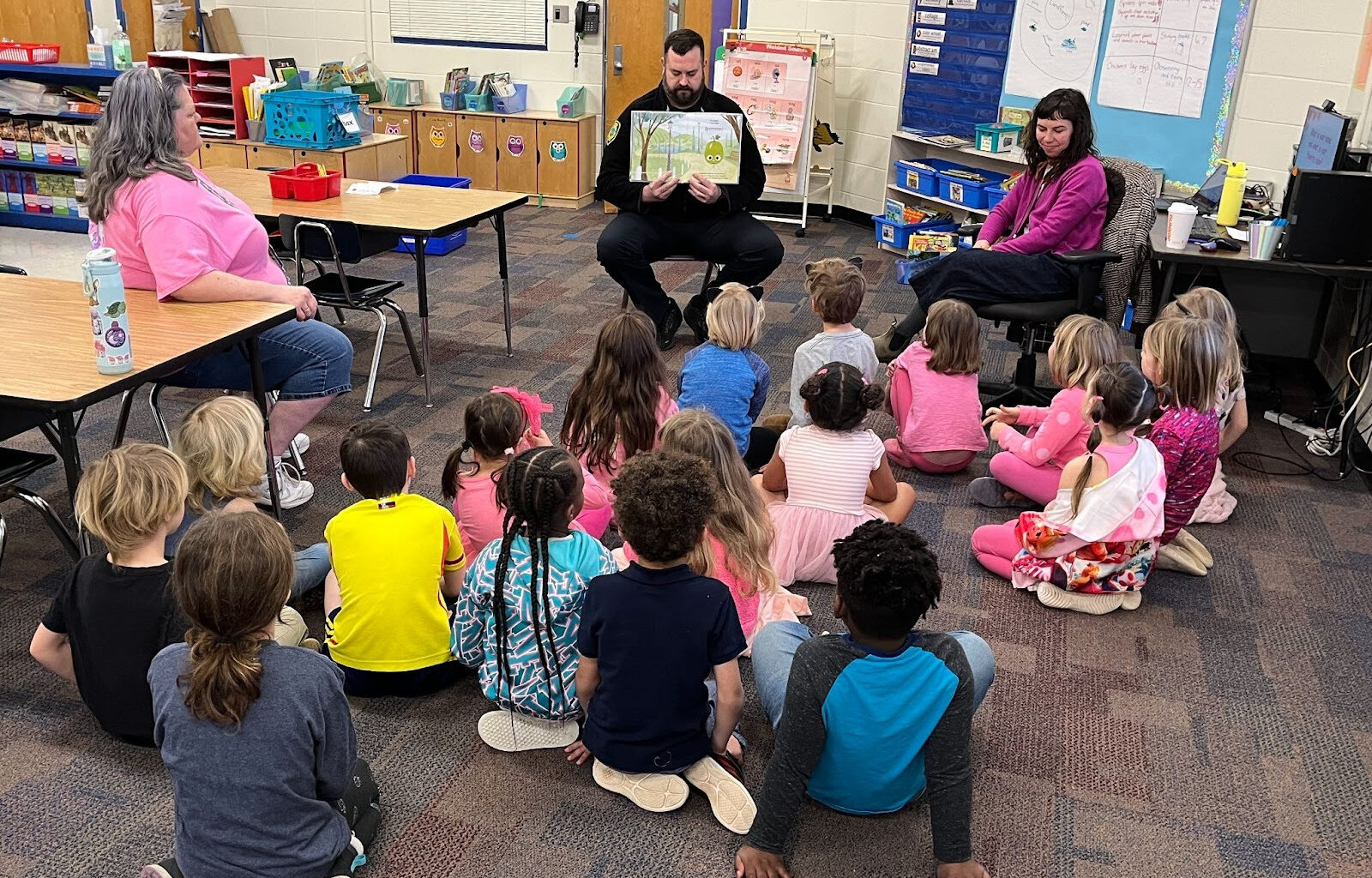
Behind every data point is a teacher making an instructional choice, a student learning a new skill, and a classroom moment that rarely shows up in a spreadsheet. In one western North Carolina district, this year’s reading data, shaped by sustained community partnership and support, tells a story not just of progress, but of how trust, consistency, and time have strengthened readers across Asheville City Schools (ACS).
Over the past three years, ACS’ Grade 3 End-of-Grade (EOG) reading assessment results tell a story of steady momentum. In 2022–23, 57.1% of the district’s third graders met proficiency on the state reading assessment. However, by 2024-25, this number increased to 61.5%, reflecting sustained growth and a strong commitment to student success. While North Carolina’s overall proficiency rates were between 48% and 47% respectively during this time, ACS has continued to gradually widen the gap between district and state by nearly 15%.
While no single data point tells the whole story, the consistency of improvement prompted a deeper conversation with district curriculum leaders, school principals, and instructional coaches to better understand the local context behind the numbers. There is no doubt that the district’s gains point to the power of aligned systems, evidence-based routines and processes, and a culture of continuous improvement sustained over time.

Sign up for the EdDaily to start each weekday with the top education news.
Sustained growth doesn’t happen by chance
For more than a decade, ACS has been implementing an evidence-based phonics curriculum, well before the science of reading became a common part of statewide conversations.
District leaders, principals and instructional coaches shared that this early understanding of word recognition, paired with a clearly aligned scope and sequence already familiar to educators, families, and students, proved especially valuable when the district announced that K-5 teachers would participate in the state’s 2022-23 Language Essentials for Teachers of Reading and Spelling (LETRS) professional development cohort.
That groundwork was further strengthened during the 2021-22 school year, when ACS adopted and trained teachers on an aligned, evidence-based knowledge-building curriculum for grades 3-5, deepening attention to the language comprehension components of the science of reading. While this provided a potential head start, it also introduced a real challenge, particularly for kindergarten through fifth grade teachers who were simultaneously engaged in LETRS and the rollout of the new knowledge-building curriculum.
Fortunately, the overlap allowed teachers to make meaningful connections between what they were learning in LETRS and how it showed up in daily instruction. The work was demanding, but it ultimately strengthened practice and the data continues to suggest it paid off.
Despite the challenges, the district stayed focused on coherence: providing curriculum and professional learning that align to evidence-based literacy instruction beginning in kindergarten, with a clear scope and sequence across grade levels.
 Courtesy of Asheville City Schools
Using data to inform instruction, not drive compliance
In ACS, data are not treated as an endpoint, but as a starting place for reflection, dialogue, and instructional planning. The district intentionally creates protected time for instructional coaches from each school to come together consistently to engage in ongoing professional learning and structured data dives primarily led by the Early Literacy Specialist provided by NC Department of Public Instruction (DPI).
They focus on identifying trends, problem-solving instructional challenges, sharing resources, and adjusting practice in response to teacher and student needs. The same processes are mirrored within schools by site-based instructional coaches, reinforcing shared expectations and coherence from the district level to individual classrooms.
This work is supported by strong, systematic structures. Multiple team members emphasized the impact of intentionally designed master schedules that include large, uninterrupted blocks for core reading instruction. These blocks allow for flexible service delivery and responsive adjustments based on formative classroom data.
In addition, schedules include structured intervention blocks beyond core instruction to provide targeted support and flexible grouping. Importantly, these intervention times do not overlap across grade levels, creating an all-hands-on-deck approach that maximizes human resources and reduces adult-to-student ratios based on student need.
Dr. Ruafika Cobb, principal of Ira B. Jones Elementary School, noted the positive impact of these intentional schedules and collaborative planning structures. Students are leaving grades K-2 with stronger foundational skills, creating space in third grade to deepen comprehension and application.
Through the use of data analysis tools, educators are able to drill down to determine specific student needs and respond accordingly. A student demonstrating high growth with high proficiency may require different instructional support than a student showing high growth but remaining below proficiency. This level of analysis allows for intentional differentiation, including both targeted intervention and meaningful extension opportunities.
 Courtesy of Asheville City Schools
Leadership alignment matters
School principals meet weekly with their coaches to align instructional priorities, professional learning, and staff support with evidence gathered from informal classroom learning walks, formal observations, lesson plans, and formative student data. Meeting agendas are intentionally developed, focusing on identifying strengths, gaps, and support needed as part of an ongoing process to remain aligned and proactive.
Recognizing the heavy workloads and limited planning time of their teachers, principals prioritize literacy by allocating funds for teachers to have substitute coverage, providing them with the opportunity to participate in quarterly half-day planning sessions. These days allow teachers to collaborate and engage deeply with their peers in data analysis discussions, identifying trends and planning next steps for process improvement.
In addition, principals regularly participate in data dives and grade-level Professional Learning Communities (PLCs) as well as in organizing systems that keep families informed of learning expectations, standards, and instructional approaches. When possible, principals are also provided opportunities for their own learning during districtwide principal meetings, engaging alongside colleagues in shared professional growth.
Meetings and ongoing communication with families and caregivers aligned to this work are a priority for both district and school leadership. Principals play a critical role in establishing structures and processes that position families and caregivers as seamless partners in literacy efforts, with a focus on clearly communicating learning standards, expectations, and student data.
Community partners are also intentionally included in this communication to ensure alignment across all student supports, particularly those extending beyond the traditional school day and academic year. These partners provide essential after-school and summer learning opportunities, as well as select supports embedded within the instructional day. One such organization is Read2Succeed, a tutoring service integrated into the school day and extended through after-school programming to help grow and sustain student learning over time.
While principals clearly understand their role as instructional leaders within their buildings, instructional coaches play a critical role in tightening literacy practices across the district.
Serving as instructional bridges between district priorities and classroom implementation, coaches support teachers through coaching cycles grounded in evidence-based instructional practices, data analysis, and reflective practice. They also contribute to the development of teacher leaders and provide literacy-focused professional learning for administrators, teachers, interventionists, and instructional assistants, further strengthening coherence across schools. Throughout the discussion, participants consistently emphasized the value of instructional coaches in driving this literacy shift that has taken place in ACS.
 Courtesy of Asheville City Schools
Continuous improvement mindset
While the district has much to celebrate and significant expertise to share, ACS leaders were equally transparent in naming their commitment to a continuous improvement mindset. They recognize that this work is never finished and that progress requires ongoing reflection, adjustment, and the willingness to push new levers as needs emerge.
One area of focus this year has been supporting teachers’ understanding of the importance and complexity of constrained and unconstrained skills. Constrained skills include foundational elements that all students are explicitly taught, such as letter knowledge and basic decoding. Unconstrained skills, by contrast, are more variable and often shaped by students’ broader life experiences, particularly background knowledge and vocabulary development.
In tandem with this learning, the district has emphasized centering instruction around complex text and using text as the organizational unit of instruction. This focus positions teachers and students well for the forthcoming 2027-28 NC DPI English Language Arts Standard Course of Study.
Corey Simons, principal of Claxton Elementary School, expressed a potential need to integrate common formative assessments (CFAs) as a routine practice in PLCs. Although overall student performance continues to improve, leaders acknowledged that disparities remain within student subgroups.
Current data indicate that Black students are not experiencing growth at the same pace as the district overall, particularly with unconstrained skills. Principals and instructional coaches emphasized their collective commitment to digging deeper to identify potential root causes and to problem-solve effective, responsive solutions. The intentional use of CFAs may provide more timely and actionable data to inform instruction and better support specific groups of students.
What this means for North Carolina
Ultimately, the story behind Asheville City Schools’ reading gains is a hopeful one. It illustrates what is possible when educators are supported to do the right work, when systems prioritize consistency over quick fixes, and when students experience coherent instruction year after year. The district’s gains reflect the cumulative impact of aligned instructional materials, consistent assessment and data-analysis practices, and sustained trust in evidence-based approaches implemented over time.
As North Carolina continues to elevate early literacy as a statewide priority, the progress in Asheville City Schools serves both as a compelling case study and a timely reminder that meaningful improvement is achievable. With sustained commitment, the effects of strong policy and practice are felt most clearly in the daily experiences of children learning to read.
Asheville City Schools offers a reminder that policy has its greatest impact when systems stay the course, especially when that commitment is shared across a coordinated team of district leaders, school administrators, instructional coaches, and classroom teachers. By supporting educators with clarity, consistency, and the conditions necessary for continuous improvement, policy moves from intent to impact.

Amy Rhyne is the former senior director of the Office of Early Learning at the N.C. Department of Public Instruction.