
CENTRE VALLEY, Pa. — Shifting demographics, political debate and changing student expectations are reshaping higher education and making it more important than ever to understand why students choose one institution over another, according to Kristy Hove, director of enrollment management and campus strategy at Penn State Lehigh Valley. Her data-driven approach aims to help institutions translate research into deeper understanding and more effective enrollment strategy.
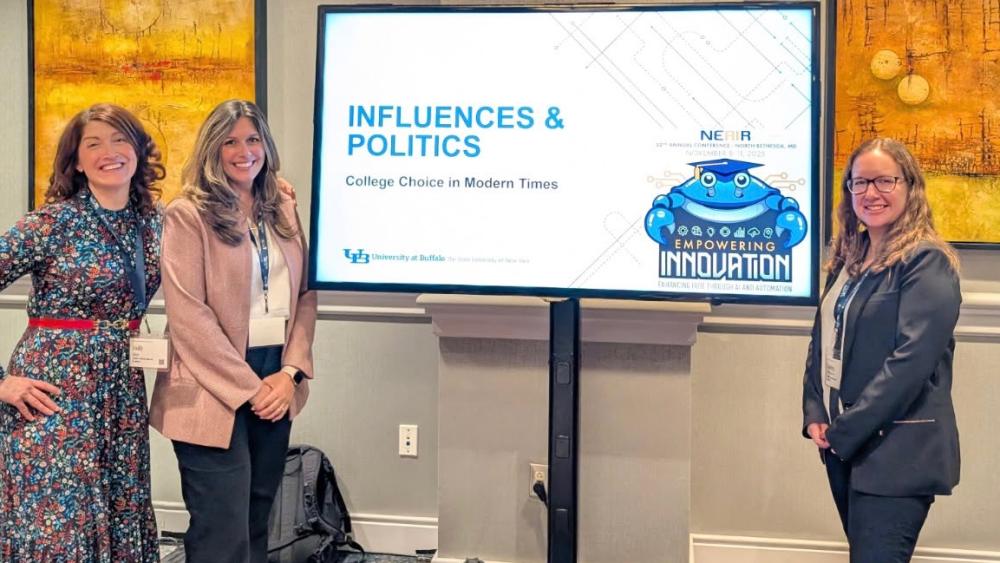
Hove presented her latest research in November at the annual North East Association for Institutional Research (NEAIR) conference, a regional meeting of higher education leaders and institutional research professionals focused on analytics, innovation and best practices across the education landscape. Presented in collaboration with researchers Holly Klick and Carolyn Owczarczak from the University at Buffalo, Hove’s session, “Influences and Politics: College Choice in Modern Times,” focused on separate projects examining how external forces shape how today’s students approach college selection and their relationship with higher education.
Examining college choice in a complex landscape
Using survey and focus group data from nearly 1,000 first-year students across Penn State’s Commonwealth Campuses, drawing from the fall 2024 cohort, Hove explored the role political ideology, party affiliation and broader societal influences play in college choice and student consumerism in higher education. She noted that while participants comprised students who all decided to attend Penn State, the sample was not uniform in ideological views. The results indicated that various aspects of the institution — including campus culture, location and extracurricular offerings — resonated differently with students depending on their political self-identification and the environment in which they were evaluating colleges.
“The findings show that politics may play a role in the college choice process, particularly in how students perceive the state and broader environment in which an institution is located — and different aspects of the same institution can appeal to a broad spectrum of political ideologies,” Hove said. “Students bring diverse political identities with them, and those perspectives influence what they value, how they evaluate colleges and how they see themselves within higher education.”
Key findings with practical application
The findings shared during the session offered actionable insights for enrollment managers, institutional researchers and campus leaders navigating an increasingly competitive and complex recruitment environment, according to Hove.
Her analysis found that student priorities varied across political self-identification. Diversity emerged as a stronger factor for students who identified as Democratic or liberal, while athletics carried greater weight among those who identified as Republican or conservative. The political orientation of the state in which an institution is located was also more influential for students identifying as Democratic or liberal. These findings suggest that admissions professionals should consider the potential role of political context in students’ college-selection decisions.
In the higher ed marketplace, enrollment strategy is no longer driven by intuition or tradition alone; it requires rigorous data analysis, a nuanced understanding of student behavior and the ability to translate research into action, Hove said. Colleges and universities that succeed are those that align evidence-based decision-making with clear mission, transparent communication and an authentic understanding of the communities they serve.
Hove emphasized that data alone is not enough, however. The integration of student voice is critical to uncovering nuance and translating findings into effective practice.
“By combining quantitative data with the student voice, we gain a much clearer understanding of how external influences shape student decision-making,” she said. “That nuance is critical, not just for recruitment, but for retention and long-term engagement. Effective enrollment strategy begins with truly understanding who our students are at the time they are making an enrollment decision.”