
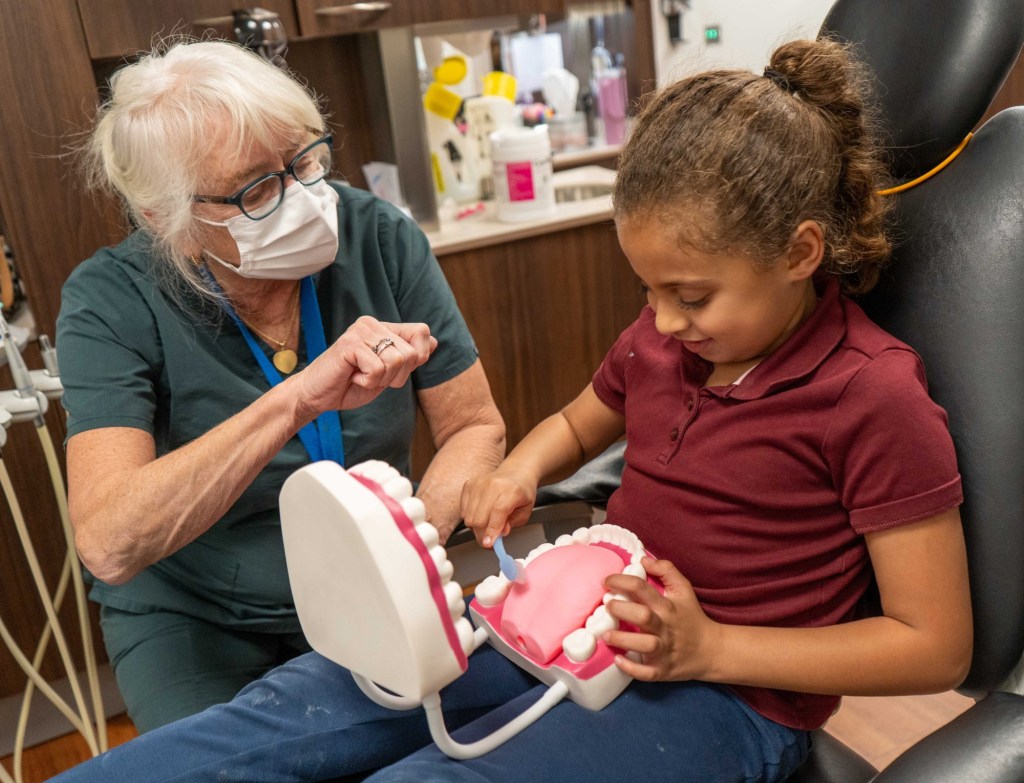
As a child, Bernadette Lukasik loved going to the dentist.
She remembers begging her mother to make appointments, even though her brothers didn’t appreciate the requests.
“I was a weird kid,” Lukasik said, laughing. “I was always fascinated by the dentist.”
More than four decades later, the public health dental hygienist at the Wright Center for Community Health Scranton regularly visits students at Head Start centers across Lackawanna County and at the Scranton School District, hoping to pass along her own love of dental visits — or at least good dental hygiene habits that will last them their entire lives.
“We visit schools because, for some, it might be the only time they’ll receive dental care,” Lukasik said. “We perform screenings, and for the little ones, we do some fun education about taking care of your teeth.”
February is Children’s Dental Health Month, organized by the American Dental Association to raise awareness of the importance of children’s oral health, emphasizing preventive care and early intervention to avoid future dental problems.
For Lukasik and Marisa Duchnik-Zelno, a public health dental hygienist at the Wright Center for Community Health Mid Valley in Jermyn, who also visits Head Start centers and the Scranton School District, teaching children about their teeth helps develop good habits early.
One persistent myth is that children don’t need to pay attention to their teeth because their adult teeth will eventually replace them. That’s not the case, the dental hygienists said.
“Baby teeth are the placeholders for your adult teeth,” Lukasik said. Duchnik-Zelno added that addressing dental problems, such as having a tooth drilled or extracted, can be scary, especially for kids.
Lukasik said parents can begin instilling good dental health habits when their children are newborns. At bathtime, parents should use a clean washcloth to wipe their child’s gums. When the child’s teeth start coming in, they can switch to gentle brushing. Parents should encourage their toddlers to brush their own teeth under supervision to make sure the job is done thoroughly, she said.
Both Lukasik and Duchnik-Zelno said many parents know that thumb-sucking can affect how teeth grow, but they don’t realize that sending children to bed with a bottle of milk can cause dental health problems, too.
“The sugar in the milk will sit on their teeth all night and cause decay,” Lukasik explained. “Parents should make sure their children brush their teeth before bed, and then if the child really needs a bottle, give them water instead of milk.”
When Lukasik and Duchnik-Zelno visit Head Start classrooms, they start with show-and-tell to help familiarize children with the equipment and the screening process. Lukasik always starts with a simple question: How many teeth do you have?
The correct answer may surprise you: Adults have 32 teeth, while children have only 20. “I get a lot of funny answers, like six or 50,” she said. “So I’ll start by counting their teeth with them.”
Duchnik-Zelno said she demonstrates the pointy, frightening-looking explorer tool by tapping it gently on children’s fingernails before using it on their teeth.
“Fingernails are hard like our teeth, so it’s a good way to show them it won’t hurt,” she said. “Going to the dentist can be scary, so I always show them what we’re going to do. Sometimes I’ll use a stuffed animal to demonstrate, which makes them laugh.”
Older kids don’t need the show-and-tell before their dental screenings, Duchnik-Zelno said, but both dental hygienists devote some time during school visits to teaching kids the correct way to floss, something they say even adults sometimes skip.
As dedicated as they are to teaching children about dental health, both Lukasik and Duchnik- Zelno said good oral hygiene begins at home.
“How dental health affects your overall health isn’t talked about enough,” Duchnik-Zelno said. “You need healthy teeth and gums to function, no matter how old you are.”
To make a dental appointment at one of the Wright Center for Community Health’s locations in Lackawanna or Luzerne counties, visit thewrightcenter.org or call 570-230-0019.
Top tips for children’s dental health
Most people know that brushing twice a day, flossing regularly and visiting the dentist twice a year are keys to maintaining their dental health. But Bernadette Lukasik and Marisa Duchnik-Zelno, public health dental hygienists at the Wright Center for Community Health, said parents might not know about these teeth tips:
Consuming candy, especially gummy candy, causes sugar to coat your teeth. Brushing after a sweet treat helps keep teeth clean and guards against cavities.
Beware of acidic drinks, like orange juice and soda. The acid can weaken tooth enamel, causing problems down the road. The solution? You guessed it — brush your teeth after finishing these kinds of drinks.
Most places in Northeast Pennsylvania don’t have fluoridated water, so kids should take a fluoride vitamin daily to prevent tooth decay and cavities. Fluoride strengthens tooth enamel, making it more resistant to acid attacks from bacteria. Ask your child’s doctor or dentist for a prescription.