
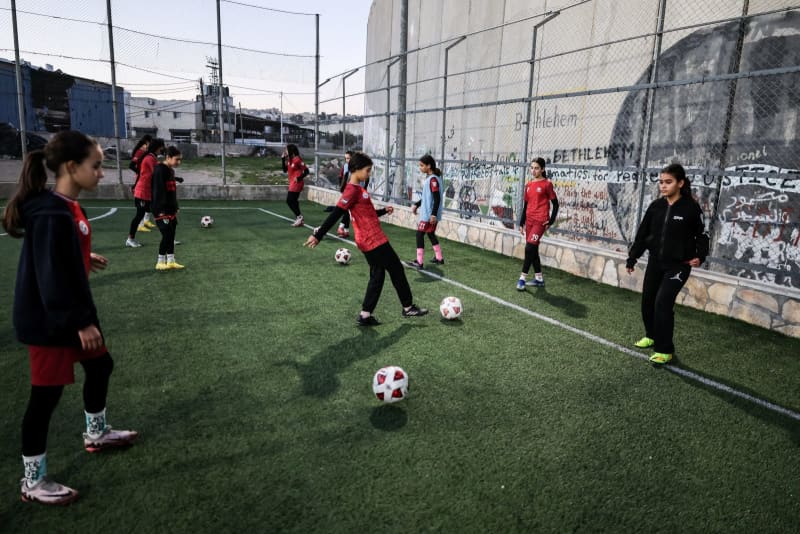
The pitch, the IDF Central Command claimed, sat too close to the seam zone, alleging that the structure and its occupants provided an observation point too sensitive for its volatile location.
In the Aida refugee camp, soccer is never just a game. It is a 90-minute reprieve from the claustrophobia of the concrete barrier that looms overhead, a place where the rhythmic thud of a ball against a fence replaces the tension of the surrounding alleys.
But on a crisp November morning in 2025, the reality of the conflict encroached onto the pitch in the form of a single sheet of paper that threatened to erase one of the few green spaces in the Bethlehem district.
Munther Amira, director of the Aida Youth Center, didn’t find a tactical scout report waiting for him. Instead, it was a demolition order from the Israeli Civil Administration. By New Year’s Day, a second order arrived. The IDF Central Command’s reasoning was succinct: Security.
The pitch, they claimed, sat too close to the seam zone, alleging that the structure and its occupants provided an observation point too sensitive for its volatile location.
“After seven years, they suddenly talk about security?” Amira says, his voice caught between exhaustion and a practiced defiance. “This isn’t a military installation. We are teaching children how to build a life instead of being consumed by the cycle of violence. We opened a sanctuary for peace, and they come with bulldozers. In a place where movement is restricted by checkpoints, this pitch was our only open road.”
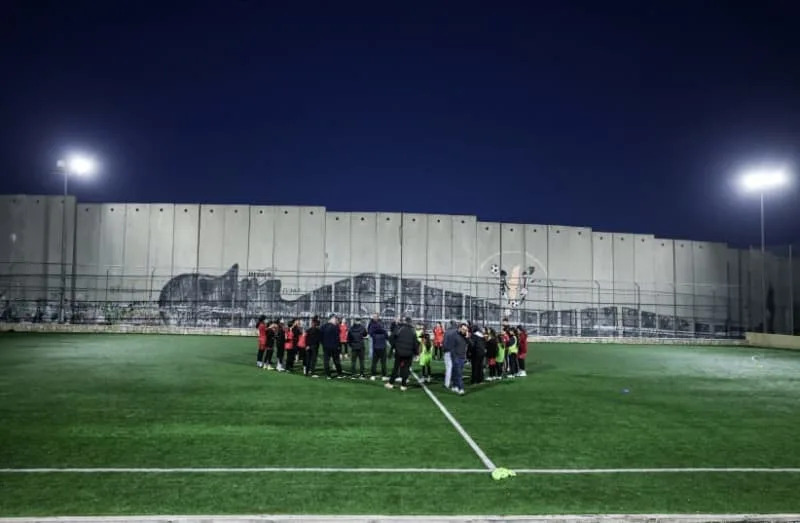
PALESTINIAN YOUTH soccer players play in a field next to the barrier separating Aida refugee camp from Jerusalem near Bethlehem in the West Bank. (credit: AMMAR AWAD/REUTERS)
What happened next was a masterclass in the interconnected, often bizarre world of modern soccer politics. Usually, when a local pitch is threatened, the dust settles quietly under the weight of administrative bureaucracy. But Aida’s “most dangerous grass in the world” became a global cause célèbre, bridging the gap between grassroots activism and elite celebrity culture.
The defense lineup was as surreal as it was formidable. In one corner stood Eric Cantona, Manchester United’s “King”, whose poetic brand of activism has long transcended the pitch. Cantona, known for his philosophical stances on human rights, viewed the Aida pitch not as a local dispute, but as a symbolic stand for the ‘right to play’ enshrined in international charters.
In the other corner, an unlikely digital ally appeared: Ms. Rachel, the American YouTube phenomenon whose nursery rhymes dominate toddlers’ screens from New York to Ramallah. When a French football philosopher and the world’s most famous preschool educator find common ground, the world – and the algorithms – tend to listen.
Their involvement transformed a regional land-use issue into a viral humanitarian crisis that the FIFA executive board could no longer ignore.
Yet, the killer blow that halted the engines of the bulldozers didn’t come from a viral tweet. It came from the sterile, wood-paneled tax offices of Bern, Switzerland.
As the January 20th demolition deadline loomed, the Swiss government emerged as the story’s unexpected protagonist. The campaign had strategically caught the eye of Swiss lawmakers who were already embroiled in a heated domestic debate regarding the financial privileges of international sports bodies.
For years, Swiss authorities have granted UEFA a coveted tax-exempt status, a privilege worth an estimated €15 million to €30 million annually. This status is predicated on the ‘public interest’, the idea that UEFA isn’t just a money-making machine for the Champions League, but an organization dedicated to the “promotion of peace” and social development through sport.
The political leverage was simple and devastating: If UEFA claims tax-exempt status based on these lofty ideals, how can it remain a bystander while a pitch, partially funded by Swiss-affiliated peace projects and NGOs, faced destruction? The threat was clear: silence in Bethlehem could lead to a massive tax bill in Bern.
Swiss Ambassador to Israel, Simon Geissbühler, found himself navigating a diplomatic minefield.
“FIFA and UEFA intervened because they heard the voices from the ground,” he explains. “Our position is clear. You cannot build ‘peace pitches’ with one hand while the other hand allows existing ones to be destroyed. It creates a policy of absurdity.”
The irony was not lost on the diplomats. At the time of the order, Switzerland and FIFA were finalizing a joint initiative to build 10 new “peace pitches,” five in the West Bank and five in disadvantaged Israeli communities, including Arab-Israeli and Bedouin towns in the Negev. The project was designed to be a crown jewel of sports diplomacy, but the destruction of Aida would have rendered the entire project a public relations liability before the first sod was even turned.
While Swiss lawmakers and French legends were working the phones, one entity remained conspicuously in the shadows: The Palestine Football Association (PFA).
Despite the international outcry, the PFA’s contribution was negligible, a few belated social media posts that felt more like an afterthought than a defense. For the Bethlehem community, this was a bitter, if familiar, pill to swallow.
The PFA, led by the politically powerful Jibril Rajoub, has often been accused of focusing on high-level optics rather than the grueling work of grassroots infrastructure.
While Rajoub was engaged in high-level diplomacy in Qatar and Cairo, often using soccer as a lever for Palestinian statehood on the global stage, the children of Aida were left to find their salvation in the Swiss parliament. The disconnect highlighted a growing rift in Palestinian sports: a leadership focused on the boardroom, and a community fighting for the locker room.
The pressure worked, for now. Faced with a potential financial nightmare in Switzerland and a PR disaster, UEFA President Aleksander Čeferin and FIFA’s Gianni Infantino finally made the calls. They reached out to the Israel Football Association (IFA), urging them to communicate the “extreme sensitivity” of the site to the Israeli government.
Israel freezes demolition order
The IFA, keen to avoid any friction that could jeopardize Israel’s own standing in international competitions, lobbied the military and political echelons to freeze the order.
The “stay of execution” didn’t arrive via an official military courier, but through news reports filtered down to the camp.
“The order said we had to destroy it ourselves or be billed for the IDF doing it,” Amira recalls. “We saw the news of the freeze online. No one from FIFA or the military has talked to us directly. In this game, the players on the field are the last to know the score.”
Back on the turf, the gates are open. The pitch serves as the training ground for four players on the Palestinian women’s national team and hundreds of kids who have played everywhere from Copenhagen to Madrid. For 90 minutes, they aren’t refugees or political pawns; they are simply midfielders and strikers.
However, the “freeze” is not a “cancellation.” The legal sword of Damocles still hangs over the Aida Youth Center, as the final decision remains in the hands of the Israeli political leadership, who must balance security concerns against an unprecedented wall of international pressure.
In modern soccer, a pitch is rarely just grass and white lines. It is a border, a tax loophole, a viral video, and a sanctuary. In Aida, the children continue to play, knowing their right to kick a ball rests on a delicate global balance, a game of high-stakes politics where the final whistle has yet to blow.