
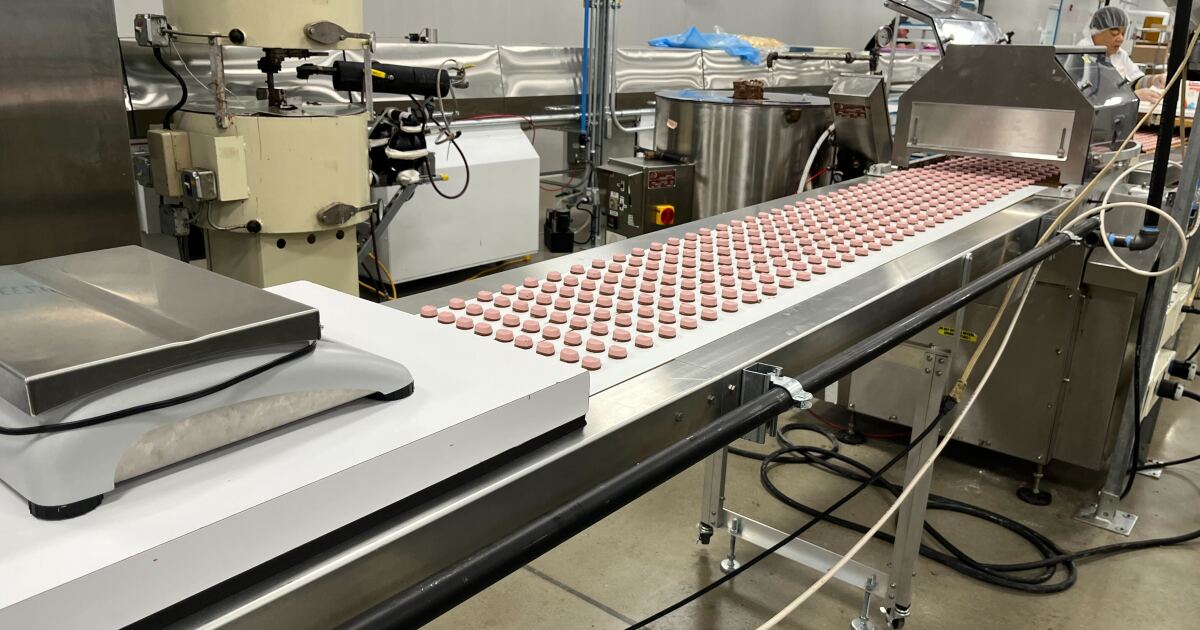
Petal-pink dollops of raspberry cream coast on a conveyor belt inside Sarris Candies’ new production facility in Canonsburg, Pa. At one stop, a machine applies a thin layer of chocolate to the bottom of each raspberry center. Then, the candies travel under a chocolate waterfall for the final enrobing.
It’s a glimpse at the many moving parts of a chocolate factory in the weeks before Valentine’s Day — the thick of the busy season for chocolate manufacturers that runs from Christmas to Easter.
Last year, about 3.5 million pounds of chocolate flowed through the company’s supply pipes, according to Bill Sarris, CEO of Sarris Candies, for their signature delicacies such as chocolate-covered pretzels and peanut butter meltaways.
But behind the saccharine drizzles and heart-shaped boxes lies a global industry struggling to stabilize after cocoa prices hit record highs during the past few years. High temperatures, unpredictable rains and dry spells led to diminished supply in the world’s major cocoa-producing regions, and the imposition of tariffs by the U.S. government pushed the commodity’s price even higher. At the end of 2025, the cocoa supply rebounded and tariffs were lifted, but the sting lingers for local manufacturers further down the supply chain.
And cocoa beans are “the driving force,” Sarris said. “If you don’t have them, you don’t have a business.”
Cocoa highs
As Valentine’s Day approaches, Pittsburgh-area chocolate manufacturers big and small continue to reckon with the global shocks of chocolate prices, but they persist — pumping out chocolate-coated sweetness from classic bites of gooey caramel to fresh cracks into ganache.
At Pollak’s Candies in Etna, caramel pecans dipped in chocolate, rows of coconut clusters and small rectangles of chocolate with a fruity jelly center line the display. The jellies are among their most popular bites.
“People don’t really carry jellies anymore,” said Susan Pollak McHale, vice president of Pollak’s Candies. “And those flavors just pop when you eat them.”
The family has been around since 1948 and uses their original recipes.
“It’s the handcraft,” Pollak McHale said. “No one I know does it like we do it. We have the old copper kettles — the caramel is stirred, it’s made from scratch.”
Business was up this Christmas, according to Pollak McHale, but they weren’t immune to the high cocoa prices of the past few years.
Cocoa or cacao is the main ingredient in chocolate manufacturing. Most of the world’s cocoa comes from West African countries such as Ghana and the Ivory Coast. And the U.S. also gets cocoa from Latin American countries, including Ecuador or the Dominican Republic.
Long stretches of drought, high temperatures and the proliferation of black pod disease and cacao swollen shoot virus plagued harvests in the West African countries, and cocoa prices shot up to a high of $11,500 per ton in the summer of 2024. Prices began to ease in 2025, when the U.S. federal government imposed tariffs on cocoa and also processed chocolate from many suppliers of cocoa.
Since November, many of those tariffs have been rolled back, and supply has rebounded. For Sarris, his company felt the impact of tariffs until January, but it “took a gamble,” absorbed the extra costs and didn’t raise prices.
“The tariffs were definitely expensive,” Sarris said. “For every $100,000 that you used to spend, you added another $18,000 in tariffs. So when your production is 100,000 pounds a week — the tariffs cost us about $68,000 a month.”
On Feb. 12, cocoa traded at less than $3,800 per ton. But that doesn’t necessarily mean that chocolate prices are going to fall at the same rate, according to David Ortega, professor of food economics and policy at Michigan State University.
“A lot of the chocolate manufacturers use contracts, so they might have purchased cocoa when we were looking at record-high prices,” Ortega said. “And so they’re still sitting on some of that inventory. And that’s one of the reasons why we still see high chocolate prices.”
Pollak’s tried to take on the additional costs at first, but eventually had to raise prices on their products.
“Unfortunately, the small business has to eat that, and you can’t consume it all,” Pollak McHale said. “But we do as much as we can to keep our product out there and keep it affordable for people.”
1 of 3
— IMG_8405.jpg
An assortment of LUX Artisan Chocolate’s hand-painted bon bons
Julia Fraser / 90.5 WESA
2 of 3
— IMG_8412.jpg
A look at the chocolate display at Betsy Ann Chocolates in West View
Julia Fraser / 90.5 WESA
3 of 3
— IMG_8400.jpg
A bevy of chocolate confections behind the glass at Pollak’s Candies in Etna
Julia Fraser / 90.5 WESA
Mixing it up
Across the river, in a commercial kitchen in Morningside, Shelby Gibson, chocolatier and owner of LUX Artisan Chocolates, stirs a red-wine ganache that will fill a row of hand-painted chocolate bon bons. Gibson creates small-batch, made-to-order artisanal chocolates from black fig and pistachio bars to strawberry and cream heart-shaped bon bons.
Gibson said she has had to raise prices to meet the rising cost of cocoa. But the higher prices haven’t led to lower demand.
“I think people see it as more of a luxury item that they purchase for special occasions,” Gibson said. “They want a treat, so they spend a little extra for it. But [demand] has always been pretty steady.”
Few companies have ridden the ebbs and flows of the chocolate industry like Betsy Ann Chocolates. After taking over the business from the founder in 1967, owner Jim Paras’ parents took the brand from the signature candy shop in department stores such as Horne’s to opening 14 retail stores as far away as Ohio.
But by 2008, all of Betsy Ann’s stores shuttered. Today, Betsy Ann has a store alongside its West View factory, sells online and has a wholesale business.
Paras had to raise prices in the past year due to the increased cocoa costs, which affected sales: “It hasn’t been terrible, but definitely people are buying less.”
In addition to churning out their bestselling truffles, Betsy Ann Chocolates was commissioned to create the candy props used in the upcoming Milton Hershey biopic filmed in Pittsburgh last year. For one scene, the company was required to make thousands of caramels on short notice and deliver them to the set.
“I had to buy pool noodles and cut them so that the trays wouldn’t move in the van with the height of all the caramel that we had to make,” said Karen Paras, co-owner of Betsy Ann Chocolates.
As cocoa prices fall, local manufacturers like Jim Paras wait to see lower numbers in their contracts with suppliers but put faith in humanity’s timeless desire for chocolate.
“We’re chocolate people, so we just go with it,” Paras said.