
A massive yellow clock popped up on Pittsburgh’s North Shore this fall, featuring a countdown to the 2026 NFL Draft on April 23. At one point, it also felt like it was counting down to the day when the Steelers would finally find their long-term answer at quarterback, ending a run of veteran Band-Aid solutions.
GM Omar Khan and company have been stockpiling draft capital and will have an estimated 12 picks — a first, a second, three thirds, two fourths, a fifth, two sixths and two sevenths. (The exact number and order won’t be officially determined until compensatory picks are awarded.)
However, even an aggressive trade up might not be enough to find an obvious starter at the most-important position. A 2026 QB class that was once seen as booming with first-round talent has almost entirely collapsed. Indiana QB Fernando Mendoza will be sitting there for the Las Vegas Raiders to take No. 1. After him? Many of the top contenders have either decided to return to school (Texas’ Arch Manning and Oregon’s Dante Moore), failed to meet preseason hype (LSU’s Garrett Nussmeier and Penn State’s Drew Allar) or both (LaNorris Sellers).
Alabama QB Ty Simpson is going to be a very popular player to project to the Steelers in the first round (in several mock drafts at The Athletic, our analysts have done exactly that). His one year of starting experience could give the Steelers’ pause — there’s not a long track record of successful QBs with so little playing experience. Maybe the Steelers still go that route and give Simpson a year to sit behind Aaron Rodgers, assuming he decides to play for Pittsburgh in 2026. But for today’s mock draft, let’s take a look at what a draft could look like if the Steelers choose to wait until 2027 to take their big swing at QB. Instead of using those picks to move up for a QB, let’s say the Steelers use some of their excess draft capital to land a different kind of playmaker.
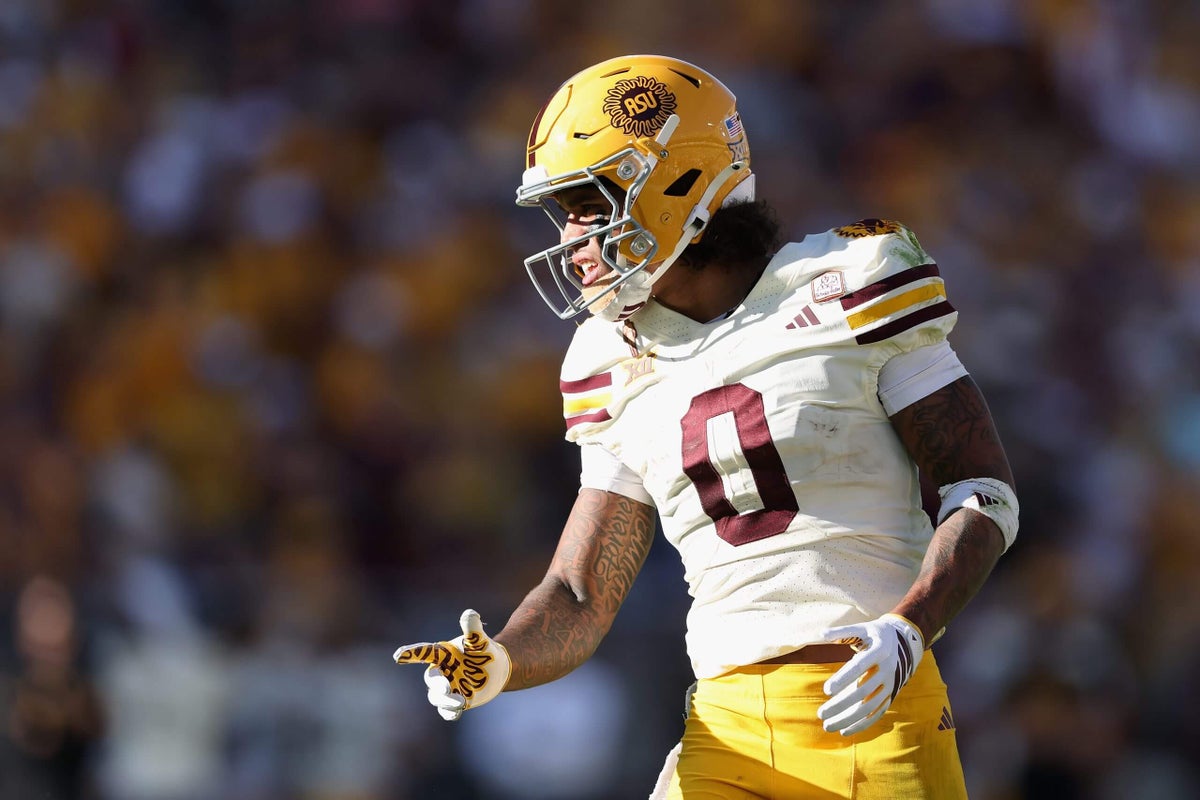
Round 1: Jordyn Tyson, WR, Arizona State
Projected trade: Pick No. 21 plus a third-round pick to move up into top 15
If you’re not already rolling your eyes at the concept of a mock draft and complaining in the comments (as is tradition this time of year), just remember the point of this exercise is to get acquainted with incoming prospects who would fill needs. With that approach in mind, what better place to start my first mock draft than with the Steelers’ most glaring hole: wide receiver.
Ohio State’s Carnell Tate (10th on Dane Brugler’s Top 100), Tyson (12th) and USC’s Makai Lemon (14th) all have a chance to be the first receiver off the board. Exactly how they stack up won’t truly be determined until after the NFL Scouting Combine. New head coach Mike McCarthy said that he’s looking for versatile receivers who can play all three positions. Lemon is more of a slot receiver who could also play the Z. Tate projects best as a Z due to his lean dimensions. Tyson, who could be a WR1 one day, best fits McCarthy’s description as an all-purpose threat. He possesses good body control, smooth route-running and an excellent combat catch radius. Coached by Hines Ward at Arizona State, he also reportedly played through hamstring injuries in both legs at points this year, something that will endear him to the Steelers.
Round 2: Davison Igbinosun, CB, Ohio State
Joey Porter Jr. is beginning to develop into the player the Steelers hoped he’d become when they drafted him with the 32nd pick in 2023. He capped his solid 2025 season with a near-shut down performance against Nico Collins in the playoffs — a major statement in one of his biggest tests to date. Set to enter the final year of his rookie deal, he’s likely in line for an extension this offseason. But who starts opposite Porter? James Pierre, who will be a free agent in March, is an option. But the Steelers need a higher-ceiling candidate who can compete for the job from Day 1 and provide long-term stability.
With an NFL frame (listed at 6-2, 195) and speed that should pop at the combine, Igbinosun is an intriguing athlete with a high ceiling. Just like Porter, Igbinosun’s physical makeup is a double-edged sword. While he’s a handful for receivers in press-man situations and a willing participant against the run, he was flagged 12 times in coverage in 2024 and four more times in 2025. That said, the Steelers often covet bigger, more physical corners to deal with Cincinnati’s Tee Higgins and others.
Round 3: Garrett Nussmeier, QB, LSU
At one point, Nussmeier felt like a potential first-round target for the Steelers. His stock reached its height after the 2024 season, during which he led LSU to a 9-4 record and passed for more than 4,000 yards, with 29 touchdowns and 12 interceptions. However, like many others in his class, he failed to meet the hype. A preseason Heisman candidate, Nussmeier went 5-4 as the starter with 12 touchdowns and five interceptions. He was ultimately benched in Week 9, but it was later revealed he was playing through an oblique injury that ended his season.
Nussmeier began to revitalize his stock in Mobile, Ala., with strong performances in Senior Bowl practices. While his footwork and decision-making can still improve and his size will turn some teams off (he measured at 6-foot-1 in Mobile), he has an elite arm and a gunslinger’s mentality. It’s also worth noting that Nussmeier’s father, Doug, served as the Dallas Cowboys’ quarterbacks coach from 2020-2022 under McCarthy. Perhaps the Steelers would be willing to bet on a prospect they know with upside. McCarthy’s ability to refine passers with West Coast philosophies that often allow QBs to play off of their back foot with better timing and rhythm can also clean up some flaws in Nussmeier’s game. If Rodgers returns for 2026, Nussmeier would have time to sit and develop before the Steelers decide if he or Will Howard might be the long-term answer. In the third round or later, a long-term backup with upside to become a lot more is worth the price.
Round 3: Gennings Dunker, OL, Iowa
With a flowing red mullet, this massive offensive lineman simply belongs in Pittsburgh — he’d be a perfect Halloween costume for Yinzers and fill several needs. A college right tackle, Dunker was part of a dominant offensive line that paved the way for Steelers’ 2025 third-round pick Kaleb Johnson. Dunker is expected to make the transition to guard at the NFL level. However, his experience at tackle and potential positional flexibility would add extra value. Pittsburgh has to decide if it is going to pick up Broderick Jones’ fifth-year option in May. If the Steelers decline it, 2026 could be Jones’ last season in Pittsburgh. Having another tackle-capable option on the roster wouldn’t be a bad thing, especially if a new position coach doesn’t unlock Jones’ first-round potential. Best case: Dunker pans out at guard, Jones plays to his draft position and the Steelers’ transformation on the offensive line will be complete.
Round 3: Traded to move up in the first round to land a top WR.Round 4: Rayshaun Benny, DT, Michigan
Trade: Original fourth- and fifth-rounders to move to top of fourth round (or late third) for a Top 100-range prospect
The Steelers double-dipped in a deep DT class in 2025 to begin preparing for life after Cameron Heyward. First-round pick Derrick Harmon was as-advertised in his rookie season when healthy, and fifth-round pick Yahya Black is a nice rotational piece who could grow into more. But before long, the Steelers will need another starter and more quality depth if they want to become a team that wins games in the trenches.
The future defensive line could feature Keeanu Benton and Harmon, with Benny/Black fighting for starting time. Both would certainly play a lot. Ideally, a defensive line should be deep enough to come at opponents in waves, so they need more than just the three young DTs currently on the roster.
Round 4: Kevin Coleman Jr., WR, Missouri
In a similar way to how the Steelers tapped into a deep DT class last year, a strong receiver class plays into the team’s needs this year. Coleman doesn’t have ideal versatility, but at this point in the draft you have to sacrifice something. Coleman brings plenty of intrigue as a speedy slot. He can get open in a hurry and creates a ton of yards after the catch, both critical parts of a West Coast-based offense. If Calvin Austin III signs elsewhere in free agency, the Steelers will also need a return man. Coleman’s burst would be a nice fit in that role.
Round 5: Traded to move up to draft Benny early in Round 4.Round 6: Xavian Sorey, ILB, Arkansas
Trade: Original sixth-rounder plus another sixth to move into the top of Round 6 or Round 5
The Steelers’ inside linebacker room features a pair of rangy, coverage types in Patrick Queen and Payton Wilson. But behind them are question marks. Typically, the Steelers feature a third, downhill thumper in their regular rotation to play on run downs. Malik Harrison was inconsistent in that role last year and Cole Holcomb is set to hit free agency after taking a paycut and adding special teams duties to stay on the team in 2025. Carson Bruener also found a place on special teams as a rookie, but as an undersized linebacker that may be his ceiling. A former five-star prospect, Sorey fits the mold as a thumper who plays downhill and loves to blow up blocks. While Sorey could go earlier, an especially deep ILB class could push him into this range and a trade up would make this a realistic selection in this spot. (Two sixths could move the Steelers back into the fifth for Sorey or a similar prospect.)
Round 6: Traded to move up for Sorey.Round 7: Xavier Nwankpa, S, Iowa
A former five-star recruit with excellent size and speed is often drafted much higher. However, Nwankpa’s on-field play isn’t nearly as good as his testing numbers will be. He’s projected to be a Day 3 pick or even a priority free agent; he’s not a finished product. But at this point in the draft, teams will be looking for measurables that they can use on special teams and develop into more. His versatility also helps, as he has experience in the nickel and both safety positions.
Round 7: Traded to 2027
If the Steelers are going to punt on an early-round QB, they’ll need to start accumulating draft capital for 2027. Often, teams can swap late-round picks for one round higher in the following year’s draft.