
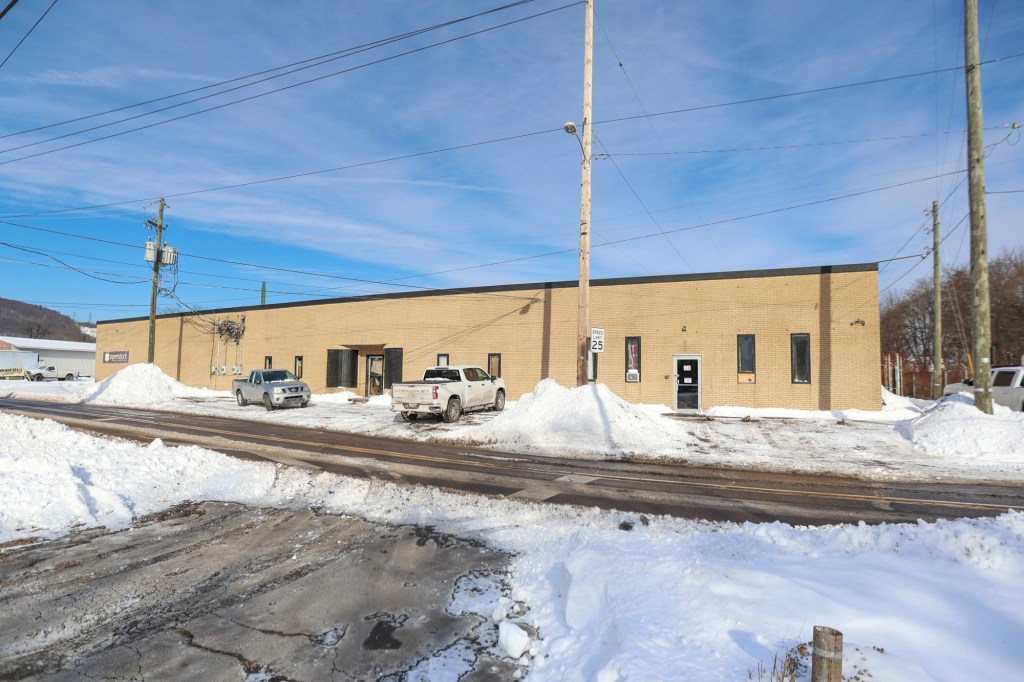
The smell emanating from a nondescript building on a West Wyoming street first attracted the attention of Peggy Paoloni’s family last winter.
The citrusy, orange-like aroma enveloped the neighborhood, unleashing an olfactory offensive that she says causes headaches and irritates her asthmatic daughter’s chest.
“We have lived here for 27 years and we’ve never had a problem like this before. It’s bad. You can’t even sit outside and enjoy your own yard. You can’t even open your own windows,” said Paoloni, who lives a few blocks away in Wyoming Borough. “It’s like a Pine-Sol — times 10. It’s wicked, and it burns your eyes. It’s a wicked, wicked smell.”
The source of the smell was KB Crash Creations at 223 W. Sixth St., a facility that produces kratom extract. The company as well as its landlord are now each facing 30 quality-of-life nuisance violation citations as as result of the neighbors’ complaints.
But Wayne Bendistis, the company’s director of operations, maintains the extraction process is safe, and he disputes the characterization that the facility emits a vile reek that has permeated the neighborhood.
“It’s not wildly offensive. It’s an orange odor,” Bendistis said. “As far as the crazy, toxic odor at KB Crash, it doesn’t exist.”
What’s kratom?
Kratom is a tropical tree that grows in Southeast Asia, whose leaves can be smoked, brewed as tea or ingested in capsule form. Its effects are described as being stimulant-like at low doses and having the effect of a sedative at higher doses.
It is legal in Pennsylvania and is frequently sold in gas stations and smoke shops. However, the Drug Enforcement Administration has listed kratom as a “drug or chemical of concern” due to the possibility of it causing hallucinations and psychosis.
At KB Crash, kratom is extracted and prepared into a powder that is sold wholesale to manufacturers of kratom products, Bendistis said.
The smell neighbors have noticed does not come from the kratom itself but rather from a solvent, D-limonene, used in the extraction process, he said.
D-limonene is a natural compound extracted from citrus fruit peels that is in wide commercial usage, according to the Environmental Protection Agency. It has several applications, ranging from being used as a food additive and dietary supplement to being used as a cleaning solvent in industrial degreasers.
“We buy food-grade D-limonene that comes from the orange juice-pressing process, we bring it here and what we do is we use that as our extraction solvent, if you will,” Bendistis said. “It’s a basic soak that we do with limonene, and that enables us to take a variety of natural plants — far beyond kratom, it’s many different things — and we can extract it.”
The D-limonene in use at KB Crash is food-grade and safe, he said.
“It’s not toxic, deleterious or harmful,” Bendistis said. “The smell is not malodorous or persistent.”
‘Like somebody punched you in your gut’
Not everyone in the neighborhood would agree with that assessment.
Area residents, including Paoloni, have repeatedly taken to Facebook to express their concerns about the smell, describing it on the Wyoming Area Community Page as being “horrible” and akin to “orange-spiked turpentine.”
During a court hearing last month, Wyoming Area Regional Police Chief Michael Turner described the aroma as “toxic” and as hitting “like somebody punched you in your gut.”
Lindo Sabatini, owner of Sabatini’s Pizza at 1925 Wyoming Ave. in Exeter, said the smell has been an ongoing problem for at least a year.
“You walk outside and you get hit in the face with an orange citrus cleaner smell,” Sabatini said. “During the summer when our patio’s open, we’ve had numerous people ask to be switched to inside because they don’t want to smell it.”
Sabatini described the aroma as delivering a chemical burning-type sensation even at his restaurant, which is about a half-mile away from the plant.
“At some points it gets so offensive where you can actually feel it in your chest when you walk outside,” Sabatini said. “It takes your breath away.”
He said he has contacted management at the kratom plant to express his concerns, but that the smell has persisted.
“I’m for business. I don’t want to see a local business harmed, but they’ve got to do the right thing so that it’s not affecting the quality of life of all its neighbors,” Sabatini said. “It affects us here, six blocks away. People that live on that block — I can’t imagine.”
Impacting the quality of life
Last year, police and code enforcement officials filed numerous summary quality-of-life nuisance violation citations against KB Crash Creations as well as against the property owner and landlord, Donald J. Zurenda.
When the case goes before Luzerne County Judge Michael T. Vough on March 3, the defendants will have to answer to 30 citations each based on complaints leveled by 14 victims, special prosecutor Laura Dennis-Bovani said.
“People couldn’t walk outside, couldn’t leave their house, couldn’t play with their kids for more than 10 minutes without them describing a feeling of it really affecting their breathing, their eyes itching, total discomfort,” she said. “People have a right to be in their own yard, walk up the sidewalk, play with their kids and not feel like they are breathing in a scent that’s covering their sinuses, their throats, their lungs, their skin.”
Dennis-Bovani noted that residents from Wyoming, West Wyoming and Exeter have all complained about the smell, and that the complaints have continued to come in even this month.
Many are concerned about what chemicals are being released into the air and their effects on their families, she said.
“I have no idea what’s in the air, and we have never been told what’s being emitted in the air. We don’t know what chemicals are being released in the air in addition to the D-limonene,” Dennis-Bovani said. “All I can go by is what the residents are complaining of, and it’s not just a scent. It’s something that causes them a physical reaction.”
‘No kratom in the air’
Bendistis disputed any suggestion that toxic substances — or even kratom itself — are wafting through the neighborhood.
“There is no kratom in the air,” he said. “That’s insane for a company to manufacture something and then just spray it into the air, first of all.”
While many kratom producers use extraction solvents such as ethanol alcohol, Bendistis said KB Crash’s use of D-limonene represents a conscious decision to avoid using “toxic” chemicals during production.
“We are a company that took a stance to invest a lot of money and go through a lot of hardship and expenditure to find a clean, green way to produce something,” Bendistis said. “We went the different route and used oranges. We took oil from oranges — like the orange juice you buy — and they tried to make that a criminal problem.”
He said the Pennsylvania Department of Environmental Protection has visited the site “dozens and dozens” of times and has never cited the company for any air quality violations.
Indeed, Paoloni said she contacted the DEP about the smell last summer and the agency sent someone to check it out. However, Paoloni said she was informed that the smell was from a food-grade scented oil and that there was no danger to public health.
Dennis-Bovani acknowledged the DEP has gone out to test the air quality at the facility dozens of times, but she said the department’s response is usually several days after the fact and not during the timeframe when most of the complaints come in.
“We have people who called with complaints at 8 o’clock at night,” Dennis-Bovani said. “They show up to investigate, usually, at noon the following day.”
However, department spokeswoman Patti Monahan said the DEP has issued two notices of violation to KB Crash — one for a malodor violation and another for operating without a permit.
“Their permit application is under review,” Monahan said Friday.
In an April 3 violation notice provided by the department, an air quality specialist informed KB Crash president and chief executive John Blair that the company “installed a tea production line and began operation” without a plan approval or an operating permit.
The second notice, issued on June 13, says an inspector investigating a complaint about the smell determined the company “permitted the emission of malodorous air contaminants into the outdoor atmosphere in such a manner that the malodors were detectable outside of KB Crash Creations property.”
In both cases, the department alleged the violations amounted to “unlawful conduct and a public nuisance.” The company was asked to submit a permit application and written corrective action plans.
Steps taken
KB Crash attorney David P. Heim, of the Philadelphia law firm Bochetto & Lentz, said in a statement that the company has taken steps to mitigate the scent.
“KB Crash believes the orange-like aroma — which comes from the use of a citrus-based oil (D-limonene) — was not a nuisance to begin with, but KB Crash wants to be a good neighbor and member of the community,” Heim said. “Since these complaints were made the company has taken every reasonable effort to eliminate the aroma in the community.”
Bendistis said those steps have included reducing production as well as installing over $250,000 in “amelioration hardware,” including commercial air-scrubbers.
Bendistis suggested that the complaints are coming from a vocal minority and are merely a pretext to go after a business that is manufacturing kratom.
“The fact of the matter is that people are only emphasizing and selectively showing to the public the small bits of negativity, but have nothing to say about how much taxes that we bring to the neighborhood, how many people that we employ,” Bendistis said, adding that the company now has about 35 workers. “Everybody here took this job, getting involved with it because they like the idea that there is safe, green chemistry.”
Dennis-Bovani disputed the suggestion that the business is being targeted because it makes kratom. She said the residents’ quality of life is her concern.
“It is not that anyone’s attacking kratom, or the good or bad effects of kratom,” Dennis-Bovani said. “They are the subject of citations because they are affecting people’s quality of life.”
However, she acknowledged the charges filed against KB Crash — which previously paid $14,000 in fines issued by the Occupational Safety and Health Administration for safety violations, including blocked emergency exits, improperly marked doors and electrical hazards — are low-level summary violations punishable by small fines under West Wyoming’s quality-of-life ordinance.
“I don’t think anything’s going to happen with this smell, unfortunately,” Dennis-Bovani said. “They keep saying they’re doing something. Maybe they are, but whatever they’re doing isn’t enough.”