
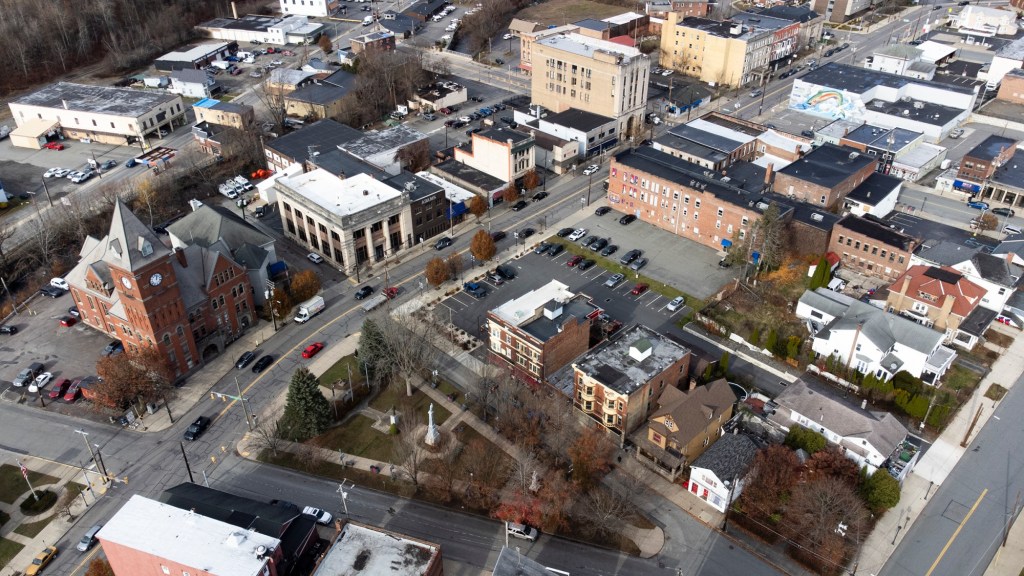
Carbondale could become the next Lackawanna County community to proactively regulate data centers with a zoning ordinance that would allow nuclear reactor-powered facilities with special approval.
Carbondale City Council will meet at 6 p.m. Tuesday at City Hall, 1 N. Main St., to consider an ordinance setting requirements for data centers, according to a public notice published Tuesday in The Times-Tribune. Carbondale has not received any applications for data centers, Mayor Michele Bannon said.
“This is entirely proactive,” she said.
The proposed ordinance would amend city zoning to define and regulate data centers, limiting them as special exceptions in Carbondale’s light industrial, heavy industrial and interchange activity center districts.
Carbondale is the second Upvalley community to address data centers, joining Mayfield, which adopted its own data center legislation in December.
The ordinance does not approve or permit any data center projects — it only establishes the regulatory process and guidelines that they have to follow for approval. Municipalities in Pennsylvania are required to allow for every type of lawful land use somewhere within their borders, which means carving out zoning for data centers.
The ordinance defines data centers and accessory uses, backup generators, data center campuses, data center parks and small modular reactors, or SMRs.
According to the legislation, an SMR is:
“A small nuclear fission reactor designed to be manufactured off-site and installed at a location to provide energy to buildings or commercial operations. SMR designs may include pressurized water, Generation IV, thermal-neutron, fast-neutron, molten-salt, and gas-cooled reactor models. An SMR must be fully licensed and permitted by the Nuclear Regulatory Commission (NRC) and may only be considered by Special Exception approval.”
The U.S. Department of Energy reports SMRs are under licensing review by the Nuclear Regulatory Commission and will likely be deployed in the late 2020s to early 2030s.
Lackawanna County communities are updating their zoning to address data centers, including Archbald, Blakely, Clifton Twp., Covington Twp., Dickson City and Jessup; other municipalities including Moosic and Olyphant are working to adopt data center legislation. Ransom Twp. rejected a data center zoning amendment last month that would have allowed a data center campus on Newton Road at the site of Scranton Materials LLC.
Municipalities have largely banned on-site power generation — aside from necessary backup generators — for data centers in their zoning ordinances. But, like Carbondale, Covington Twp. also provided for SMRs as special exceptions. A recently rejected settlement agreement between Clifton Twp. and a data center developer looking to build a campus along Interstate 380 in Clifton and Covington townships included a stipulation that had prohibited nuclear reactors or gas power plants on the site. The stipulation is no longer in effect.
Bannon said she doubts Carbondale would get an SMR, but city officials wanted to avoid technicalities.
“It’s not that we want to allow it,” she said. “We want to cover our bases.”
The ordinance stipulates that on-site energy generation during normal operations — not backup generators — is a separate use and subject to applicable zoning regulations.
Carbondale’s draft zoning ordinance is similar to Dickson City’s newly adopted zoning standards, which borough council unanimously approved Thursday, by designating data centers as special exceptions. Other communities regulate data centers as conditional uses.
The conditional use and special exception processes are similar in that they require data center developers to abide by specific regulations on top of standard zoning requirements. Developers also have to attend a public hearing where they discuss their plans and residents have the opportunity to testify and ask questions. The central difference between conditional uses and special exceptions is which legislative body votes on the proposal. Conditional uses go before councils and township supervisors, whereas special exceptions are before zoning hearing boards.
The city’s zoning amendment would make data centers special exceptions across light industrial, heavy industrial and interchange activity center zones in:
• Carbondale’s southwest corner, continuing north along Brooklyn Street.
• Between Cottage Street and Gordon Avenue.
• Around North Scott Street, Apple Avenue, Clidco Drive and Dundaff Street.
• The industrial park surrounding Enterprise Drive.
So far, every data center proposal in Lackawanna County has followed the high-tension power lines strung across the valley. In Carbondale, those lines enter the city’s northeast corner from Carbondale Twp., running across Carbondale’s northern tier over Canaan Street and moving northwest across North Main Street and Enterprise Drive until crossing the Fell Twp. border.
Bannon noted most of the available locations are small, and larger lots are split between Carbondale and its neighbors in Carbondale Twp. and Fell Twp., which makes developing data centers there unattractive due to the logistics of navigating approvals from two municipalities instead of one.
“The city of Carbondale is very dense — there’s not a lot of open area,” she said. “However, I’d rather make sure that our residents are secure and that we’re proactive in that we’re doing the best we can to serve them while at the same time being compliant with regulations.”
The zoning ordinance also includes requirements to:
• Provide will-serve letters from a local water utility, sanitary sewer conveyance utility and electric utility if connected to the electric grid, confirming adequate capacity and service.
• Submit an analysis of raw water needs from either private or public sources; the city can request, at any time, a developer-funded water study by a company of Carbondale’s choosing.
• Provide a water feasibility study to determine if there is an adequate supply, and to estimate the impact on wells within 1,000 feet of property lines.
• Conduct preliminary, interim and as-built sound studies six months after receiving an occupancy permit, as well as a vibrations study showing no vibrations beyond property lines.
• Submit an emergency response plan.
• Submit decommissioning plans addressing e-waste and hazardous materials.
The ordinance also has specific regulations for SMRs, including:
• Approval from the Nuclear Regulatory Commission or a similar/successor entity.
• Demonstration of a federally approved constructor and operator of the facility.
• Demonstration by the licensed operator and developer there is an adequate repository of nuclear fuel produced by the SMR with a federally licensed facility/agency.
• Prohibiting processing or enrichment activity.
• Any temporary fuel storage, used for refueling or removed during refueling, will be disposed of in accordance with an NRC-approved plan.
• Before beginning construction, the operator must submit any required decommissioning plan, and if the NRC does not require one, then the operator must submit it to the city, ensuring the removal of all radioactive materials when it is no longer operational.
• Submit a safety plan complying with federal standards.
Although the ordinances have not yet gone into effect, Carbondale will eventually share land uses with its Upvalley neighbors as part of the Northern Lackawanna Planning Association, or NorLack — a zoning collaborative involving Carbondale, Carbondale Twp., Greenfield Twp., Jermyn and Mayfield.
Zoning collaboratives like NorLack require only one municipality to allow a land use, which means only one of the five towns will have to agree to accept data centers. If no town agrees to allow them, all five will have to allow them.