
By SHANNON O. WELLS
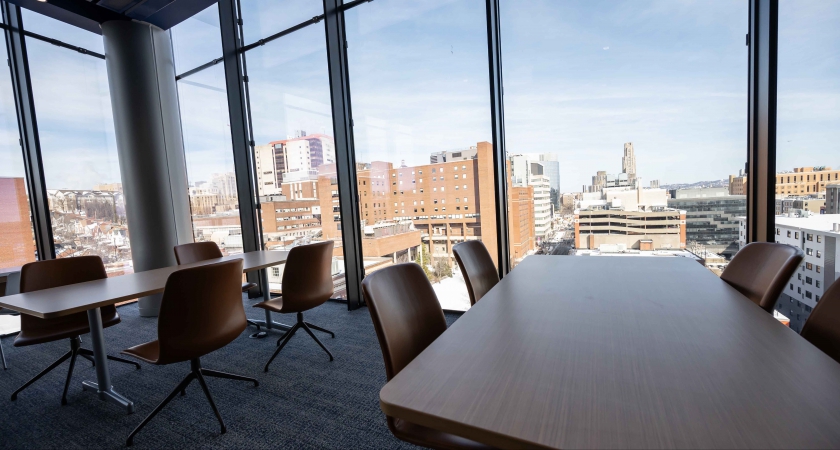
Walking through the new School of Health and Rehabilitation Services (SHRS) facility at Fifth Avenue and Halket Street is to experience a state-of-the-art, well-appointed 10-story building with gleaming fixtures, accessories and spacious classrooms bathed in natural light from windows that provide striking views of Oakland and the Forbes Avenue corridor leading to Pitt’s lower campus.
The new building consolidates all SHRS programs previously scattered among three Oakland structures under one roof, including Communication Sciences and Disorders, Community Health Services and Rehabilitation Science, Counseling and Behavioral Health, Health Information Management, Physician Assistant Studies, and Sports Medicine and Nutrition.
It also houses the Doctor of Chiropractic program that SHRS launched in fall 2025, the first of its kind at a public, research-oriented university in the U.S. The program relocated from The Box office building on Pittsburgh’s South Side to a dedicated space at Fifth and Halket.
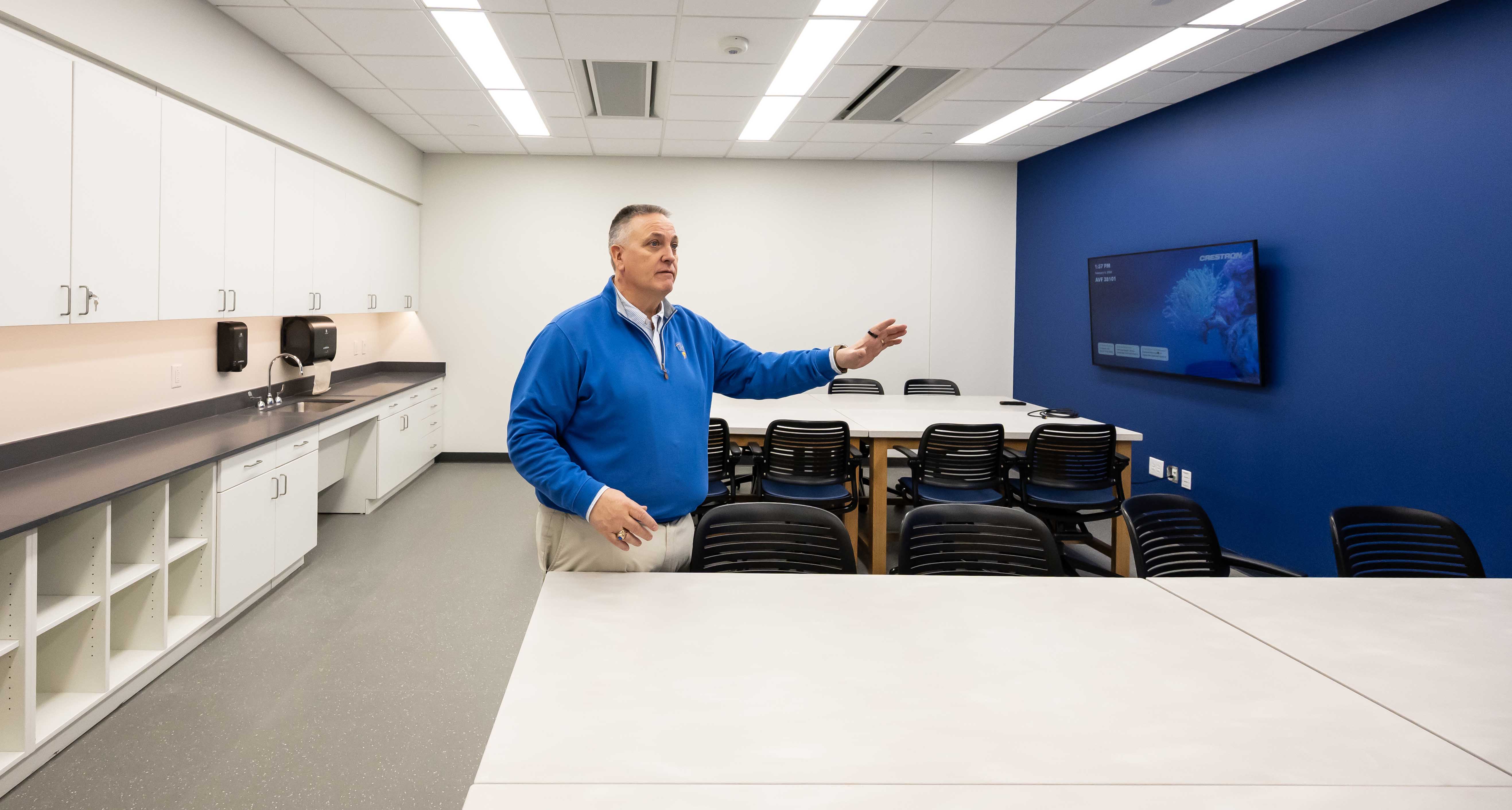
On a recent tour of the building, Greg Smith, SHRS director of space management & planning, explained the transition process.
“SHRS has vacated our footprint in Forbes Tower,” he said of its third- and fourth-floor spaces. “We had a program on the second floor in the Murdoch Building just down a couple blocks. Our Emergency Medicine program, which was in the McKee Professional Building, has moved over here.
“We have a few select programs that were down on Bridgeside Point that have moved … and then we have some research admin folks.”
‘Tremendous learning space’
SHRS is the building’s primary occupant, filling up floors three through eight. Each floor includes classrooms, while every other floor includes staff and faculty workspaces along with specifically designed clinical skills labs to serve across various SHRS disciplines.
“Once you kind of see a few floors, you’ll start to get the hang of it,” he noted. “It’s a lot of the same thing over and over, but there’s some unique stuff on each floor.”
Large, bright, ample-windowed student lounge areas are found on floors four, six and eight. Those are also what Smith called “workplace floors,” sharing similar layouts and housing faculty and staff offices. Floors three, five and seven, conversely, are the “learner floors” containing more complex-designed dedicated lab and research spaces.
The third floor includes specialized skills labs for the Doctor of Chiropractic and Physicians Assistant Studies programs, and the Communication Science Disorders department has a research floor on seven, Smith noted.
On the fifth floor, Smith’s disclaimer about repeating layouts tends to lose some of its relevance.
Along with Sports Medicine’s athletic training and therapeutic exercise labs, the fifth floor includes a dedicated food-science lab. The kitchen-on-steroids is a veritable sea of stainless-steel, hood-vented, video monitor-accompanied islands with gas ranges and food-preparation counters.
“We did have a food science lab in Forbes Tower, but it was six kitchenettes with sort of a couple tables right in front,” Smith said. “Here, we have a dedicated food science lab. On the other side (of the wall) is an adjacent classroom.
“Now we have the ability to have a separated learning space — or a hands-on space — versus a more classroom-style space (along with) being able to integrate the technology with the (video) monitors.”
The lab is augmented with a washer and dryer and a food-waste room. “We have separated cold and dry storage. … We have industrial-sized freezers in here for cold storage. We have racked dry storage in the underside,” he noted. “So it’s just a tremendous learning space for our (Sports and Nutrition Program).”
Simulated street scenes
And then, down the hall, there’s the ambulances. Yes, you read that correctly. Well, technically, they are replicas of emergency medical transport vehicles — lacking wheels and an engine — but that doesn’t make their appearance any less surprising or impressive.
Tom Platt, professor and chair of Community Health Services and Rehabilitation Science and professor of emergency medicine, who happened by during the building tour, demonstrated how the ambulance simulators — one of three on the floor — fit into the school’s learning experience.
“Our (previous) building was shared space between another organization and this program, so we’re in the process of acquiring the equipment for in here,” he explained, including a stretcher, vital functions monitor and defibrillator. “Everything an ambulance has inside, with the idea that the students can run a scenario in the floor space and then move the patient into the ambulance for transport.”
Platt said the open-air ambulance replica models were chosen to maximize student benefit.
“You can buy them with television screens and camera, but we chose this because the rest of the students can now stand here and watch what’s happening and do (patient) evaluations in real time, as opposed to spending all the money for a monitor and a camera in there,” he said. “The nice thing about it is, when it does light up — we turn the lights off in the room and close the blinds — we’ll be able to simulate street scenes where they’ll be distracted by the flashing strobe lights that are in the room …”
Outside the simulators, three colored LEDs lights allow students to communicate to folks outside the ambulance the condition of the patient, using red, yellow or green. “So that the evaluators on the outside can see what’s happening.”
Noting that the ambulance simulator is the first of its kind for Pitt, “but not for the world,” Platt called the amenity “very exciting. I think it’ll really enhance the (learning and experience) ability of our students.”
Just down the hall from the ambulance simulators are rooms with hospital-like beds.
“We’ll either be able to do a transfer from a hospital to an ambulance or from an ambulance to a hospital, so our students will actually have the ability to care for a patient in here,” Platt said. “The patient will already be on a stretcher, (so we) take the stretcher down the hall to another classroom, deliver that patient and give a report.”
Platt envisions further enhancing SHRS’s inter-professional education by having “maybe the nursing students … certainly our physician assistant students, come down and visit. They’ll be able to hand off a report right there at bedside to another set of clinicians,” he said.
Continuity and community
David Beck, SHRS interim dean, said the move to the new facility is nearly complete, with some programs and events transitioning through the rest of the semester. Phases of occupancy are aligned to ensure continuity of learning and minimal disruption for students, staff and faculty.
“Our goal is to have the building completely operational and humming with activity by the start of the next academic year,” he said. “That timeline honors both the complexity of a move of this scale and the excitement it has generated across our community.
“We want to ensure a thoughtful, strategic transition that sets every program up for success from day one.”
Contemplating the transition from three campus buildings to a single, fully integrated one, Beck said the legacy of accomplishments and camaraderie of the past will continue to grow at Fifth and Halket.
“Forbes Tower, the Murdoch Building and the McKee Professional Building have served us well as homes to countless memories, rigorous training and deep friendships,” he said. “Though our time in each space has varied from decades to a handful of years, we honor what we achieved in them and how SHRS evolved, grew and improved within their walls.
“Most importantly, our people are the ultimate measure of our school’s worth,” Beck added. “The heart of SHRS has always been our community, and that will never change.”
Shannon Wells is a University Times reporter. Reach him at shannonw@pitt.edu.
Have a story idea or news to share? Share it with the University Times.
Follow the University Times on Facebook.