
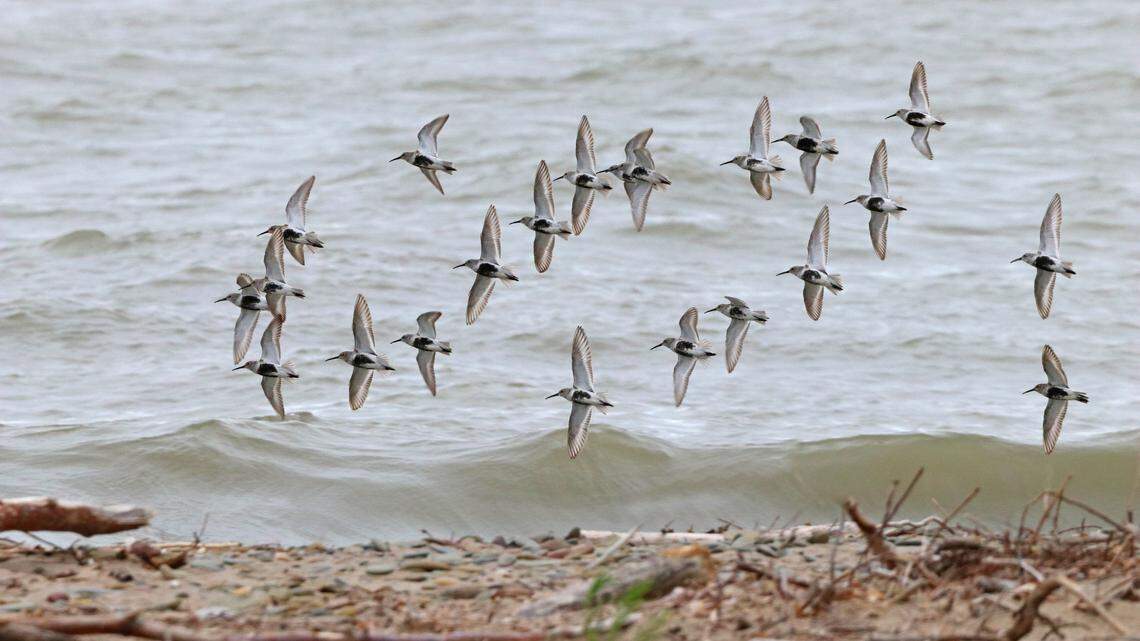
A group of dunlins fly along the Lake Erie shore.
Mark Nale
For the CDT
In mid-May, I attended the Pennsylvania Outdoor Writers conference in Erie. The conference was its usual good mixture of craft improvement seminars, newsmaker presentations and good fellowship. Since I was in the northwest corner of the state, I was particularly interested in presentations by Visit Erie and Captain Eric Guerrin and Teresa Guerrin of TowBoatUS Erie PA. They spoke about the uniqueness of Lake Erie and of Presque Isle Bay in particular. I wanted to see this for myself.
On the windy day following the conference, Michael Kensinger of Altoona and I decided to visit Presque Isle State Park, a short drive from the conference hotel. We passed the Tom Ridge Environmental Center just before entering the peninsula.
Large parking lots, mostly empty on this cool May morning, supported the fact that Presque Isle is Pennsylvania’s most visited state park. It often tops 3 million visitors per year. Bald Eagle, Canoe Creek, Black Moshannon and Prince Gallitzin do not even come close.
Right off the bat, we noticed that experiencing Presque Isle is like visiting two different worlds. The 5.8-square mile Presque Isle Bay is protected by a narrow arching land mass that separates it from Lake Erie. As you enter the park, the bay is on the right and the lake on the left.
I commented that the wind had died down, which would make our birding and sightseeing a more pleasant experience. The bay was calm with a few people kayaking or fishing from small motorboats. A birding festival was also occurring in Erie that same weekend, so other birders were out and about.
Hoping for an identification, Kensinger and I followed an unknown bird across the peninsula toward the lake. As we inched closer, we could hear what sounded like a raging storm. Curious, we crossed the remainder of the peninsula and encountered a different world. Wind was blasting us, trees were swaying and three-to-four-foot waves were crashing into the stone breakers and the sandy beach. Several surfers were out on the lake in wet suits. If I hadn’t known better, I would have thought that I was looking out over the Atlantic.
We spotted a flock of 22 dunlins, a few sanderlings and two turkey vultures feeding on the remains of a goose that had washed up on the beach.
A turkey vulture feeds on a dead goose that washed up along the Lake Erie shore. Mark Nale For the CDT
Captain Guerrin had mentioned that the bay provides many more safe boating days than the lake. On this windy morning, it was clear to see why.
We continued our journey in a northeastern direction, stopping at each vista and taking time to walk to the Feather Observation Platform. Warblers migrating north are known to stop along the shores of Lake Erie to rest and re-fuel before flying across the lake. We were fortunate to see bay-breasted, yellow-rumped, magnolia, chestnut-sided, palm, and blackpoll warblers, as well as dozens of yellow warblers. We also logged American redstarts, northern parulas and common yellowthroats — also warblers. What a treat it was to see so many different warbler species in such a short distance.
“This is my new favorite place to bird,” Kensinger commented.
I was frustrated at first because Kensinger could hear blackpoll warblers, and our cellphone app was recording them as well. Sadly, my aging ears could not detect their high-pitched song. Finally, we both spotted two blackpolls near the Feather Observation Platform.
The elusive blackpoll warbler is pictured in Presque Isle State Park. Mark Nale For the CDT
We continued on, checking out the Presque Isle Lighthouse and more of the beach and wetland areas. Built in 1872, the brick lighthouse is one of the most popular historic landmarks on the peninsula. The lighthouse is still functional and serves as a navigation aid — its light visible for up to 15 miles.
A mature bald eagle watched over a wetland on the bay side. Great blue herons prospected the shallows. After a lunch break, we walked the short Pine Tree Trail because it had been reported that there were many warblers there, but only a few could be found while we visited.
We watched two men flying huge kites on the beach near Sunset Point. The lake was calmer here because the lakeside of the peninsula now faced north, instead of west.
Huge kites are flown at Sunset Point. Mark Nale For the CDT
With our last bit of energy, we walked the 1.5-mile Gull Point Trail, which ended at an observation platform where a piping plover was nesting. We wanted a chance to see this bird because it is the only documented case of a piping plover nesting in Pennsylvania. Along the way we saw a red-headed woodpecker, a common loon and two great egrets. The hike gave us several views of the North Pier Light — a lighthouse located at the entrance to the bay.
The plover nest was easy to spot when we arrived at the platform because it was surrounded by a wire exclosure to protect the nest from predators. In 2017, piping plover chicks hatched on Gull Point — the first in over 60 years.
We ended the day with over 75 bird species spotted, good exercise and a real, but brief taste of what Presque Isle State Park has to offer.
If you go
Presque Isle State Park is a little over three hours from State College via I-80 and I-79. Park admission is free. There are plenty of things to do and see at the park, and I only touched on the historical aspects here. Be sure to experience both sides of the peninsula — they are truly different worlds. The city of Erie offers many hotels and restaurants — can’t wait to go back.