
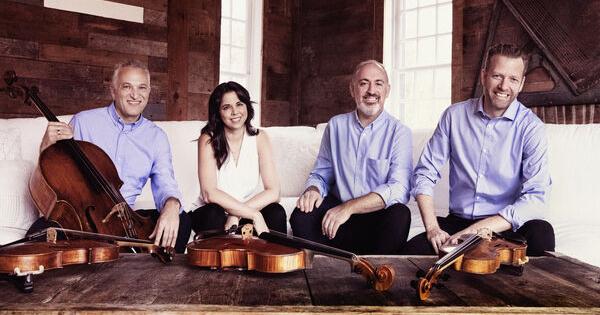
Violist Mark Holloway has travelled the world playing music – both as a freelance musician and as a member of the group “The Pacifica Quartet.”
Through his experience, Holloway has experienced many forms of collaboration and developed his sound.
“It’s amazing to meet different people, exchange ideas and then use your skills to match and come up with an interpretation, to really blend and show your individual personalities,” Holloway told 69 News reporter Patrick Gunn in an interview last week.
The Pacifica Quartet added the violist Holloway in 2018 – more than 20 years into its existence. Holloway loves the experience of performing chamber music ad hoc, but he appreciates the ability to delve into themes and pieces in more detail.
“You have lots of performances under your belt to sort of see how things change in the concert hall, see how audiences react,” Holloway said. “Something might feel good in a practice room or in our studios when we’re rehearsing, but you learn a lot when you’re playing on stage. The characters of thing, are they coming across from the stage, timings, cadences, articulation, are things being clear, heard clearly in the hall? It’s a much deeper dive.”
Holloway, a New York native, has roots in the Lehigh Valley through his mom who grew up in Phillipsburg, and his grandfather worked at Lafayette College. He says she still pays attention to who’s going to win the big [Lehigh vs. Lafayette] football game.
He’s performed with the chamber group the Pacifica Quartet since 2017 and has taken his experience traveling the globe and seeing the country through its music, and he’s about to share this story at Kutztown University.
Kutztown continued its concert series for the year with a look at America’s history through music. The Pacifica Quartet brought their decades of experiencing scoring the highs and lows of the American Experiment to Schaeffer Auditorium this week and hope to connect with audiences over their string music as they reflect on our country’s 250th birthday through song.
The Quartet performed works of three artists: Antonin Dvorak, Charles Ives, and Erich Wolfgang Korngold. Two of those composers – Dvorak and Korngold – were not born in America, yet their works capture American sensibilities along with the impact immigrants have on our culture.
“It’s just kind of a snapshot of different voices that were creating music in America or American voices and I think there’s a great contrast between them even though timewise there’s not a huge difference in 20 or 30 years perhaps,” Holloway said.
Holloway said Dvorak, a Czech composer, wrote the “American” Quartet while living in a Czech community in Iowa. Holloway credited the strength of the piece – and how much fun it is to perform – to its inspiration. That would be music by Native Americans, African Americans, folk songs, and sounds in nature.
“Audiences love this piece because it just speaks to them directly it’s beautiful, it’s soulful, it has lots of character, lots of beautiful colors, it’s really fun to play,” Holloway says.
Korngold – a child prodigy from Austria – split time between performing in Europe and making film scores in Hollywood. But he moved to America full time in the late 1930s as Hitler and the Nazis invaded Austria returning to Europe after World War II in the 1940s. After this he performed one of the most famous works: the score for the film “The Adventures of Robin Hood” starring Errol Flynn. Korngold won his second Oscar for this score. Holloway says provided a unique voice as making these works in his adopted home escaping the Holocaust. He added they’ve recorded some of Korngold’s music before, and it’s a joy to perform his cinematic music.
“We sort of have these chords and chord progressions that as we’re rehearsing, wow I’ve never really heard anything like this before,” said Holloway. “The imagination is really, really special.”
Charles was a radical musician (at least for the turn of the 19th Century), incorporating marching bands playing different music in the same area at once. Holloway said Ives had money working in insurance, so he never had to focus on making art for commerce and could mix a variety of sounds in different time signatures. Part of that includes Christian music which the quartet is performing.
Holloway and the Quartet have experience delving into the music that makes America. The Quartet is about to release their third record relating to music surrounding our country, titled “American Portraits.” They previously released American Stories and American Voices which delved into topics as far ranging as racial identity and food insecurity.
The third addition was timed with America’s 250th and they’ve already recorded two parts: the piece “Adagio for Strings” by the Barber String Quartet, which Holloway says became famous as the soundtrack for mourning following the deaths of President Franklin Delano Roosevelt and John F. Kennedy.
“It became very famous and also known for this melancholy, elegiac meaning behind it,” Holloway said.
They’ve also recorded a famous Vietnam protest piece from George Crumb’s “Black Angels,” which became a challenge using not only strings but also wine glasses as instruments (presented here by the Cleveland Institute of Music).
As for their work to come, they’ve commissioned pieces from composers Jennifer Higdon and Gabriel Lena Frank commemorating the words of Supreme Court Justice Ruth Bader Ginsburg and scientist Rachel Carson, known for her book “Silent Spring” an important text in the history of environmentalism.
While “American Portraits” is not the focus of his performance at Kutztown, Holloway and the Quartet’s work will continue its themes of showcasing sounds that embrace America’s roots. Holloway emphasized his excitement to showcase this section of American History in Kutztown.
“Each audience is different,” Holloway said. “It’s a completely different collection of people and depending on what side of the bed they woke up on this morning and what they had for lunch and whatever everyone is feeling differently and hearing differently, we’re humans, too, and we have days where we feel differently and we prepare this music the best we can to try to tell stories and transmit character to people who are sort of ready to receive it. We receive from the audience, too, and so it’s very nice to be able to go to a different place and commune with this great music.”