
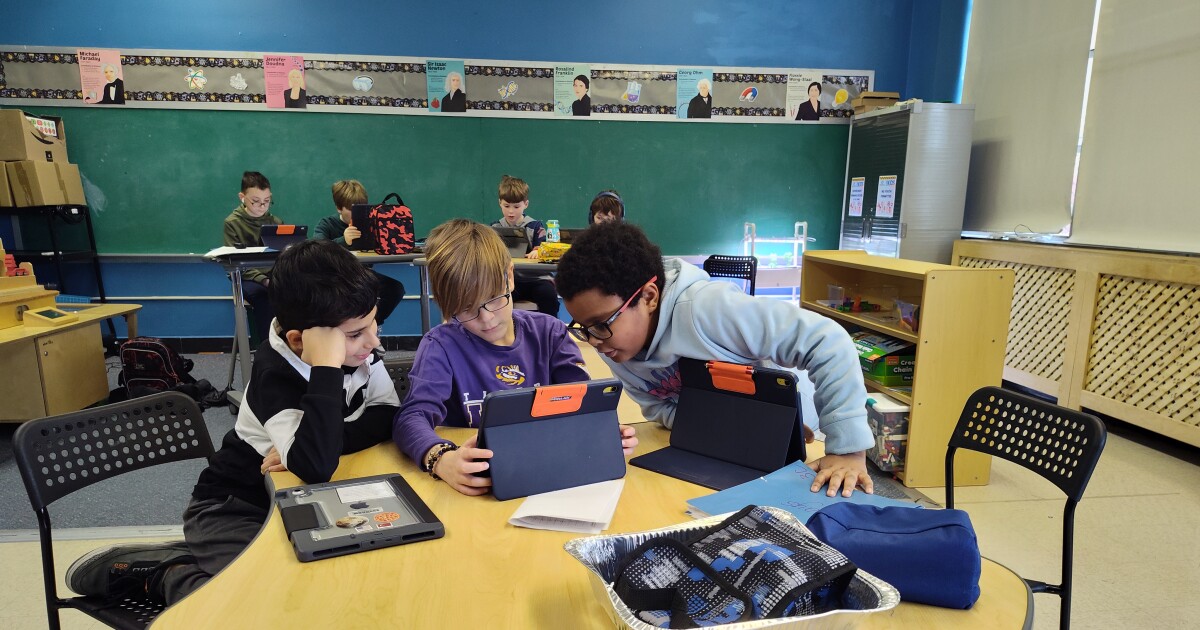
Last month’s historic snowstorm sent schools across Allegheny County online, in some cases for an entire week.
WESA tracked remote learning across the region as crews worked to clean up snow-covered roads in the days that followed the winter storm. On Friday, Jan. 30, 33 school districts and charter schools — more than half of public schools countywide — opted for remote learning.
For some students and families, these remote days were a welcome continuation of classroom lessons. For others, however, online and asynchronous instruction meant missing the essential services they rely on to access their right to public education, protected by federal law.
Pam Harbin, a former Pittsburgh Public Schools board member, runs the parent support hotline offered by the Education Rights Network, a parent advocacy group based in the city.
“We heard from so many families… on our hotlines during remote learning, and the stories show us that remote learning doesn’t affect all students equally,” Harbin said. “It lands hardest on the students who are already the most vulnerable.”
Pennsylvania schools can offer remote or virtual instruction as long as they meet the number of school days or instructional hours required by state law, according to Department of Education spokesperson Erin James.
Schools must provide students at least 180 days of instruction, or 900 hours of instruction for kindergarten and elementary students. For secondary students, the number of instructional hours required is 990 hours.
State law allows schools the discretion to configure their school year however they’d like, James said, as long as they continue to meet all state academic standards and students’ individual instructional needs.
But Harbin says not all instructional hours are created equal. Remote learning across the region varied greatly during the snowstorm fallout, with some schools teaching students over live video, while others prepared lesson packets for students to complete on their own time.
“Those are completely different experiences,” Harbin said. “And for many students with disabilities, the difference matters enormously, and it directly impacts whether a student can participate or benefit from instruction.”
Mitigating the impact of remote learning
Research shows that remote learning during the pandemic was a primary driver of widening achievement gaps between high-poverty and low-poverty schools, as well as by race.
But other studies show shorter, more temporary disruptions to in-person learning — such as snow days or teacher strikes of less than two weeks — don’t lead to significant learning declines.
Still, Harbin said that schools that go online without carefully considering how they will meet the needs of students with disabilities and other vulnerable groups are setting families up to struggle.
PPS is still making up the more than 600,000 hours of learning time students with disabilities missed out on during the pandemic. More learning days lost, Harbin said, could add to that total.
“The law is clear, if a student with a disability can’t participate in or benefit from the way instruction is being delivered, the district is breaking its legal promise to that child and the family,” she said.
The commonwealth’s Department of Education advises that, prior to making instructional changes, schools should consider how they will impact special education programs, access to meals provided in school and before- and after-school care.
Some districts, like Deer Lakes and Sto-Rox school districts, offered families grab-and-go breakfasts and lunches while schools were operating remotely.
“Those schools that have pre-planned for those situations are those where the students end up being the most successful,” said Hetal Dhagat, a senior attorney with the Education Law Center in Pittsburgh.
But Dhagat said schools around the region would be prepared for these disruptions if they met with families in advance. She said that’s especially important for students with disabilities, who often depend on individualized, in-person support during the school day.
“We’ve seen better results when the school stays in communication with parents and students with disabilities, explaining, if they can, what’s coming up in advance, and then afterwards being able to discuss with the [Individualized Education Plan] team if make-up services are necessary,” she added.
After-school providers like the Boys and Girls Clubs of Western Pennsylvania say better coordination between districts and community partners would also help ensure students can participate in remote instruction.
Rumors of an ICE agent approaching Taylor Allderdice High School’s campus in Squirrel Hill last week had students and teachers on high alert.
In the days following the recent winter storm, the Boys and Girls Clubs opened two of its clubhouses, in Millvale and Somerset, to working families who needed childcare while schools were remote.
“When they are in our clubhouses for the flexible instruction days, they have that hands-on support from our staff,” said Kara Petrosky, the organization’s vice president of programs. “And they also have that in-person social connection with their peers, which enhances that learning experience for them.”
Where the program’s facilities couldn’t open, staff reached out to students to make sure they had support while online.
“The pandemic really showed that the lack of social connection had a significant impact on the mental health of our teens,” Petrosky explained. “To make sure that they’re okay and to help support them in ways that they could right through that social connection was really important and continues to be important.”
What counts as learning time
In 2019, state lawmakers revised the state’s school code to allow districts to take up to five flexible instruction days each school year, to be used during weather emergencies and other disruptions.
These days can be online or offline, or some combination of the two. Before enacting a flexible instruction day, districts must first provide the state with an implementation plan, examples of lesson plans and get their school board’s sign-off.
About a quarter of Allegheny County schools took at least one flexible instruction day after last month’s storm, according to WESA’s tracking.
Many other districts, however, announced simply that schools would be operating remotely, without pointing to a specific, state-approved flexible instruction plan. Steel Valley, Gateway and Sto-Rox school districts switched between the two, taking flexible instruction days on Wednesday, Jan. 28 and remote learning days later that same week.
The Department of Education has issued little guidance pertaining to the rules districts must follow when they want to implement remote learning beyond their five allowed flexible instruction days.
A presentation from the department’s School Services Office last year states only that schools “may vary instructional time models, with the use of virtual or remote learning, if approved by the governing body of the entity, and if instruction is provided by certified educators.”
When asked what policies regulate remote or virtual learning, Department of Education officials pointed only to the state code outlining the required instructional hours and days schools must provide.
Districts could satisfy those requirements by extending their school calendar into the summer. But that could come at a steep cost, said James Fogarty with the nonprofit A+ Schools.
“There’s a big fiscal cost if you have to extend the school year by a few days,” Fogarty said. “You’re paying your staff to do that as well.”
Fogarty said having the ability to use virtual instruction flexibly makes sense for districts given the tightening budgets they face, despite the downsides.
“I do think, at times, it’s sort of a necessary evil that we have to kind of address within the context of the current policies that we have at a state level,” he said.
Harbin said she would like to see the state expand the number of flexible instruction days schools are allowed to take. That way, she said, schools would be held to the same standards during remote learning as they are on flexible instruction days.
“Flexible instruction days work because they require planning, board authorization, limits on the number of days and annual reporting to the Department of Education. There’s public notice and accountability built in,” she said. “Any alternative method of delivering instructions should operate under the same rules.”