

Hannah Hohman and Koa Reitz stood on an old bridge on a sunny afternoon, looking down at the confluence of two streams. Hohman glanced back and forth between the iced-over streams below and the GPS on her phone.
“I think that’s unnamed trib…and then that’s Montour…and they meet here,” Hohman said.
Hohman, environmental steward at Three Rivers Waterkeeper, a local environmental group. Reitz is an environmental scientist with the group.
Since 2023, their group has been sampling streams around Pittsburgh International Airport for PFAS, a class of 14,000 compounds also known as “forever” chemicals that have contaminated the environment nationwide.
LISTEN to the story
https://s3.us-east-1.amazonaws.com/media.alleghenyfront.org/AF021326_RF_PFASAirport.mp3
The Waterkeeper’s monitoring data showed high levels of PFAS in Montour Run and its tributaries, as high as 430 parts per trillion,100 times the safety level of 4 parts per trillion established by the U.S. Environmental Protection Agency for drinking water.
“That value of 430 was an, Oh my gosh, what’s happening here? moment,” Hohman said.
Hohman and Reitz decided to look at new publicly available data. Since last year, the airport has been sampling its stormwater outfalls for PFAS and reporting the results to the Pennsylvania Department of Environmental Protection.
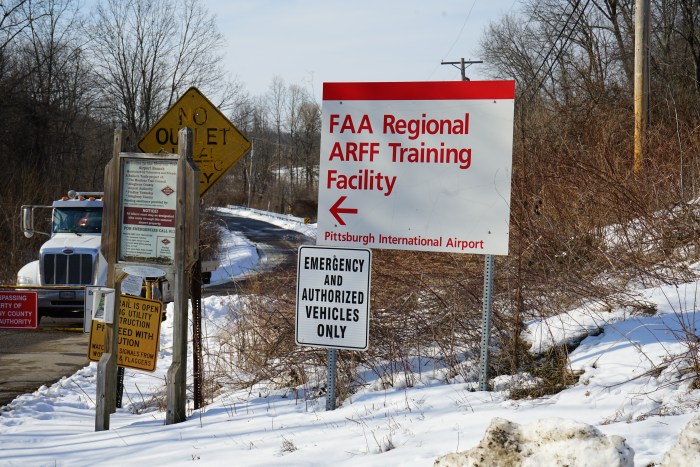 PFAS-containing firefighting foam was used at the Aircraft Rescue and Fire Fighting (ARFF) training center at the Pittsburgh International Airport. The site no longer uses fluorinated foams. Photo: Reid Frazier / The Alleghey Front
The highest level the airport reported was 62,900 parts per trillion of one type of PFAS – over 15,000 times the EPA’s safety level.
“It was alarming when we did pull that number because initially I think all of us were like this has to be a mistake’” Hohman said. “That’s a number that is pretty hard to fathom.”
The highest PFAS levels submitted by the airport were from a stormwater drain near the airport’s firefighting training facility.
Reitz dips a clear plastic cup into the unnamed tributary to Montour Run that flows downhill of that drain, about a mile away. The water drips through a filter, which a lab will screen for 55 of the most common PFAS chemicals.
“They’ll analyze what’s in the filter and then report back to us how many of each type of PFAS is in the creek,” Reitz said.
A long brewing problem
For decades, the Federal Aviation Administration required airports to use Aqueous Film-Forming Foam (AFFF), also called fluorinated foams because it contains the element fluorine.
“For a long time, it was mandated that those fluorinated foams be used not only in emergency response, but also in drills,” said Kimberly Garrett, assistant professor of environmental health at the City University of New York’s Graduate School of Public Health. “So [airports were] really spraying that concentrated PFAS.”
The FAA mandated these foams for good reason, Garrett said. AFFF is very effective at extinguishing oil-based fires, like those involving jet fuel.
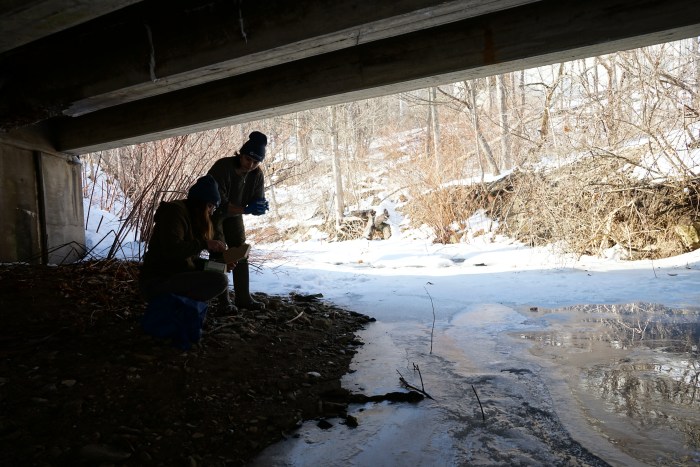 Koa Reitz, standing, and Hannah Hohman, both of Three Rivers Waterkeeper, are monitoring for PFAS along Montour Run near Pittsburgh International Airport. Photo: Reid Frazier / The Allegheny Front
“You can spray them over a fire, and they will create a kind of a layer, a membrane between the outside atmosphere and what’s below, so they will kind of snuff out the fire that way,” Garrett explained.
But two things about using PFAS chemicals – found in a broad range of materials from non-stick pans to waterproof clothes – present a problem to the environment and people.
For starters, PFAS molecules are built around a uniquely strong chemical bond between carbon and fluorine.
“They are one of the strongest bonds we can observe in chemistry,” Garrett said. “Carbon and fluorine, it’s really a remarkable bond, so [PFAS] can persist for centuries in the environment.”
So when PFAS get inside the body, they don’t break down, and lead to a second problem: serious health effects.
According to the EPA, peer-reviewed studies show the chemicals are known to increase the risk of some cancers, including prostate, kidney, and testicular cancers, decreased fertility, developmental effects or delays in children, reduced ability of the body’s immune system to fight infections, increased cholesterol and obesity.
These health effects of exposure to PFAS in firefighting foam only emerged in the last few decades, said Carrie McDonough, an associate professor of chemistry at Carnegie Mellon University.
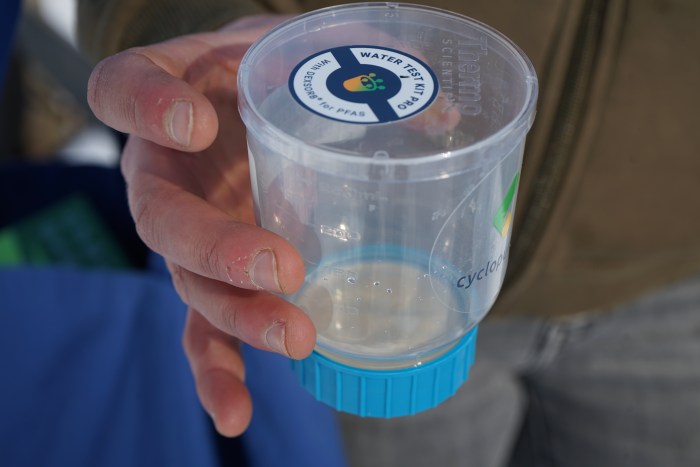 Water from a stream near Pittsburgh International Airport drips through the bottom of a plastic sample cup, where it will pass through a filter that will be tested for PFAS. Photo: Reid Frazier / The Allegheny Front
“For a long time, the risks associated with PFASs were not really well understood,” McDonough said. “So these foams were basically treated like soap.”
As a result, many airports and military bases around the country are PFAS hotspots, said Alissa Cordner, a professor of sociology at Whitman College in Walla Walla, Wash.
“All of that foam [would have] either settled into the training pad or made its way into the water system directly around the airport,” Cordner said. “There are many airports around the country where very high levels of PFAS are measured in soil samples, in groundwater under the airports or in surface water adjacent to the airport.”
The EPA has since classified two of the main PFAS chemicals in AFFF – PFOS and PFOA – “likely” carcinogens.
Rules and regulations are emerging
States and the federal government have begun regulating chemicals. Pennsylvania established its own drinking water standard for the two chemicals in 2023, and the EPA is on pace to set even tighter standards by 2031 for PFOA and PFOS, though the Trump administration rescinded regulations for four others.
Pennsylvania water providers say they’re complying with federal PFAS regulations
Pittsburgh International Airport spokesman Bob Kerlik said in a statement that the airport “implemented Fluorine Free Foam more than a year ago” after the FAA stopped mandating airports use AFFF firefighting foam.
Kerlik did not respond to questions about how the airport would prevent future releases of the chemicals from its site.
The Pennsylvania Air National Guard’s 171st Air Refueling Wing, located just outside Pittsburgh International, no longer uses AFFF either, said Shawn Monk, a spokesman, in an email.
“We still have AFFF present on the installation, but it is not being used and is properly stored in accordance with regulations and EPA guidance,” Monk said. “We continue to work with the Air Force, National Guard Bureau, and applicable agencies to follow guidance addressing detection, mitigation, and restoration.”

Stopping PFAS use is one thing; removing them from the local environment is another, experts said.
“Because PFAS are so persistent, so widespread, and have been used in so many different use applications for so long, this is not a contamination problem that will be simple to address,” Cordner said.
A well-loved stream
A case in point is Montour Run. Reitz is concerned about PFAS accumulating in the food chain once they enter the watershed.
“PFAS is one of those things that bioaccumulates,” said Reitz. “That’s one of the things we’re most concerned about when we see people fishing. And we’re pushing for some sort of regulation or fish consumption advisory in this area.“
The Pennsylvania Fish and Boat Commission stocks Montour Run with trout.
A 2023 study found that eating just a single serving of freshwater fish per year with the median level of PFAS detected by the U.S. EPA monitoring programs can be equivalent to drinking highly PFAS-polluted water and “would lead to a “significant increase” of PFAS levels in humans.
In an email, a commission spokesman said the cold-water trout they stock don’t last in the warm-water stream much past the spring, so PFAS chemicals are unlikely to bioaccumulate in the fish. The commission samples fish tissues periodically in PFAS hotspots to assess toxicity. Only one stream in the state – Neshaminy Creek in eastern Pennsylvania – has a “do not eat” advisory because of PFAS.
 An unnamed tributary to Montour Run near a firefighter training facility at the Pittsburgh International Airport, where PFAS-containing firefighting foam was used. Photo: Reid Frazier / The Allegheny Front
Sean Brady, executive director of Hollow Oak Land Trust, a conservation nonprofit that preserves land near the Montour Run and other parts of Allegheny County, said the stream is flanked by the Montour Trail, a popular recreational corridor.
“When you walk along a beautiful trail, and you see the stream and your kids see the stream, it’s hard to keep them out, right? You got to get in that beautiful stream and splash around and see what lives in there and turn over some rocks,” said Brady, who is also a boardmember of Three Rivers Waterkeeper.
Brady would like the airport to help investigate the source of PFAS and outline what it will do to prevent it from entering the environment.
“Why are the levels of contamination so high? What can they do or what are they already doing, I hope, to reduce that contamination? That’s what I would like to see,” he said.
For Hohman, PFAS in Montour Run is a long-term problem.
“If it’s going into the Ohio River, that’s source drinking water for millions of people, if people are recreating in the creek and they’re eating fish from that creek …like there’s so many points where impacts can be felt,” Hohman said.
At press time, the DEP had not responded to questions about how it would address PFAS levels around Pittsburgh International.
Three Rivers Waterkeeper says it will keep sampling in the streams throughout the spring.