
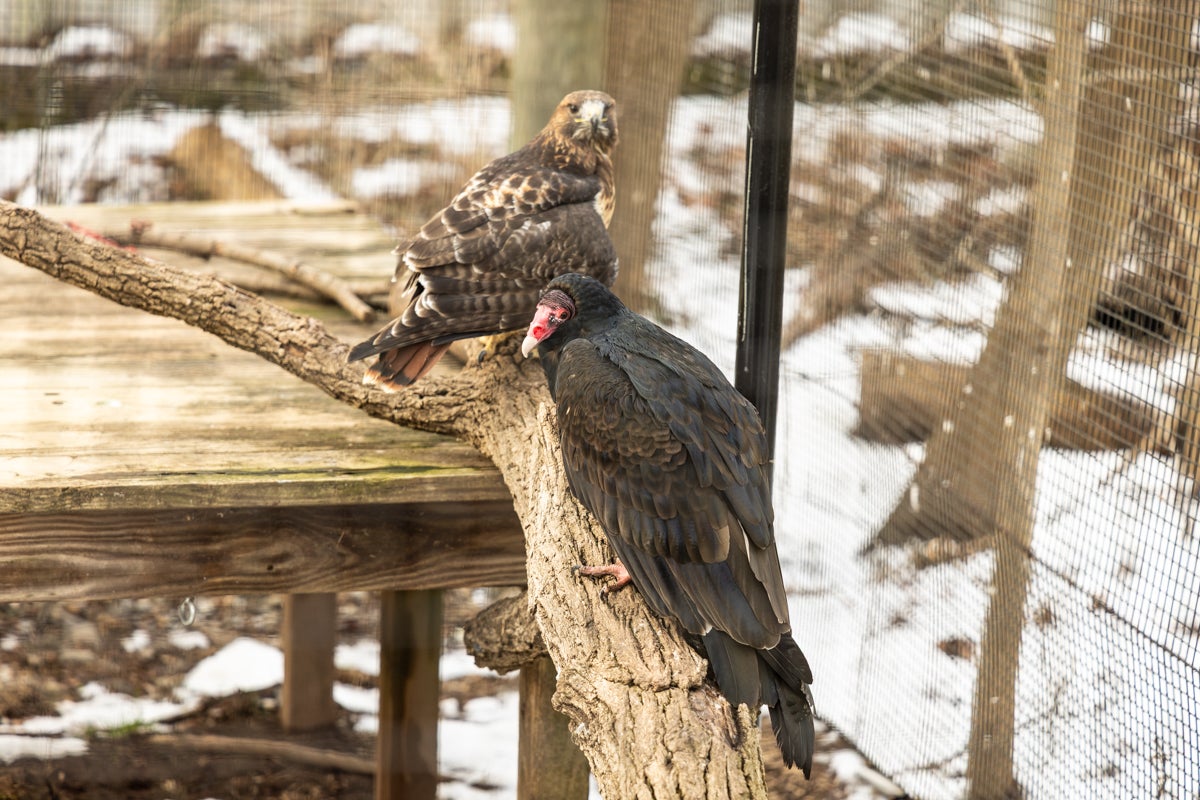
Are these birds in love?
To the human eye, Hunter and Stan’s relationship has all the hallmarks of a romantic partnership. But it may be impossible to know what the birds actually feel for one another.
“Obviously, we can’t ask [animals] directly what they feel,” said Zanna Clay, a psychologist at Durham University in England who studies the behavior of great apes and humans. “We can’t ask them about their inner experiences.”
Many scientists, including Clay, believe that animals experience emotion. A 2024 survey of 100 animal behavior researchers found that 78% think most or all birds have emotional responses that shape their behavior. But those researchers defined “emotion” differently. Some referenced emotion as a response to stimuli, others said it motivates behavior, while others referenced a connection to consciousness.
“Some people would argue … [that] some animals, particularly our close relatives like chimpanzees and bonobos, have many of the same emotions that we do — so pride, envy, disgust, rage, love,” Clay said. “Others would argue that it’s difficult to really know if that’s the case based on the objective evidence we have. So it really … depends on how you want to think about what emotions are.”
Human emotional concepts like love are shaped by culture and language, said Eliza Bliss-Moreau, a professor of psychology and scientist at the California National Primate Research Center at the University of California, Davis. She said humans have a tendency to try to intuit the mental states of others, both humans and animals.
“We can’t assume that we can just look at an animal and understand their emotional state,” Bliss-Moreau said.
Ciaramello, the zookeeper, hesitates to project human emotions onto Hunter and Stan. She sees their relationship as born of opportunity and what the birds may see as necessity.
“As a human being, … you want to say [it’s] friendship and love and all that fun stuff,” she said. “But as a [zoo]keeper, it’s, I think, a part of getting through the day-to-day and surviving.”
But scientists have found physiological signals that indicate bonds like Hunter and Stan’s may feel good, said Stephanie Poindexter, a biological anthropologist at the University at Buffalo who studies primate behavior. For example, studies have found decreases in the stress hormone cortisol after macaques collaborated with individuals they shared close bonds with and increases in oxytocin levels in chimpanzees after grooming with bond partners.
The evolutionary benefits of social connections include reproduction and having more eyes to watch out for predators or find food, Poindexter said. She theorized that living in the zoo, Hunter and Stan may think they can reproduce, or they may interact simply to stay stimulated.
“There is no doubt that there is some positive thing that they’re taking away from these interactions,” she said.
But saying the two birds are in love may be a stretch.
“It’s hard to define love anyway,” Poindexter said.