
If you walk along Bedford Avenue on a weekday morning, you might notice him. He stands across from 1727 Bedford, looking at the house longer than most people do.
Reggie Howze studies the brick for cracks in the mortar. He checks the trim and the steps. He notices where trash gathers along the foundation after a windy night. Around midday, he watches how the light hits the front windows. If something looks off, he fixes it.
“I want people to do a double take when they come here. I wanted it to look as good as a Carnegie Library,” Howze says. “I wanted people to see that somebody cares.”
At 81, Howze tends the exterior of the August Wilson House, the modest brick row house where August Wilson grew up. He lives minutes away. He also contributes to the house’s oral history archive, “Voices of History,” meant to preserve the firsthand stories of a neighborhood that has watched its landmarks disappear.
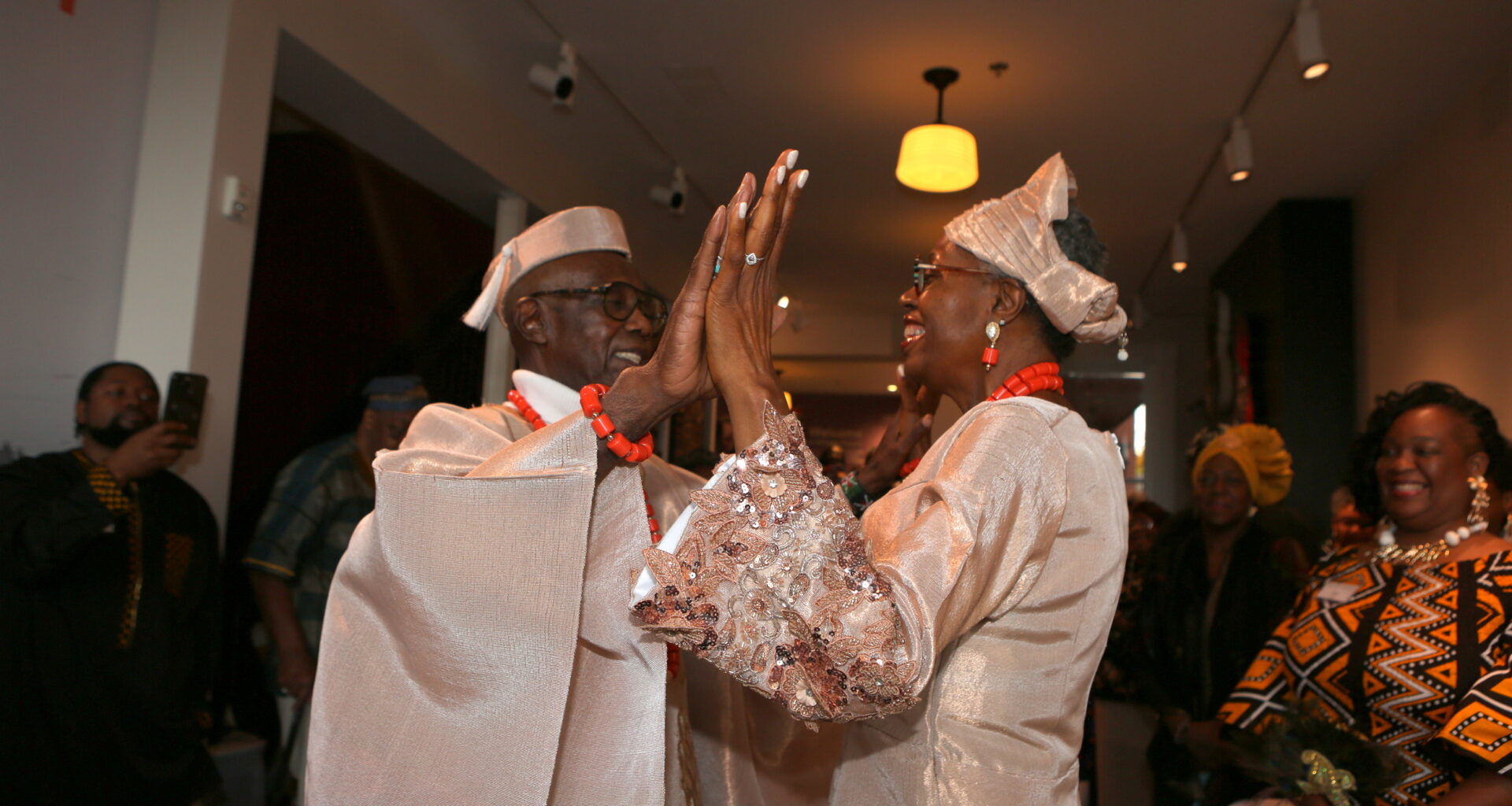
This past fall, Howze added his own milestone to the building’s timeline. He was married inside the August Wilson House, the first wedding ever held there.
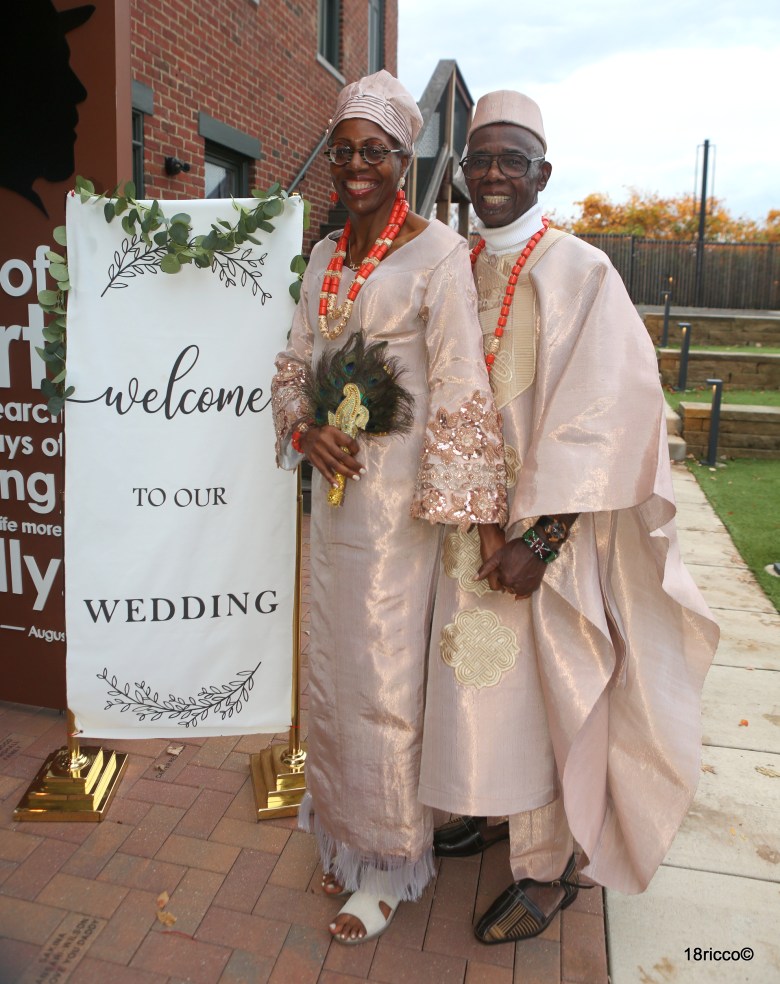 Nov. 8, 2025, Reggie Howze and Shawna Bridgett Howze were married inside the August Wilson House. Wedding photos by Ricco J.L. Martello courtesy of Shawna Bridgett Howze.
‘The Hill never slept‘
Howze was born in 1945 “right in the beating heart” of the Hill District, during what many still call its cultural peak, Pittsburgh’s version of “Little Harlem.”
“At that time, the Hill District was more like Las Vegas,” he says. “Song in the air, laughter on the sidewalks, neon lights in every window. All night long. The Hill never slept.”
Centre Avenue was a jazz corridor. Clubs hosted Duke Ellington, Ella Fitzgerald and Billy Strayhorn. The Crawford Grill pulsed as a major cultural hub. Black-owned businesses flourished, including world-class jazz clubs, clothing shops, doctors’ offices, beauty parlors and restaurants. The neighborhood functioned as a self-contained economy.
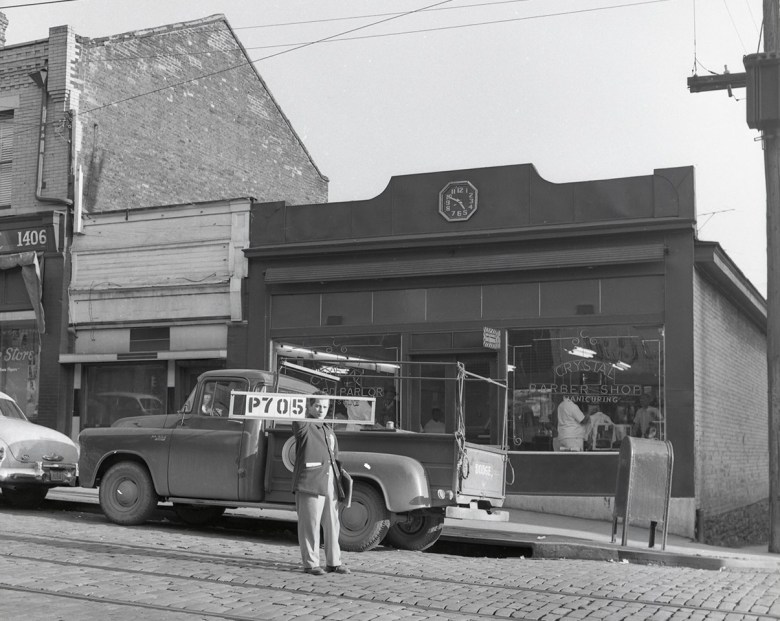 The Crystal Barber Shop at 1400 Wylie Ave. in the Hill District featured a clock that was a neighborhood fixture in the 1940s. URA photograph courtesy City of Pittsburgh Archives.
“If you needed a brand-new shirt, you could go to the shirt store. New tire, new shoes, whatever you needed,” Howze says. “You never had to leave the Hill District for anything.”
He grew up across from the Ringside, a bar owned by a former professional boxer. Up the street, the Musicians Club brought in touring legends.
“The ladies came out of the cabs with stockings on, long gloves, big hats,” he says. “Holiday dressed so beautifully. The men wore suits. Big hats. That’s the way they traveled.”
When he was 4 he discovered he could shimmy down the narrow alley between his house and the one next door.
“The alley was so skinny,” he says. “I could put one foot on my house and one foot on the building next door and slide all the way down to the street.”
Below him, music pulsed through the night.
“It was filled with music all night long,” he says. “And I lived right in the heart of it.”
That ecosystem began to fracture in the mid-1950s, when the city used eminent domain to clear roughly 95 acres of the Lower Hill for construction of the Civic Arena. More than 1,000 buildings were demolished. An estimated 8,000 residents were displaced.
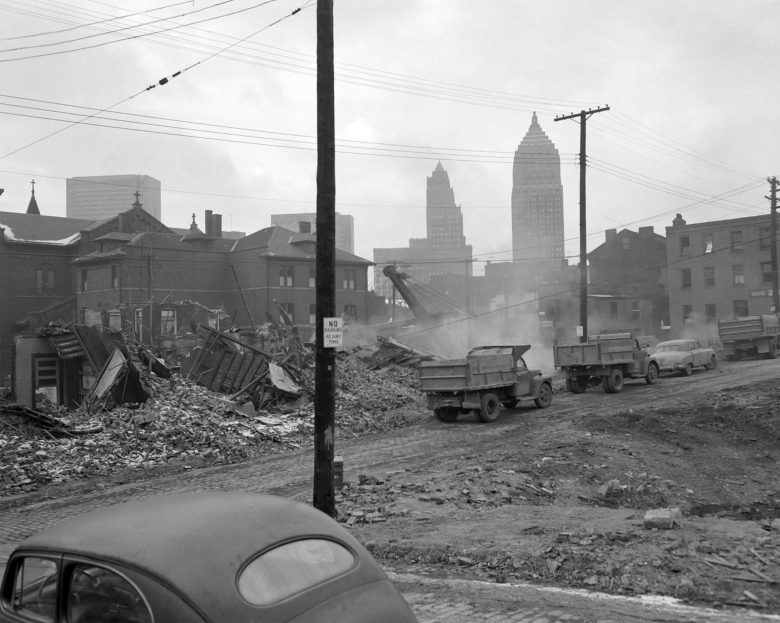 Buildings being demolished in 1957 during urban renewal in the Lower Hill District. Pittsburgh City Photographer Collection via historicpittsburgh.org.
“The city came in and just declared possession of the whole neighborhood,” Howze says. “They tore it all down. Blocks and blocks and blocks.”
The Civic Arena was demolished in 2012. Redevelopment of the site continues. The dense Black commercial spine that once defined Centre Avenue did not return.
“You can’t even buy any decent fresh food in the Hill District now,” he says. “You never had to leave before. You have to go out the Hill District for everything that’s worthwhile.”
Sitting next to history
In elementary school, Howze sat beside Frederick August Kittel Jr. He recalls that their last names placed them alphabetically near one another.
“For five years we sat close to each other,” he says.
Kittel struggled with a severe stutter.
“It took him several minutes to say one sentence,” Howze recalls. “You had to have patience. I was one of the few who stood around long enough to listen.”
In fifth grade, when a classmate stole someone’s lunch, the teacher blamed Kittel.
“Everybody knew he didn’t do it,” Howze says. “The boy who did it had crumbs all over his mouth.”
The teacher pushed him toward the door. His arm was in a sling. Howze remembers him retaliating.
“August was a fierce, fierce, fierce defender of his character. Everybody knew. You don’t bully August.”
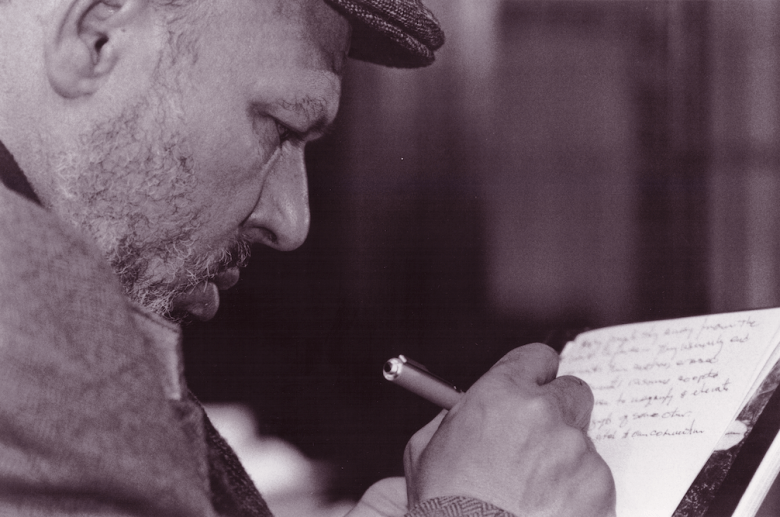 August Wilson. Photo by Joseph Mehling.
The boy would become August Wilson, the playwright whose 10-play Pittsburgh Cycle chronicled Black American life across the 20th century.
Born Frederick August Kittel Jr., he later took his mother’s surname, Wilson. His father, a German immigrant baker, was largely absent. His mother, Daisy Wilson, raised him in the Hill District. The name change reflected both familial loyalty and a conscious embrace of the Black identity that would shape his work.
Howze also remembers the racial complexity Wilson carried as a child.
“He had a white dad and a Black mom,” Howze says. “So he was dealing with a lot.”
Not a museum
Howze left Pittsburgh in 1964 and spent decades moving among cities, Atlanta, Philadelphia and Los Angeles, working in commercial cleaning, film development and other trades.
In 1968, Howze reconnected with Wilson through Black Horizon Theater, co-founded by his older brother Sala Udin, Wilson and writer Rob Penny. They traveled to Hofstra University and to Spirit House in Newark to perform.
“They wouldn’t admit it but they got me because I was the only one with an automobile,” he says. “None of them drove.”
When Howze returned to Pittsburgh in 2023 after decades away, he visited the August Wilson house during renovations and was alarmed.
“They were doing a terrible job,” he says. “Even I could see it.”
He found out who chaired the board and contacted them. He delivered what he calls “a piece of my mind.”
The contractors were replaced. Howze credits Denise Turner, acting chief executive and board president of the August Wilson House, for intervening quickly. Once the restoration was complete, he began showing up daily to tend the exterior. At first he volunteered. After about a year, the organization began paying him.
“I wanted it to look as good as any elite civic institution,” he says.
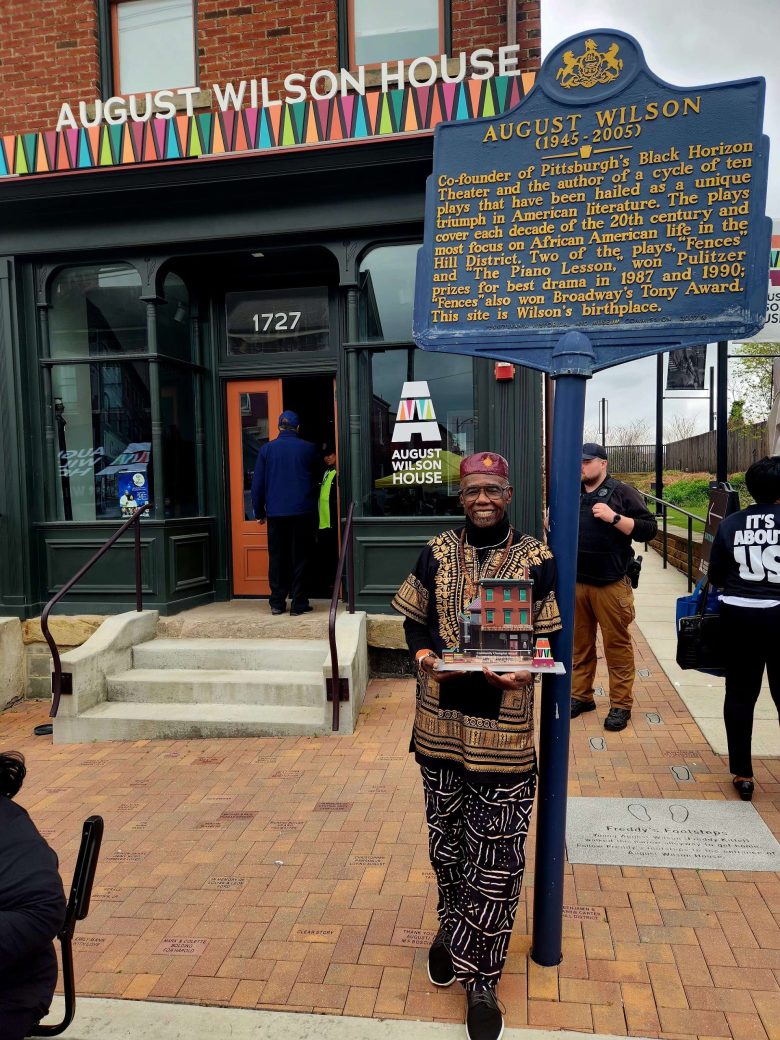 Reggie Howze outside of the August Wilson House. Photo courtesy of Shawna Bridgett Howze.
On Aug. 17, 2022, the City of Pittsburgh proclaimed “Reggie Howze Sr. Day,” recognizing his community commitment and neighborhood beautification efforts.
The house itself is modest, with a narrow staircase, small rooms and quintessential old Pittsburgh brick exterior. Wilson grew up there with five siblings and their mother, with a father “in and out,” Howze says. Two rooms held much of the sleeping. At times, Wilson slept on the kitchen floor. The physical footprint is tight. The artistic imagination it produced was not.
Wilson would go on to win two Pulitzer Prizes. His childhood home was nearly demolished in the early 2000s before preservationists and community leaders intervened. In 2022, it was designated a National Historic Landmark. For the Hill, the designation marked something larger, a reclaimed landmark in a neighborhood that had lost thousands of structures.
The house, Howze says, is trying to follow Wilson’s intention.
“August never wanted his house to be a shrine or a museum,” he says. “He never wanted people to just come and look, and just preserve the place where he lived. He never wanted that.”
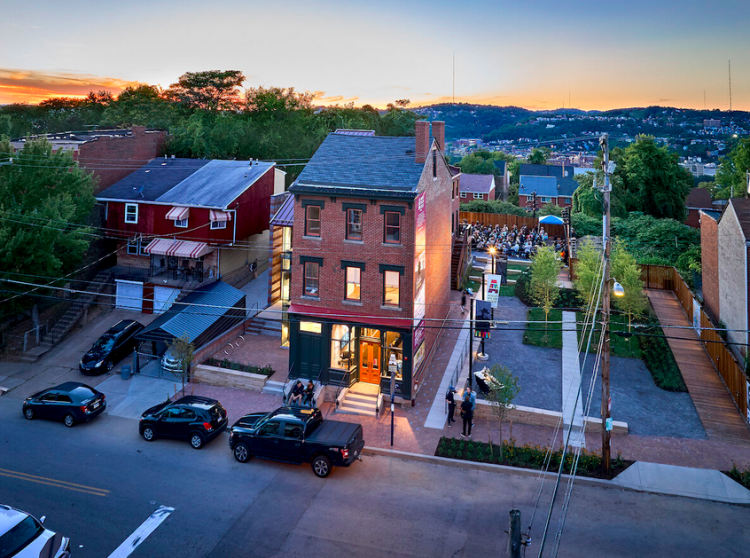 August Wilson House. Photo courtesy of Ed Massery Photography.
Instead, he says, Wilson wanted it “functional.” “Something people could use.”
The organization that operates the house runs playwriting workshops, artist residencies, oral history projects, community events and cultural convenings. The “Voices of History” archive captures lived memory before it disappears.
A wedding in a reclaimed house
When August Wilson died in 2005, he was buried in Pittsburgh, the city that shaped his 10-play American Century Cycle. His funeral was held at Soldiers & Sailors Memorial Hall & Museum in Oakland.
Howze was the first pallbearer. “It was packed,” he says. “It was star-studded. And it was just beautiful.”
In March 2025, Howze attended a plant-based lifestyle meeting at the YMCA. That is where he met Shawna Bridgett, 70, a lifelong Hill District resident and master gardener at Phipps Conservatory and Botanical Gardens. Bridgett holds bachelor’s and master’s degrees from Duquesne University and lives near her children, grandchildren and great-grandchildren.
“I remember that smile,” he says. “If I was a painter, I could paint that scene.”
Three months later, he proposed.
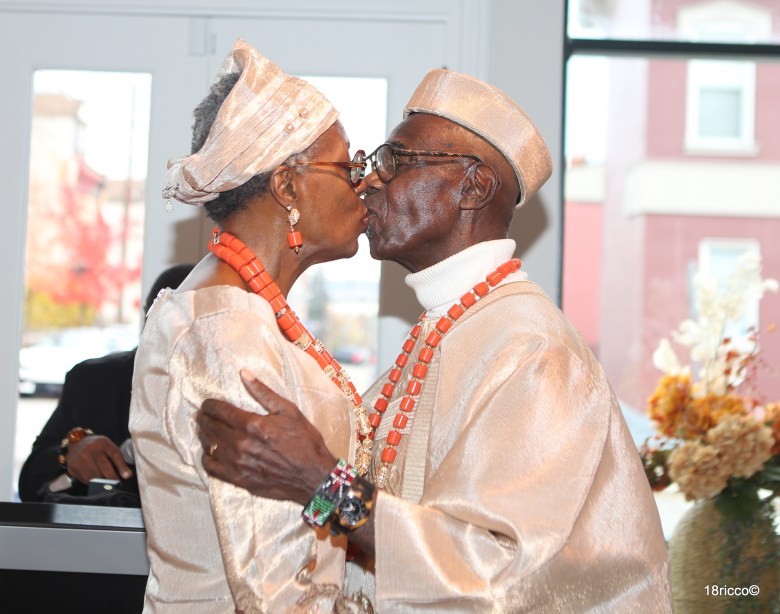 Photo courtesy of Shawna Bridgett Howze.
On Nov. 8, 2025, Reggie Howze and Shawna Bridgett Howze were married inside the August Wilson House.
For a few hours, the restored landmark returned to what it once was, a lived domestic space.
Howze believes Wilson’s spirit was present, “I told them he would show up, and he did,” he says.
Outside, the “Hill is layered, it is a confluence of old and new,” Howze says. Preserved brick stands beside new construction. Debates about equity and belonging remain unresolved.
Howze says he considers himself more than a steward of brick and mortar.
“I’m also a keeper and recorder of memories,” he says. “If I close my eyes, I can feel the Hill District come alive again.”
Today, Howze power walks competitively at the YMCA. He tends the brick and steps on Bedford Avenue. He works on a book he hopes to write, titled “How to Live to 100 Years: No Medications, No Disease and No Pain.”
“At this stage in life, I don’t do anything that doesn’t have fun connected with it,” he says. “It’s got to bring me joy. Or I’m not going to do it.”