
Rutgers University–Camden honored Dr. Martin Luther King, Jr.’s enduring legacy last month with the fifth annual “Beyond the Dream” lecture, welcoming two eminent King scholars to discuss how King’s early life and his time in South Jersey as a divinity student laid the foundation for his civil rights leadership.
On January 21, the university welcomed the Rev. Dr. Mark Kelly Tyler, who currently serves as the historiographer, executive director of research and scholarship, and one of nine general officers of the global African Methodist Episcopal Church. Tyler is also a documentary filmmaker and has produced or participated in several projects on religion and culture, including providing commentary for the award-winning PBS documentary, “The African Americans: Many Rivers to Cross.”
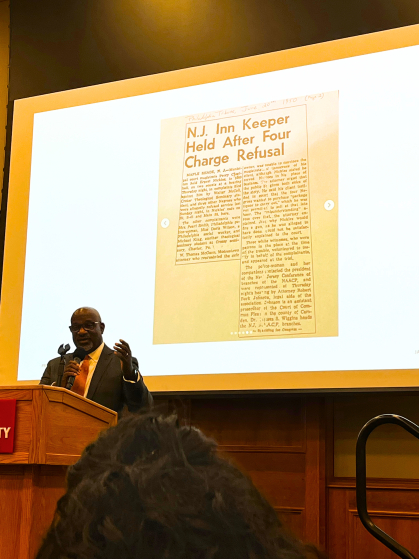
The Rev. Dr. Mark Kelly Tyler
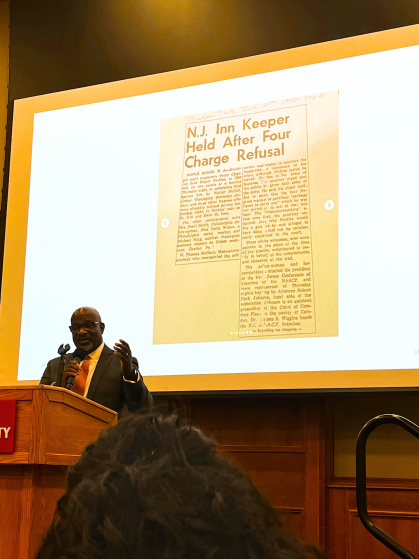
“As a civil rights leader, King offered a different vision for what the world could be,” Tyler said. “That vision – in search of the ‘Beloved Community’ – was shaped in part during his time in the classrooms of Crozier Theological Seminary in Pennsylvania and by his experiences here in South Jersey.”
Tyler shared a story from June 1950, when King and several friends stopped at a small pub in Maple Shade for a bite to eat after attending a church service in Merchantville. When the group was refused service by the owner, they decided to remain seated in protest. Tyler noted that this moment is considered one of the first examples of King employing the tactics of nonviolent civil disobedience.
After the owner threatened the group with a gun, they left. King later filed a police report under a new state law prohibiting the refusal of service based on race. This was one of the first cases filed under the law, and the experience had a meaningful impact on King’s beliefs and his vision for a better world.
“That experience, coupled with the time King spent in this area in 1950, was literally the turning point for King,” Tyler said. “Who he became, the movement he led – it was all influenced by experiences that happened right here.”
On January 29, the university welcomed Dr. Lerone A. Martin, director of the Martin Luther King, Jr. Research and Education Institute at Stanford University, where he is also the Martin Luther King, Jr. centennial professor and a professor of religious studies, African, and African American studies. An award-winning author, Martin’s latest book, “Young King: The Making of Martin Luther King, Jr.,” chronicles King’s often-overlooked childhood and adolescence and how that period shaped his life and work. The book will be published by HarperCollins in May 2026.
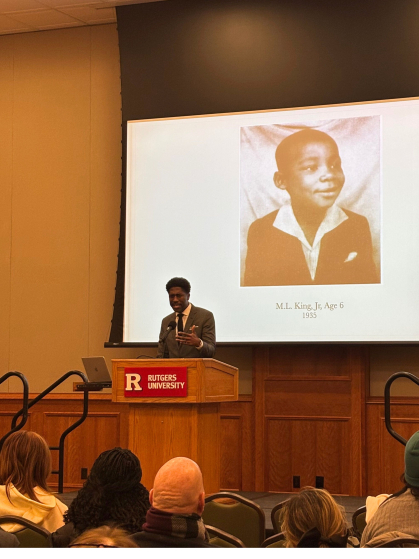
Dr. Lerone A. Martin
Martin shared a story from King’s earliest years, when he would spend his afternoons playing with two white brothers who lived in his neighborhood. When the time came for kindergarten, the boys attended a different school from King. When King later went to their home to see if they could play, their mother sent him away, using a racial slur.
What King’s own mother shared with him at that moment began to lay the foundation for his perspective on life.
“His mother had what we now call ‘the talk’ with him – it is something that Black parents all do, even today,”Martin said. “But she made sure to tell King that while the world around him told him he was not as good as everyone else, he must always remember he was made in the image of God, and he must never forget that he is somebody.”
Martin went on to detail key moments from King’s life, from the death of his beloved grandmother, to being admitted to Morehouse College at 15 years old with the intention of becoming a lawyer and eventually working to change the laws and societal structures he saw as racist and unfair, to his work on a farm in Connecticut to earn money for college.
It was on that farm in the North, where he experienced life beyond the rigid racist structures of the Jim Crow South, that King began to consider theology rather than law. For Martin, these early formative experiences are essential to understanding who King became.
“So much of what we know about King and the ‘Dream’ comes from somewhere, and that’s why understanding every part of his life is essential,” Martin said. “Every superhero has a backstory, and you only really come to understand them when you study that backstory.”