
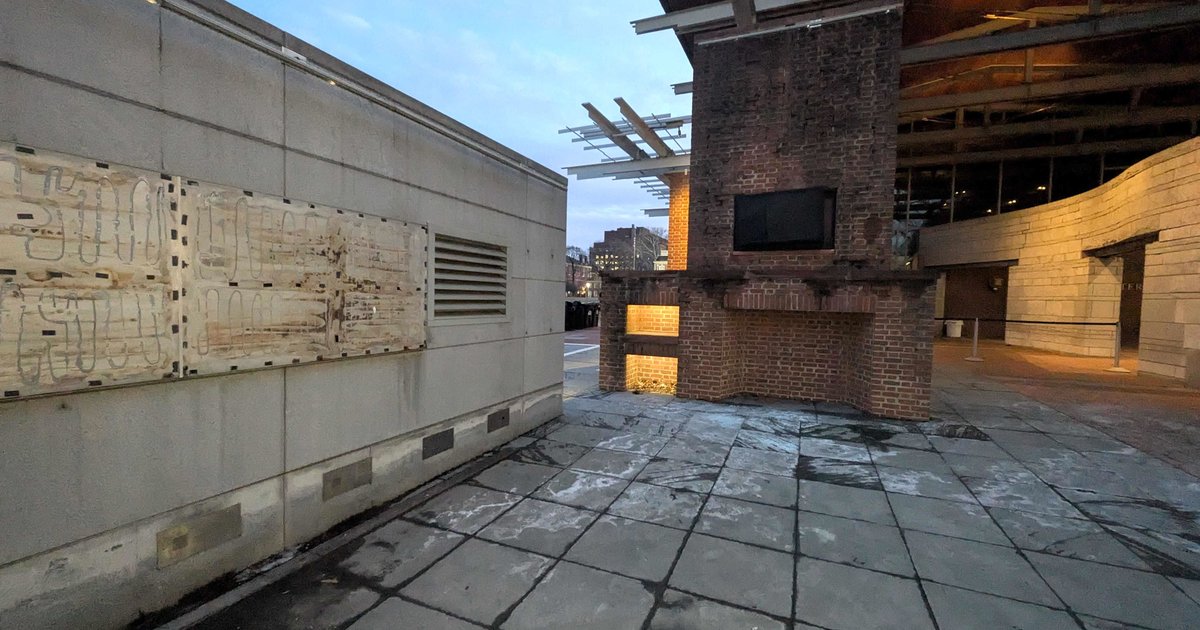
The President’s House on Independence Mall must be restored to include the slavery exhibit that the Trump administration abruptly removed last month, a federal judge ruled Monday.
All portions of the exhibit, including panels and artwork, must be returned and rehung at the site at Sixth and Market streets, U.S. District Judge Cynthia Rufe ordered. The federal government may not make any changes to the display or hang replacement exhibits without the approval of the city, and it must must maintain upkeep of the display.
The displays acknowledge the country’s history with slavery and the enslaved people President George Washington brought with him to Philadelphia during his presidency. Rufe described the action to remove the exhibit as Orwellian.
“As if the Ministry of Truth in George Orwell’s 1984 now existed, with its motto “Ignorance is Strength,” this Court is now asked to determine whether the federal government has the power it claims – to dissemble and disassemble historical truths when it has some domain over historical facts,” Rufe writes. “It does not.”
Later in the 40-page opinion, she calls the actions by the defendants in the case, including U.S. Secretary of the Interior Doug Burgum and acting National Park Service Director Jessica Bowron, a “jarring alteration to the integrity of the site.”
The city of Philadelphia filed a lawsuit challenging the removal of the exhibit on Jan. 22, the same day the federal parks workers pried the displays from the walls of the President’s House. Others joining the lawsuit, seeking an injunction to stop the federal government’s actions, were Gov. Josh Shapiro and the Avenging The Ancestors Coalition, the group founded by attorneys Michael Coard and Michelle Flamer that was instrumental in the creation of the slaver exhibit.
Coard said Monday that other groups fighting to preserve parts of history the Trump administration is trying erase should take note of the ruling.
“(This order) tells us that sites like the President’s House slavery memorial must remain, and sites around the country that are similar can remain,” said Michael Coard, a criminal defense attorney who led the efforts to create the President’s House exhibit. “So it emboldens everybody to fight back and win. It’s a clarion call that if you yell loud enough and persistently enough for justice, you’ll get it.”
City officials did not immediately comment on the ruling but are expected to later Monday.
The President’s House exhibit tells the story of nine people who were enslaved by George Washington at his home in Philadelphia during his tenure as the first president of the United States. They were taken down on Jan. 22 – eight months after Interior Secretary Doug Burgum called for a review of displays that “disparage Americans past or living.” All that remained was a monument with the names of those nine people.
The exhibit opened at Independence National Historical Park in 2010 as a joint endeavor between city officials, the federal government and the Avenging the Ancestors Coalition, an activist group that had advocated for the exhibit.
After the exhibit was removed, the city filed a federal lawsuit demanding its return, claiming federal officials could not remove or alter the President’s House without the city’s consent. As Rufe crafted her ruling, the panels were stored at a facility near the National Constitution Center.
At a court hearing on Jan. 30, Rufe said that no more changes could be made to the exhibit until she issued her final order. City officials said that NPS had planned to take down more at the site before Rufe directed that things must remain as is.
During the hearing, lawyers for the city argued pointed to several agreements, including National Underground Railroad Network to Freedom Act, the agreement and subsequent amendments to create the exhibits and the 1948 agreement that established the 54 acres of Independence National Historical Park, which includes the land underneath the President’s House. Per those documents, NPS could not remove or change the exhibits without consulting Philadelphia officials, as they said it was a collaborative effort.
In response, Assistant U.S. Attorney Gregory in den Berken said that following the project’s completion in 2015, ownership was transferred to NPS. He also said the 2006 agreement, which said city’s approval was required for changes, had expired.
Following this ruling, Coard expects that the federal government will appeal the decision to the Third Circuit and seek a stay to suspend Monday’s order. Still, he thinks that the ruling sends a message to current and future federal officials that exhibits such as the President’s House and others slated for removal can’t be erased.
“Some people said this is a victory for Black History. No, it’s not, this is a victory for American history,” Coard said. “It was a dangerous precedent, and the judge put a screeching halt to it.”
This is a developing story. Check back for updates. PhillyVoice staff Jon Tuleya and Molly McVety contributed to this article.