
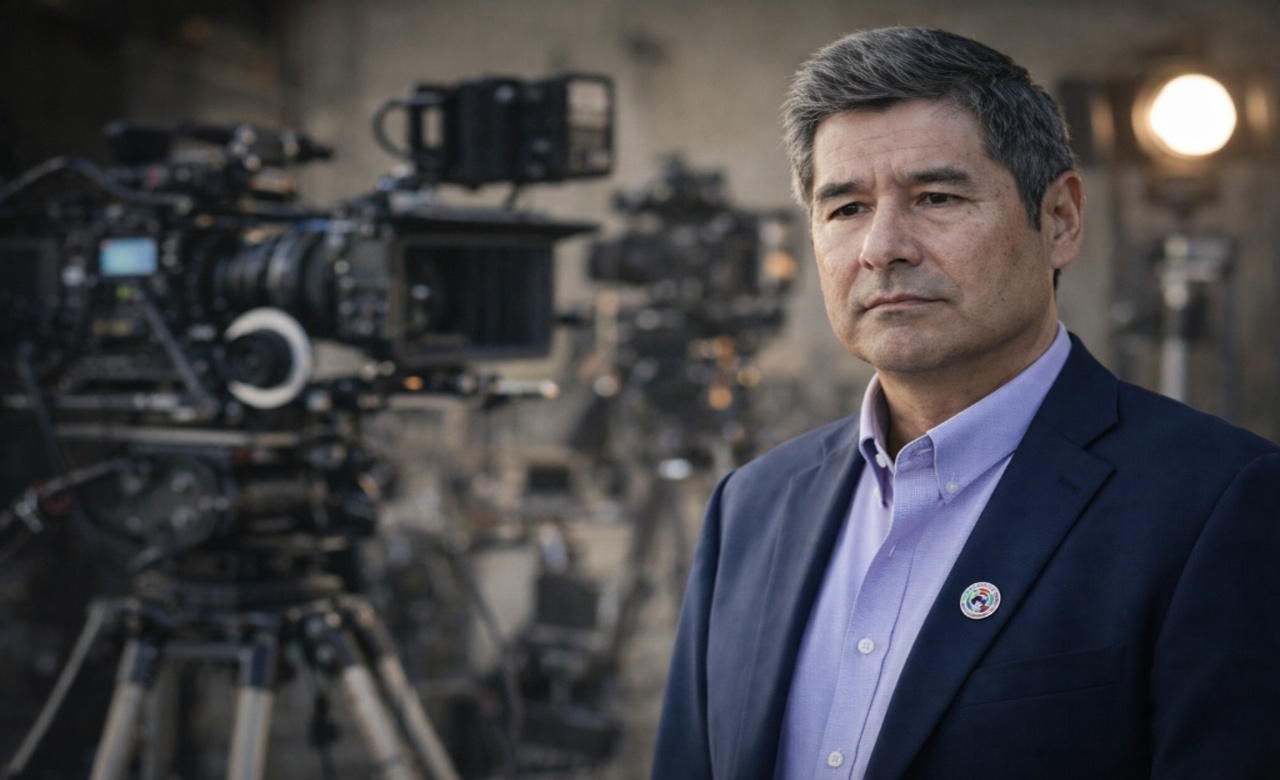
At a time when more than 122 million people worldwide have been forcibly displaced, according to the latest UNHCR report, the distance between a statistic and a face can be vast. For Fernando Ramírez, a nonprofit executive director and filmmaker based in Philadelphia, that distance is precisely where his work begins.
“I don’t consider myself a filmmaker. I’m a storyteller on a mission to share my journey and the voices of people in need,” he says.
Ramírez did not arrive at that mission by accident. He was born in Bogotá, in the El Galán neighborhood of Colombia. He remembers a childhood marked by daily soccer games with school friends, family gatherings filled with music and dancing, and a deep sense of belonging that is only fully understood when you are far from home.
When he immigrated to the United States as a child, the adjustment was complicated. “Hard. Very hard,” he recalls. They arrived in a town where they were the first Latino family. Acceptance did not come easily. There was racism, discrimination, and the pressure to learn English quickly in order to defend himself. “Kids can be cruel,” he says. The image that still stays with him is from July 1968, when he watched his father get dressed to leave alone for the United States, promising him that everything would be okay.
That uprooting shaped his perspective.
After graduating from college, he began working in insurance, but corporate routine did not fulfill him. He became an entrepreneur and devoted much of his career to developing small businesses focused on energy and water. Yet something deeper pushed him forward: the need to tell stories.
He collaborated with the United Nations, and there he grasped the magnitude of the global crisis Somalia, Afghanistan, Congo, Syria, Venezuela, Ukraine. “The numbers keep rising, and each individual has a voice that goes beyond statistics,” he says.
From that conviction came the short documentary Beyond the Statistics, premiered at Temple University in February 2024. The film tells the story of displaced Ukrainian families who arrived in Philadelphia after the Russian invasion, and the community network that mobilized to support them.
But behind the camera, Ramírez saw himself reflected. “I saw my parents, my sister, and my brother as we struggled with the language barrier, uncertainty, and the feeling of being out of place in a foreign land.” One scene in particular broke him: a 16-year-old boy speaking about the father he had left behind in Ukraine. “I remembered that July morning in 1968,” he confesses.
His organization has a dual mission: to support displaced and immigrant communities and to educate future generations about global challenges. “We seek to cultivate empathy and compassion,” he explains. His target audience includes young people, students, and citizens who are still shaping their global awareness.
Ramírez also acknowledges an unfinished commitment to Colombia. He grew up defending his country against stigmas associated with drug trafficking and violence. “The pride of being Colombian brings tears to my eyes,” he says. He dreams of filming a movie titled Pride!, inspired by the collective emotion he felt watching Colombia’s women’s national soccer team sing the national anthem at the last World Cup.
When asked whether the American Dream exists, he does not hesitate: “Yes, it does. However, it’s imperative to understand that achieving that dream involves a great deal of suffering.” He witnessed his parents’ stress, the hard jobs, the silent sacrifice. “Son, we came here to work and to suffer,” his father would repeat.
Today, after hearing so many stories of loss, he quietly asks himself, “Are we doing enough?”
For Fernando Ramírez, the answer is not found in numbers or headlines, but in the ability to look at another human being and recognize something of yourself. In a world that labels immigrants as villains or victims, he insists on showing what they truly are: people. And in that gesture deeply political and deeply human lies his true mission.