
When the United States was still young- a traveler traipsing through northwest Pennsylvania might have got an on-the-nose reminder they were in a fledgling nation.
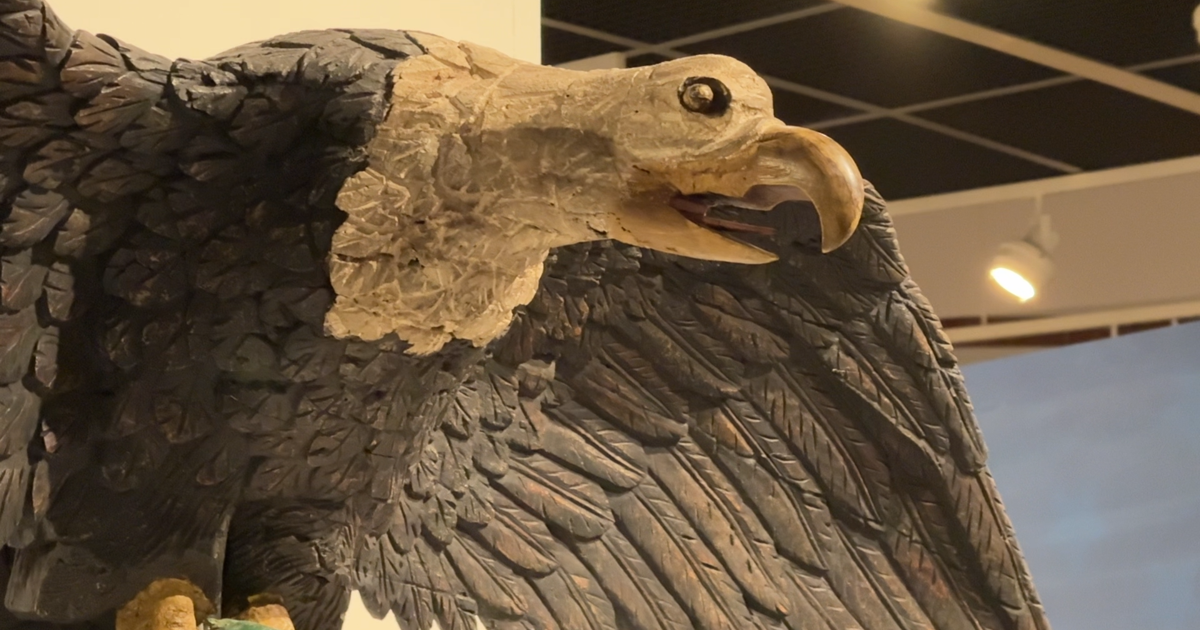
“We have a carved eagle. It dates to the early 1800s, and it was documented to have stood at the entrance to the Eagle Hotel in Waterford, Erie County,” said Dr. Curt Miner, the senior history curator of the State Museum of Pennsylvania.
This 200 year old carving is one of many relics at the Revolutionary Things exhibit in the state museum. Miner says the eagle is a tangible reminder of how the commonwealth can take some credit for picking the national mascot.
“A fellow named William Barton, who was a Pennsylvanian, was elected to serve on a design committee for the Great Seal of the United States,” Miner said. “They were pitching around for ideas. And Barton, who is an expert in heraldry said, ‘I have an idea. Let’s put an eagle on there’.”
The founding fathers liked it- but specified it should be the bald eagle, a uniquely North American species.
The state museum display also corrects a myth about Benjamin Franklin wanting the turkey as the national bird.
“Turns out there’s really no evidence that he said, ‘I want the turkey.’ However, he was disparaging of the bald eagle, which he thought was a bird of bad moral character,” Miner said. “Nonetheless, the eagle prevailed.”
The seal was set, and unofficially, a mascot was born. It was first used in 1782.
“After that, the eagle starts showing up on all sorts of official documentation and common, everyday items,” Miner said.
The bird of prey showed up in everything from hotel décor to clay pots- to presidential seals.
According to the White House Historical Association, the office of president was never legally assigned a seal. So, executives would use personalized seals often inspired by the great seal– the eagle often remained front and center.
President Millard Fillmore drew his own presidential seal design in 1850. Abraham Lincoln also had an individualized seal.
Rutherford B Hayes wanted the eagles head to face left, to the talon holding the arrows. Decades later, designers in Franklin D. Roosevelt’s term turned the eagle head back to the olive branch of peace.
Woodrow Wilson commissioned an official president’s flag by executive order- because the Navy and Army had both designed their own and were subsequently feuding over it.
The carved, wooden eagle will be on display until August of this year at the State Museum of Pennsylvania.