
By Brenda Hillegas
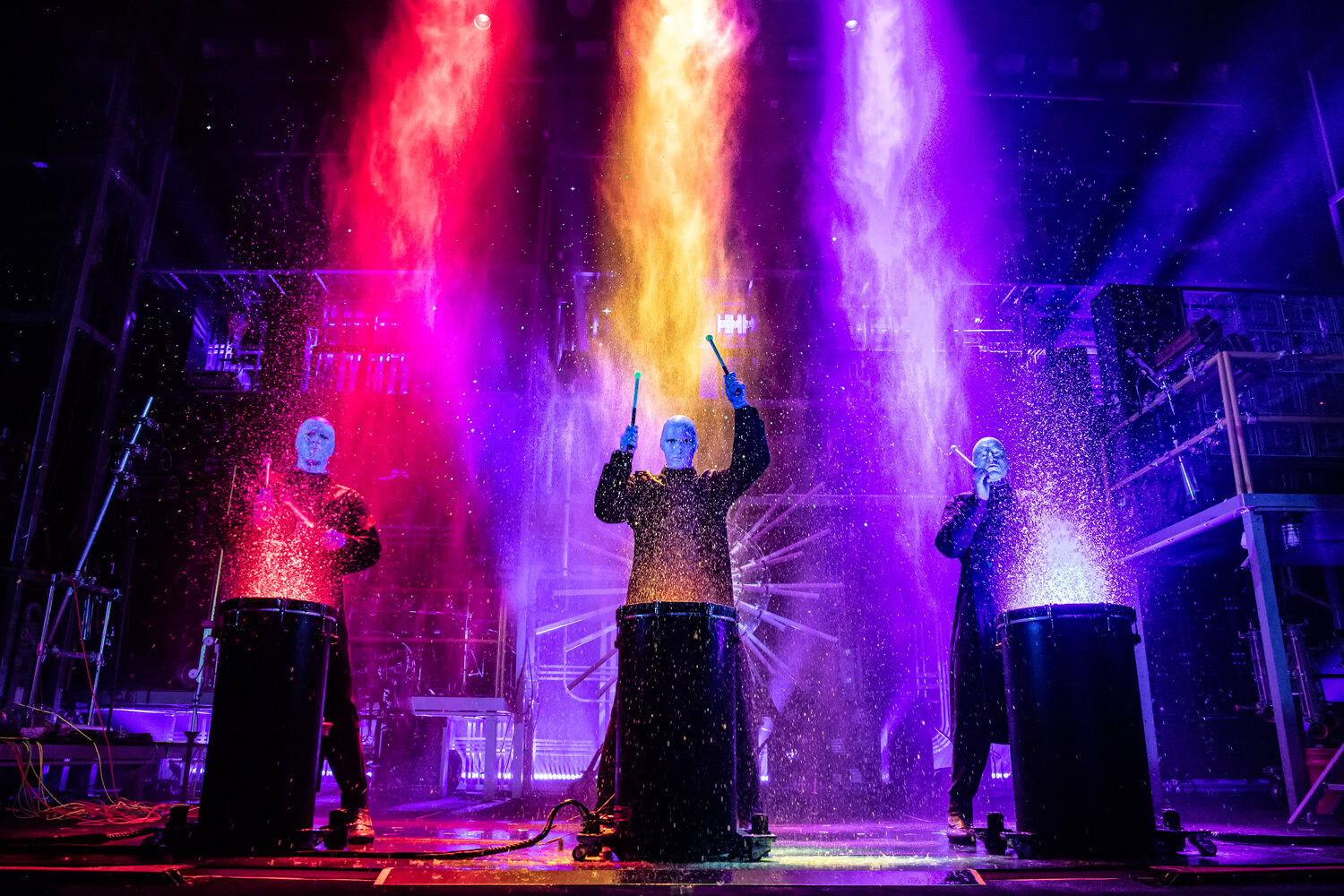
For decades, Blue Man Group has captivated audiences around the globe — without uttering a single word. Now, the iconic trio is heading back to Philadelphia on a new North American tour, debuting a major addition to the lineup: the group’s first-ever female DJ and drummer, known as “The Rockstar.”
Blending fresh material with the fan-favorite moments that made them famous is a delicate balancing act. Artistic Director Matt Ramsey, a longtime Blue Man performer himself, knows firsthand how to evolve the show while preserving its signature spirit.
Ramsey recently spoke with Metro about the creative process behind the tour, the inspiration for “The Rockstar,” and why Blue Man Group’s wordless storytelling continues to strike a chord with audiences everywhere.
Blue Man Group has connected with audiences for decades without relying on words. Why do you think the show’s mix of rhythm, comedy, and non-verbal storytelling feels especially powerful right now?
Why it works now, as well as why it worked in the early days, is because of those unique elements you just mentioned, but primarily non-verbal. It allows us to be communicators and storytellers without being hindered by language or by preconceived notions about how we talk. Speech in general is a wonderful method of communication, but it also has some hindrances. This eliminates all those boundaries.
The Blue Man character does not belong to this culture. So we are others. Because of that, and the fact that it’s a non-verbal character, [the show] allows for very funny situations and circumstances. The audience can see themselves in the character, regardless of what language they speak, where they’re from, what culture they identify with, or any other identifiers that we, as human beings, automatically gravitate towards. Anyone can see themselves in our performance, which is really wonderful.
In addition to that, there is the music. Every culture has rhythmic, percussive versions of early music. There’s a lot of drumming and really wonderful music that is unique to us, played on instruments that we’ve invented. It’s raw and organic, and universal in a way that nothing else is out there right now.
We can take this show anywhere — any country, any culture, any part of the United States, any part of the world. Human beings will identify with what they see on stage and that’s the point.
This tour introduces the “Rockstar,” the group’s first-ever female DJ and drummer. Can you talk a bit about what inspired this character and the timing of her debut?
We have worked for a long time, ever since the early days, of finding ways for every type of human being to audition and perform the Blue Man character. Blue Man was created to represent human — it was never gender-specific.
So because of that, we have worked to bring in female-presenting performers to play the role, and we’ve succeeded. We’re actually on a current initiative to do just that. But it is a challenge. One of the ways that we have found to round out this challenge is to create [the Rockstar] and cast a female-presenting performer. That has its own challenges because we have a very difficult show to perform. The drumming, the music, what the Rockstar has to do to sort of curate the sound of the entire show and keep the show moving forward is incredibly difficult.
Casting for our show is never an easy task, but that was an answer to one of the challenges that we’ve been struggling with for a long time — bringing in this female character that aligns with, cooperates with, and collaborates with the Blue Man character, and the audience.
When introducing new material, how do you decide what can evolve while keeping the spirit of Blue Man Group intact, and did your time on stage help inform those choices?
There’s a current push to create a lot of new material for the new Orlando show that’s opening. Thankfully, I performed the role for a long time so when I’m trying to come up with new ideas or new content for the show, I put myself in their shoes. I know exactly what it’s like to sit on the stage, to stand behind the instrument, to understand how the communication between the three characters exists and the audience. The creation of new material is always, for me personally, through that performative lens. How will this land? If I were handed this material, how would I perform it? Is that the best way to tell this story? It takes a long time [to create material] and it’s an iterative process.
We have parts of our show that have been fan favorites for decades. We’ve found through audience polls in the past that there are certain things they expect when they come to a Blue Man show. Diverting from that has never been successful for us, so there are some considerations that we have to keep in mind when we’re creating new stuff. We can’t reinvent the wheel, but a real part of why our show is successful is because of its cultural relevance and how the show represents pop culture — things like screens, and how technology separates us, rather than brings us together, or does it? Elements of scientific exploration- these are themes that are woven into the DNA of how the show has always evolved, but there are new ways to communicate those things depending on what decade you’re in, what is being explored scientifically, what new technology emerges. The way the show can evolve is by still staying true to our pursuit of exploring these themes, but by doing it in a way that feels more contemporary. It’s not easy.
We throw gumballs and marshmallows. We catch things in our mouths and we play on tubes. It’s funny and those elements are expected, so we need to honor that. You don’t go to your favorite band and only want to hear music from the latest albums. You want to hear the hits. You want the things that you connected with when you were 15-years-old or four-years-old with your parents, or 25-years-old and saw it for the first time. Thankfully, we are able to present new material, see how it plays, iterate on it, refine it, and continue to grow.
Do you have a favorite “hit”?
I have several! The audience participation pieces were always my favorite because they’re so unpredictable. We would bring audience members on stage with us and sit with them. You have some ground rules and some structure to the piece, but when you bring up an unpredictable element, like an audience member, or two audience members, simultaneously, anything can happen. I’ve experienced audience members screaming and running out of the theater.
I also love playing music. I started as a drummer and some of the music is just so fun to play with an amazing rock star musician or an amazing band. Those are my favorites. It’s a really fun show to perform.
I read an old interview with you where you mentioned that the people who are more successful in getting a job with Blue Man Group are the ones who have never seen the show before. Why is that?
My impression from experiencing this many times over the years, and training performers in this character, is that when someone says, ‘Oh, I love this show, I’ve seen it so many times.’ They come in and they’re doing an impression.
What’s vital about a successful way to learn this role is to drop all of your performative habits and just be able to be exposed and vulnerable on stage in front of an audience. You want to be open, you want to connect and make eye contact, and be still and not fidget. Then add the element of a live audience that’s talking and doing weird things. Add the element of two other people that you have to communicate with. We use this term “flock”. It’s like a flock of birds where no one is leading, but everyone is following. Maybe you’re leading, and so you learn to connect and listen and communicate physically in a way that we’re not used to as human beings. It takes a process of breaking down and breaking away all of our habits before successfully learning how to embody this role.
People who have grown up watching the show and who’ve seen it come in [to audition] thinking they know how to do it, but it’s all an impression. There’s no internal connection to what the environment is demanding of them. That’s my experience with it. There are, of course, exceptions, but in general, that tends to be true.
Is there anything you want first-time audience members to know before coming to see the show in Philly?
As little as possible. Just show up and get ready to be surprised. I would always love it when people would say, ‘Oh, Blue Man Group, yeah I hear it’s funny,’ then they show up and say, ‘Whoa, I did not expect that!’ I’ve been doing this for almost 26 years, and it’s still hard to describe. There isn’t a plot. It really is just an experience of watching and participating, collaborating with these characters, and learning and building something in real time with the audience. It’s a journey— a hilarious, overwhelming, positive, experiential journey.
Blue Man Group will be at Miller Theater, presented by Ensemble Arts Philly, from Feb. 25 through March 1. Tickets are available at ensembleartsphilly.org.