
One of Henri Rousseau’s works is among the most widely known paintings in Western art (as in European and American, not “cowboys and Indians”). Filed in many minds with “The Mona Lisa,” “The Birth of Venus,” “The Creation of Adam,” “The Blue Boy,” “Starry Night,” “Guernica,” “American Gothic,” “Christina’s World” and a few others is “The Sleeping Gypsy,” first exhibited in 1897.
In the desert under a full moon, lying near a river beside a mandolin and a tall water jar, a barefoot figure with dark gray skin in a cloak of many colors grips a walking stick and dreams, smiling, unaware that a male lion with long, raised tail is inches away.
Normally at New York’s Museum of Modern Art, through this Sunday, Feb. 22, “La Bohémienne endormie” (its original title, which skirts the offensive term “gypsy” and clarifies that the figure is female) is on view in “Henri Rousseau: A Painter’s Secrets” at the Barnes Foundation in Philadelphia.
Assembling more than 50 works, the exhibition is a rare opportunity to take the full measure of the hard-to-classify Rousseau, a “naïve” (“naif,” in French) painter doted on by the Parisian avant-garde.
Nicknamed “Le Douanier” — meaning the customs officer, though he worked for the city’s toll service — Rousseau created art that, mostly unappreciated in his lifetime, helped point the way to modernism.
Perhaps he belongs with the Post-Impressionists. Like van Gogh, Rousseau painted in a comparatively awkward, semi-realistic style. And like Gauguin, he made a specialty of exotic settings. Gauguin, however, really lived in such places.
The closest that Rousseau came to a jungle was Paris’s Jardin des Plantes, the adjacent zoo, the Universal Expositions of 1889 and 1900 and illustrations in books and magazines.
Eight Rousseau jungle scenes, including a smaller painting of a worried-looking Eve receiving an orange from a pink serpent, occupy the fifth of the exhibition’s six galleries, titled “Playing to the Crowd” to suggest that the painter was giving the public what it wanted.
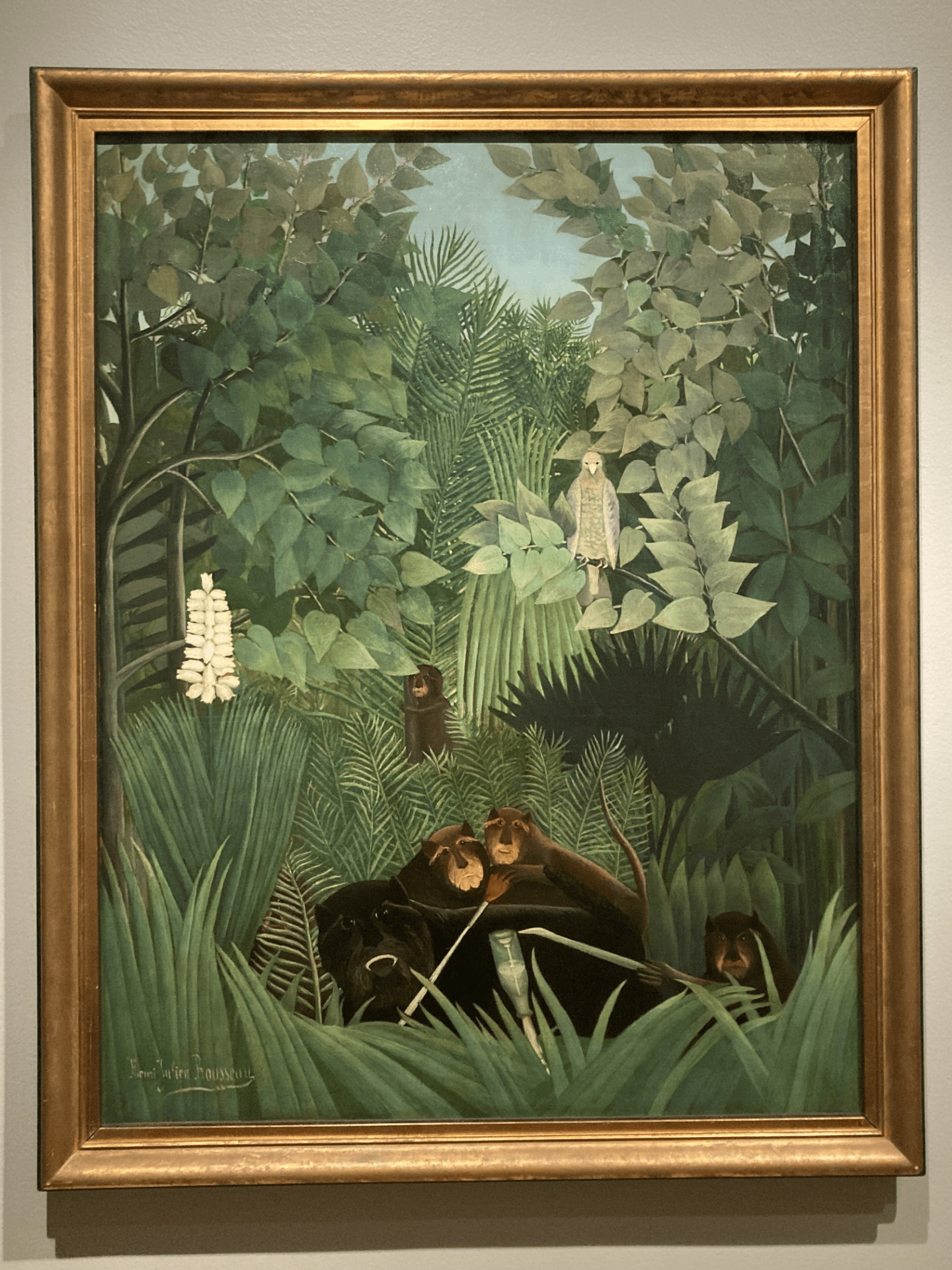
The three standouts: “The Merry Jesters,” featuring six bearded (De Brazza’s?) monkeys, one well hidden, a parrot and, inexplicably, an overturned milk bottle and a white stick with a red hand; the thrilling “Fight between a Tiger and a Buffalo”; and “Tropical Forest with Monkeys,” depicting five (tamarin?) monkeys and a hard-to-spot snake. In the latter, two orange monkeys on their way to the foreground give a sense of perspective generally missing from Rousseau’s work.
The exhibition ends with “An Enigma,” a gallery with lavender walls and a long wooden bench for contemplating “La Bohémienne endormie” and two other large, even more bizarre works: the Barnes-owned “Unpleasant Surprise,” in which a hunter fires a rifle at the comically fierce bear that has alarmed a longhaired, full-frontal nude, who has removed her clothes to bathe in a lake; and, with serpents and a flutist in silhouette (and a roseate spoonbill), “The Snake Charmer,” from the Musée d’Orsay.
Seeing these major paintings together is wonderful, but exploring the earlier phases of Rousseau’s production is equally rewarding.
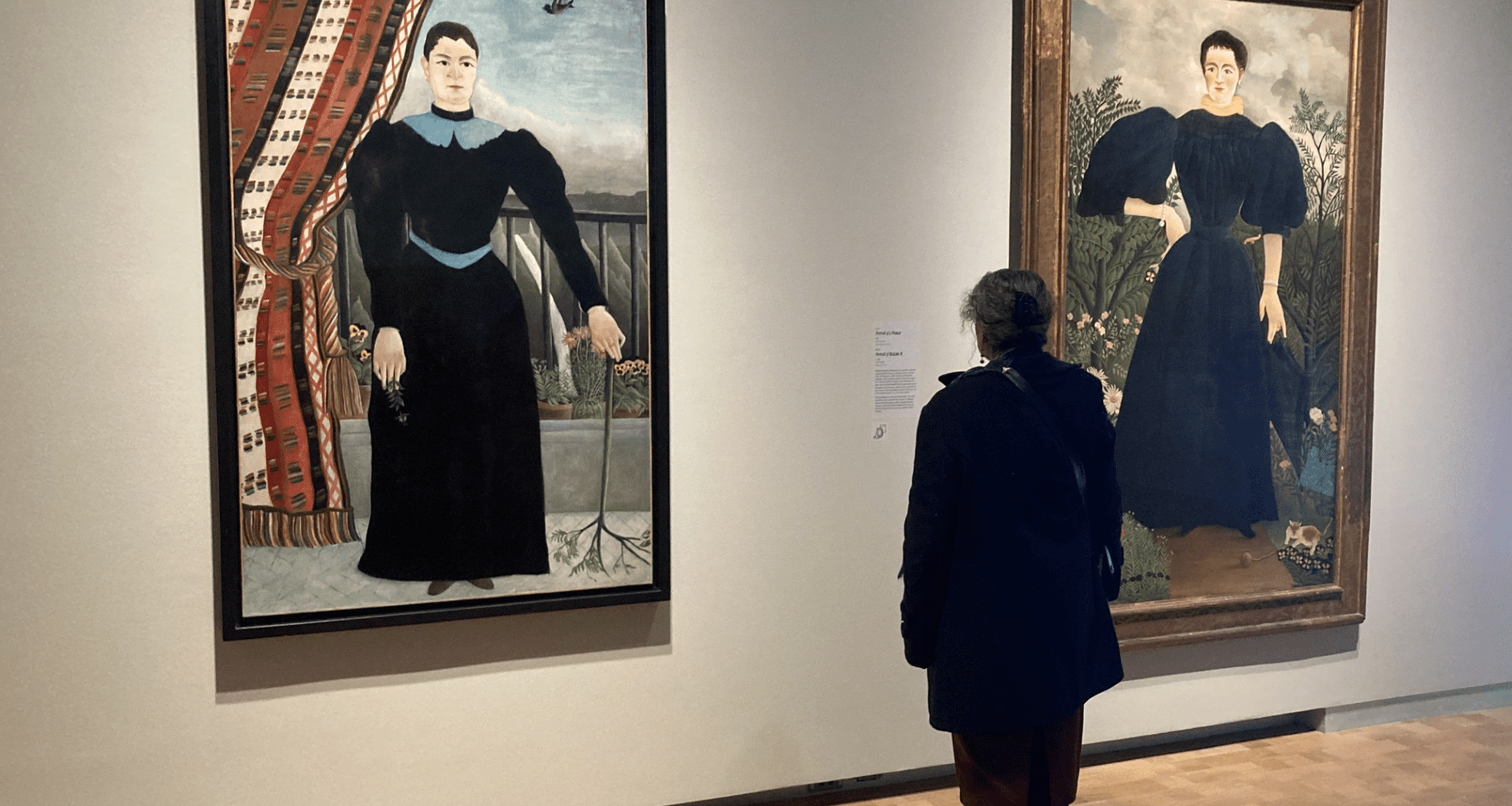
A wall in the third gallery, “Capturing Community,” displays two full-length portraits, “Portrait of a Woman” and “Portrait of Madame M.” — thought to be Rousseau’s Polish lover — and the smaller “Child with Doll.” The three bring to mind portraits by untrained, itinerant American artists of the late 18th and early 19th century, such as Winthrop Chandler and Ammi Phillips. The perspective is shallow, the proportions are inconsistent and there is a compulsive quality to the detail (the foliage in “Portrait of Madame M.,” for example, would later transform, in “Where the Wild Things Are” fashion, into Rousseau’s dense jungles).
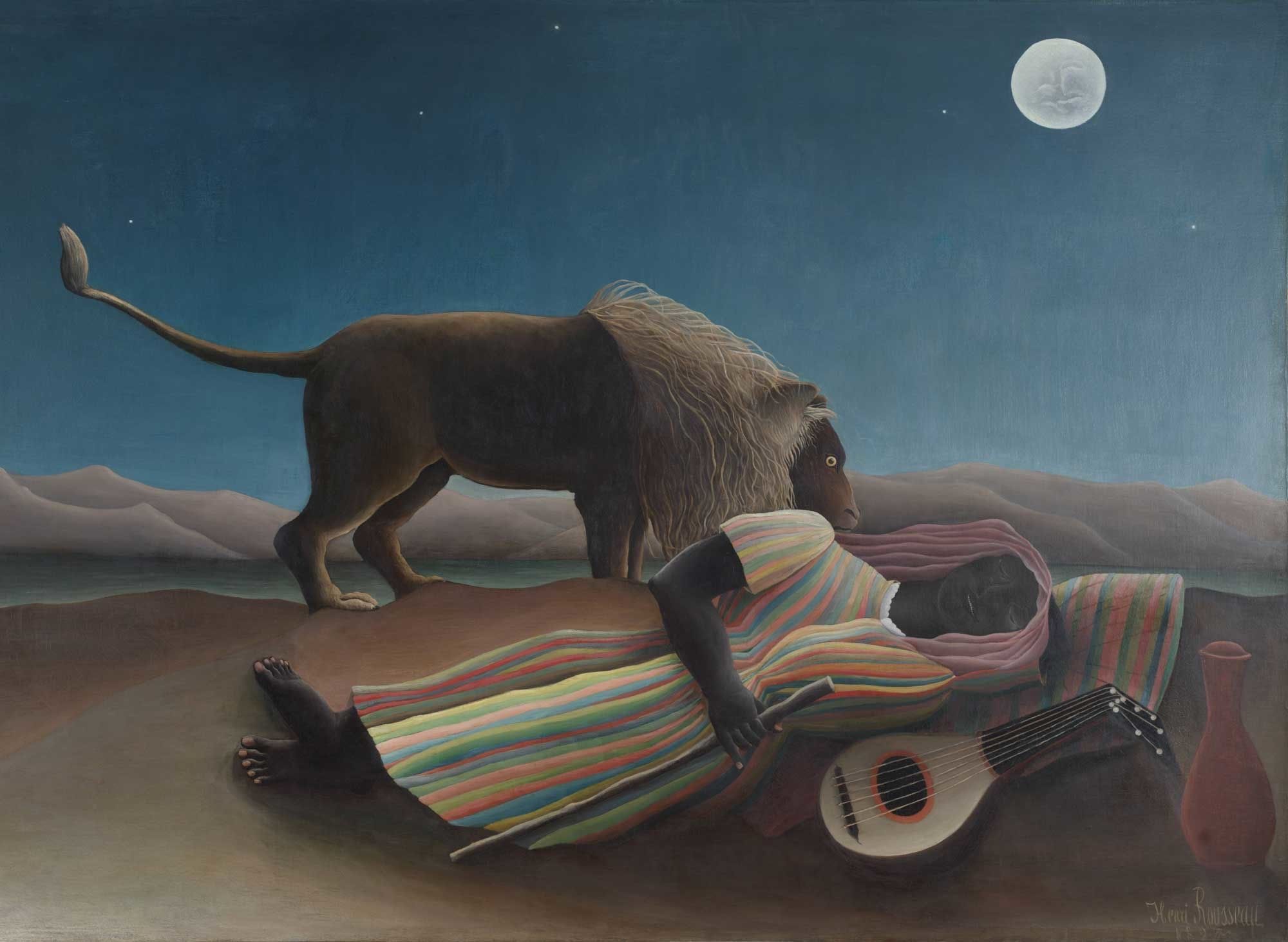
“La Bohémienne endormie (The Sleeping Gypsy),” 1897. Henri Rousseau. Courtesy MoMA.
Like many other works, “Portrait of a Woman” contains non sequiturs, called “quirks” in the exhibition text: an elaborate striped curtain, an upside-down branch used as a cane, a single bird on the wing, a background of pointy gray mountains.
Also in the third gallery: “The Football Players,” showing four moustachioed men in striped uniforms. “The rival teams even have opposing hair colors,” notes the text, but it appears that they are really two men, doubled (if not one man quadrupled). Adding a strange beauty, a near-mirror image is formed by the row of skinny trees on each side, which frame a lozenge of sky.
The term “uncanny valley” refers to the vague feeling that something is off when one interacts with the humanoid (dolls, robots, chatbots), but it could also apply to paintings by Rousseau and other artists once categorized as primitive, folk or naïve and more recently as visionary. Something is off, yes, but that something makes the art distinctly compelling.
“A Painter’s Secrets” seeks to portray Rousseau as more sophisticated, skilled and ambitious than do most accounts, yet it is hard to deny the simplicity of his nature.
Toiling at his easel in the modest apartment where he gave art and music lessons, this retired functionary, though mocked and taken advantage of, was also beloved. (The title of critic Roger Shattuck’s book about turn-of-the-century modernism in Paris, “The Banquet Years,” refers to a raucous 1908 party in Picasso’s studio at which Rousseau was guest of honor and “Portrait of Madame M.” displayed.)
Rousseau began painting in his 40s. Starting off with “The Toll Gate,” a scene connected with his official employment, the first gallery, “Mysterious Meetings,” displays five “portrait-landscapes,” a genre he claimed to have invented, in which small figures — a lost lady, an old woman (perhaps Rousseau’s late mother), a costumed couple — are dwarfed by nature. Also on view: “The Past and the Present,” with the faces of their earlier spouses hovering in the clouds above Rousseau and his second wife, both formally dressed.
In the fourth gallery, “Small Pictures for Small Homes,” are a dozen landscapes — with tiny fisherman and boaters and, in one case, a biplane — views that Rousseau encountered on long walks to the city’s outskirts, along with a painting of a ship in a storm and two still lifes.
The text admits that “his perspectival details could confuse, and his figures are sometimes impossibly large or small,” concluding: “These ‘faults’ are so apparent that they must have been deliberate.” Of course, just because they were deliberate doesn’t mean Rousseau was capable of painting more “correctly.” That said, several of the “Small Pictures” demonstrate his proficiency at depicting clouds.
Finally, in addition to the charming posed group “Artillerymen” and studies for unexecuted mural commissions, the second gallery, “An Ambitious Artist,” features two of Rousseau’s largest and most uncharacteristic paintings, both allegories: “War,” a gruesome scene of ravens on corpses, above which a vengeful girl leaps, seemingly pasted onto a weird, silhouetted horse; and “The Representatives of Foreign Powers Coming to Greet the Republic as a Sign of Peace,” showing, to the left of a Parisian street with citizens joining hands around a monument, a ceremonial grouping of French and foreign dignitaries, Marianne (symbol of France) and a lion far less realistic than the one who sniffs at “La Bohémienne endormie.”
Downstairs, from the archives, through March 2: “The Doctor and the Douanier: How Dr. Barnes Built His Collection of Rousseaus.”