
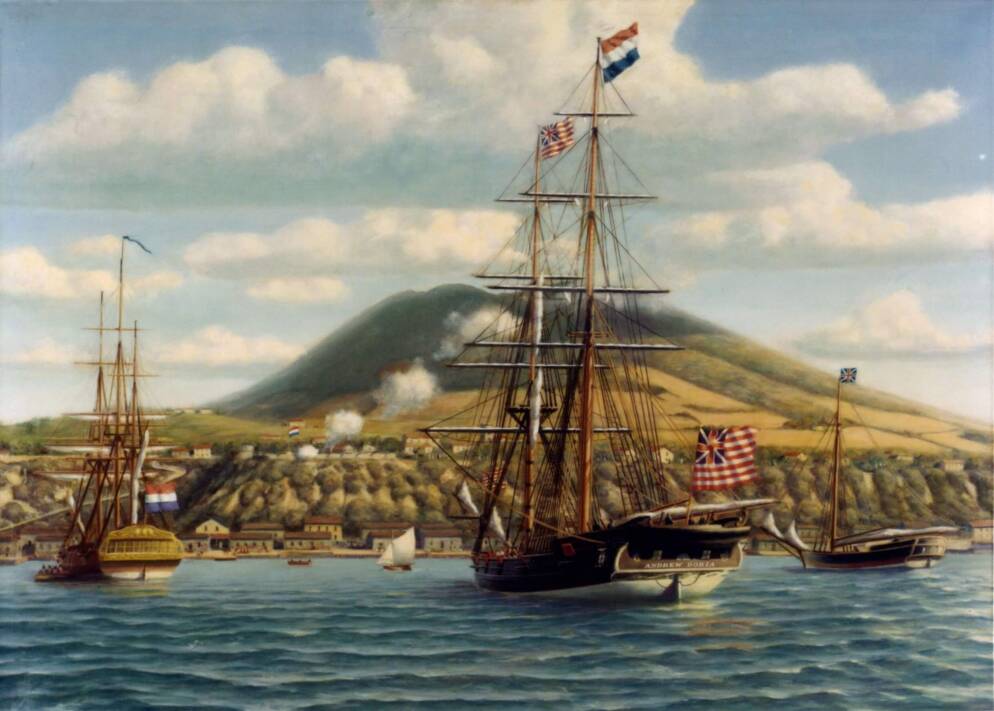
 The Andrew Doria in St. Eustatius Harbor (United States Department of the Navy – Naval History and Heritage Command – Phillips Melville Courtesy of the Weitzman National Museum of American Jewish History)
While there were no Jewish representatives at the Constitutional Convention in 1787, Philadelphian Jews still played a pivotal role in shaping the Bill of Rights and in the American revolution.
Before James Madison headed to the Constitutional Convention in Philadelphia to draft the U.S. Constitution with representatives from the other colonies, he worked with a Philadelphian Jew named Haym Salomon.
Salomon was originally born in Poland. According to Britannica, he is thought to have been forced to leave because of his revolutionary activities for Polish liberty. He ended up in New York City, where he established himself as a commission merchant. A supporter of the cause for the American Revolution, he was consequentially arrested by the British but escaped and made his way to Philadelphia.
In Philadelphia, Salomon helped fund the revolution, including soliciting loans and support from other Philadelphians and allies, in addition to fighting for religious freedom to be included in the Bill of Rights.
His story is one of many that will be highlighted at the Weitzman National Museum of American Jewish History’s new special exhibition called “The First Salute,” which is one of three exhibits commemorating American’s 250 anniversary at the museum.
A curator of the exhibit, Josh Perelman, told the Jewish Exponent that Salomon was one of many Jews who came down to Philadelphia from New York and played a crucial role in the revolution.
 Dr. Josh Perelman, “The First Salute” Cutator and Senior Advisor to The Weitzman for Content and Strategic Projects, and Raimie Richardson, heritage inspector on St.Eustatius (Statia).
Photos by Avida Linvy, St. Eustatius, November 2025 (Courtesy of the Weitzman National Museum of Amican Jewish History)
“When the British occupied New York, the New York Jewish community came down to Philadelphia and joined up with Mikveh Israel,” said Perelman.
Congregation Mikveh Israel, a Sephardic synagogue in Philadelphia, was founded in 1740 and is known as the Synagogue of the American Revolution. Many of the congregation’s members and spiritual leaders became critical players in advocating for religious liberty. Salomon was one of those members.
“Also … the British occupied some cities in the south, like Savannah and Charleston. Members of those communities came to Philadelphia and were welcomed into the Mikveh Israel orbit,” Perelman added. “Because it didn’t have a strong British presence … Philadelphia became a haven for Jews.”
Another name attendees of the exhibit are likely to see is Jonas Phillips, another notable figure that came out of Mikveh Israel who also played a crucial role in shaping the Bill of Rights.
“Jonas Phillips was a real advocate for religious liberty and for the rights of Jews in the early American times, both advocating to Pennsylvania to remove its religious tests from [public] institutions, and also — although there were no Jews at the Continental Congress that eventually produced the Constitution — [he] wrote to the Continental Congress in order to advocate that religious liberty would be codified in [the] constitution,” explained Perelman.
The people who will play the most prominent role in the museum’s “The First Salute” exhibit is the Gratz family.
The Gratz family were active contributors to the Continental Army fighting against the British, both in terms of funding and supplies.
“All of that makes them no different in some ways than their neighbors, lots of different people who supported independence contributed with their lives … or through the skills that they had, whether those skills were finance or blacksmithing or agriculture,” Perelman said.
“Everybody found their own way to contribute to independence.”
Rebecca Gratz, a member of the prominent family, was also a member of Mikveh Israel.
Rebecca Gratz help found the first Hebrew school in the U.S. as well as some of the first philanthropic endeavors for women and children, Jewish and otherwise, according to Perelman.
“What’s exciting about exploring the Revolutionary era is that what produced the United States was not one group of people from one small kind of leadership cadre. What produced the United States was people of so many different backgrounds, ethnicities, religions, different types of Christianity, that it was a diversity of people who came together, inspired by the ideals of the revolution, to form a new nation,” Perelman said.
“And it took that uniting of diverse peoples in order to win war against the British and set in motion [a] revolutionary new ideal for our society.”
Perelman added, “At that time — at least from the Jewish perspective — the rights, civil rights, religious rights, political rights, and the liberties that were being offered by America were unavailable to them nearly anywhere else in the world.”