
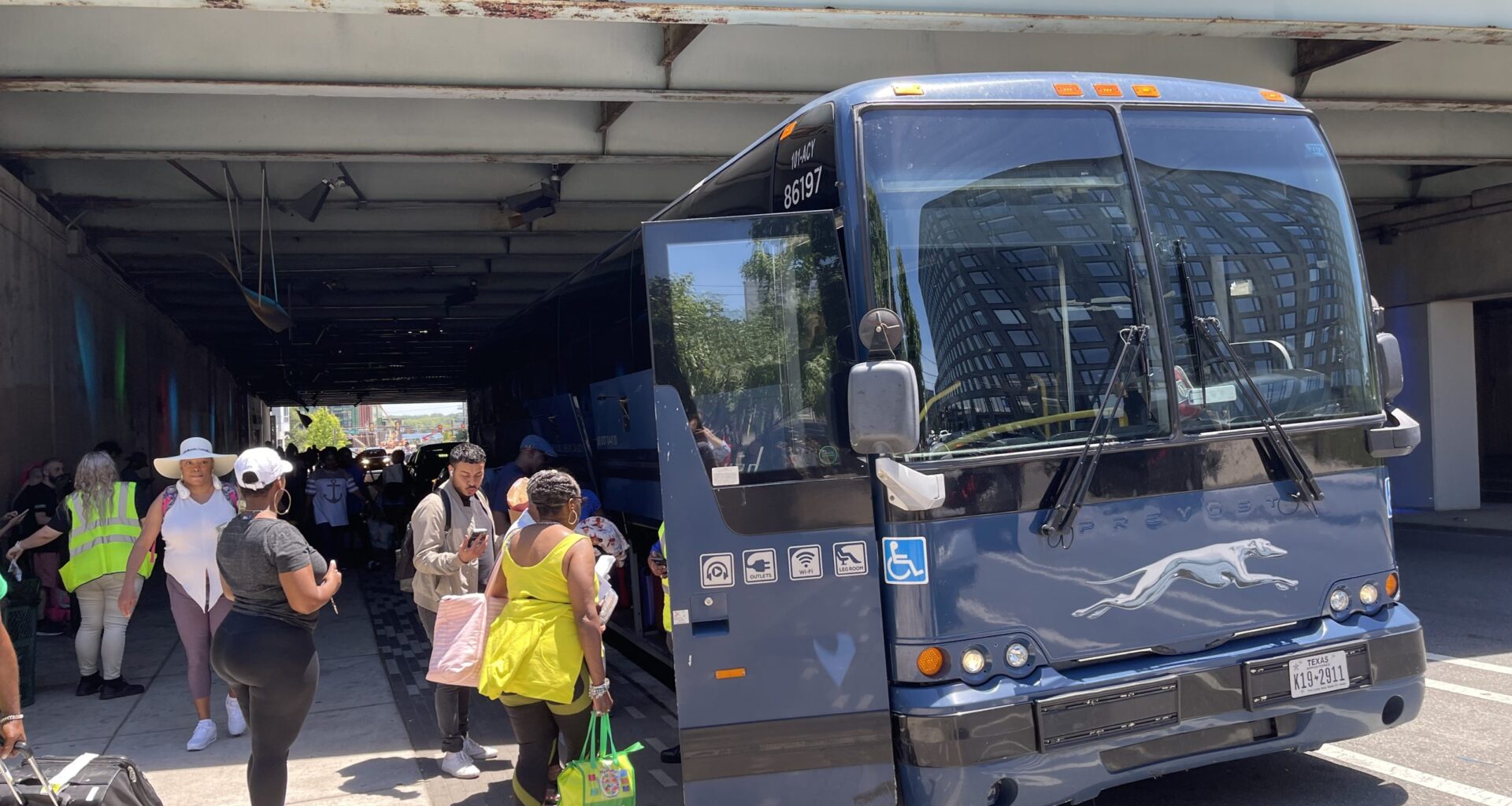
As work continues to temporarily reopen the city’s old Greyhound station on Filbert Street, officials are also moving ahead with long-term planning for a new, permanent, intercity bus terminal.
After reviewing over 280 locations, the Department of Planning and Development has narrowed them down to three options for a new “world-class travel hub” and possible multi-use development:
A pair of parking lots at 701-709 and 721-737 Arch St, near 8th Street, which are next to the African American Museum. The properties are owned by the city and Parkway Corp.
The Philadelphia Gateway garage and an adjoining parking lot at 1500-1598 Vine St., owned by PennDOT and the Philadelphia Parking Authority.
A parking lot at 2931 Arch St., immediately north of 30th Street Station and adjacent to the Cira Centre office tower. It is owned by Amtrak.
The department will hold a meeting to get public input on the three locations on Feb. 25 at the Independence Visitor Center, 599 Market St., from 6-8 p.m. It’s also launched an online survey, with responses due March 13, and is taking comments at BusStation@phila.gov.
After the city holds a second meeting later this year, the City Planning Commission will publish a report with its recommendations. Once a final location is selected, the long process of finding funding for the project and building the station can begin, the department said.
Seeking a long-term solution
The meeting is the latest development in a winding process that began after Greyhound vacated its longtime station in June 2023 and shifted to curbside pickup, first on Market Street and then on Spring Garden Street in Northern Liberties.
The change drew intense criticism from businesses and residents near the pickup sites, and from riders who lamented the lack of shelter or services while they waited for buses.
After briefly considering using a garage on 2nd Street in Old City as a bus station, and encountering fierce opposition from neighbors, in October the Philadelphia Parking Authority announced it will lease the old station space on Filbert for at least 10 years.
It is being renovated and is scheduled to reopen in May, just in time to host the surge of visitors expected for this summer’s World Cup games and America250 celebrations.
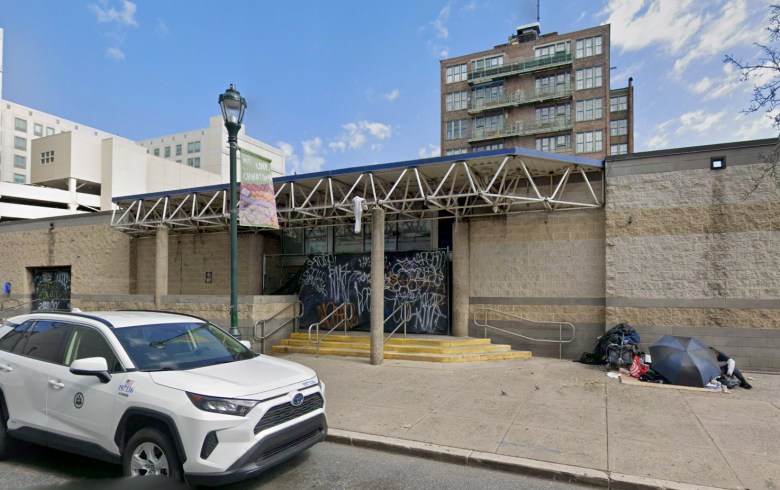 The former Greyhound bus station on Filbert Street has been boarded up since it closed in June 2023. (Google Maps)
“However, it is not a long-term solution for the City’s intercity bus needs,” the Planning Department said in a message posted online last week. “The city’s goal is to establish a long-term intercity bus station that accommodates the many buses serving the city and provide riders with the amenities expected of a modern transportation hub.”
Unlike the Filbert Street facility, the new station would be publicly owned, the agency said.
“Public ownership means it won’t be closed down by a landlord or private bus company. Also, the new intercity station could be designed to have housing in the floors above the station or retail spaces within the station. These uses could help support station construction and operation,” the department said.
Narrowing down the options
For years, public officials and business leaders have discussed the need for a proper urban bus terminal in Philadelphia like those in Boston, Washington and other big cities.
As far back as 2016, Amtrak proposed using the lot near 30th Street Station, and in 2020 Brandywine Realty Trust reportedly talked to city officials about creating a station in the company’s parking garage at 30th and Chestnut. Brandywine’s CEO Jerry Sweeney now heads a task force on rejuvenating the Market East commercial corridor, where the Filbert Street station and the 8th and Arch site are located.
Those conversations accelerated after the old station closed two and a half years ago. Philadelphia received a $90,000 grant from the Delaware Valley Regional Planning Commission to hire consultants to study locations for a permanent bus terminal. In addition to Boston and D.C., they looked at terminals in San Francisco and Montreal for inspiration.
Consultants and city staff started by reviewing 280 sites in Philadelphia and picked 35 for closer analysis. They included locations near Wayne Junction Station, near Broad and Allegheny in North Philadelphia, near Front and Girard streets, and at more than a dozen spots in Center City, according to a Planning Department map that will be exhibited at next week’s public meeting.
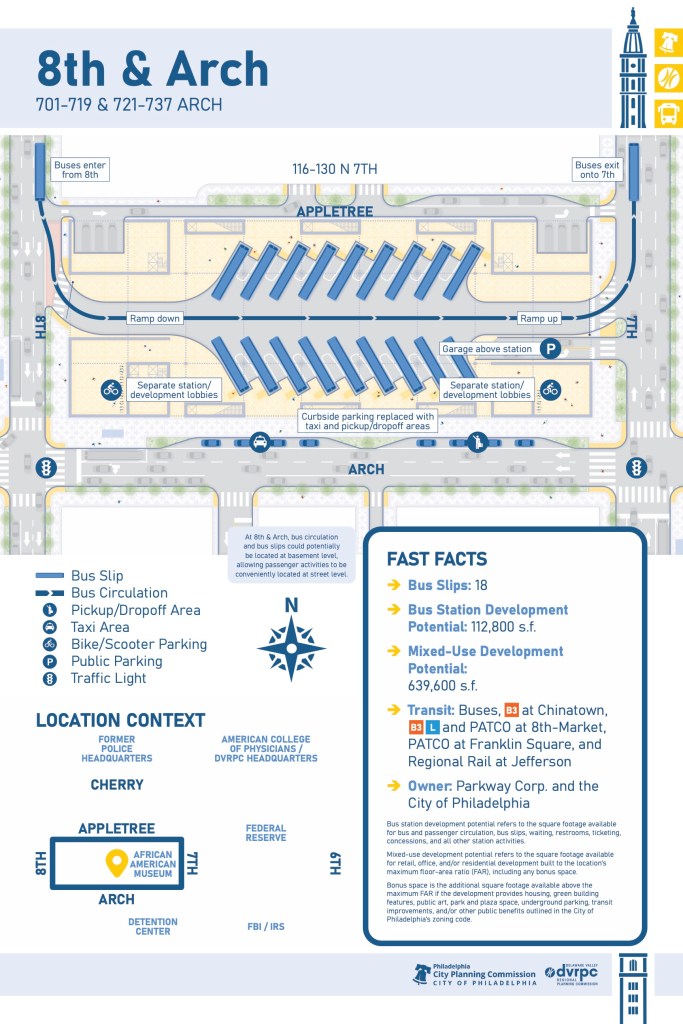 A site at 8th and Arch streets in Philadelphia is one of three locations being considered for permanent intercity bus terminal. (City of Philadelphia)
They considered whether the sites could accommodate a multi-story, mixed-used development in addition to a station; were close to Center City or University City, transit, and highway ramps; and, preferably, were publicly owned and not already slated for development, the document says.
They also focused on lots that were vacant or being used for parking, and not adjacent to homes, and they considered environmental contamination and environmental justice concerns.
Six locations initially made the cut. On closer examination, the team discovered pre-existing development plans or other issues at three of them, leaving them with three feasible sites, the city said.
The surviving options do not include the Roundhouse, the architecturally distinctive former police department headquarters at 8th and Race streets. In November, a few volunteer design teams proposed redeveloping the building as a multi-use bus terminal. But Mayor Cherelle Parker’s administration has blocked historic preservation of the structure, paving the way for its possible sale and demolition.
Advantages and challenges
The 8th and Arch site has room for 18 bus parking spots, per the Planning Department. It could fit a 113,000-square-foot station and an overall 640,000-square-foot development.
Its strengths include proximity to several transit stops, and to I-676 and I-95, as well as the potential to build public parking above the station and to reuse the African American Museum building when the museum relocates to the Benjamin Franklin Parkway.
Challenges include coordinating with the museum, the impact on the nearby Federal Detention Center and other federal facilities, and the mixed ownership by the city and Parkway Corp. In addition, like the Filbert Street station, it would require routing buses near Chinatown, which could draw neighborhood opposition.
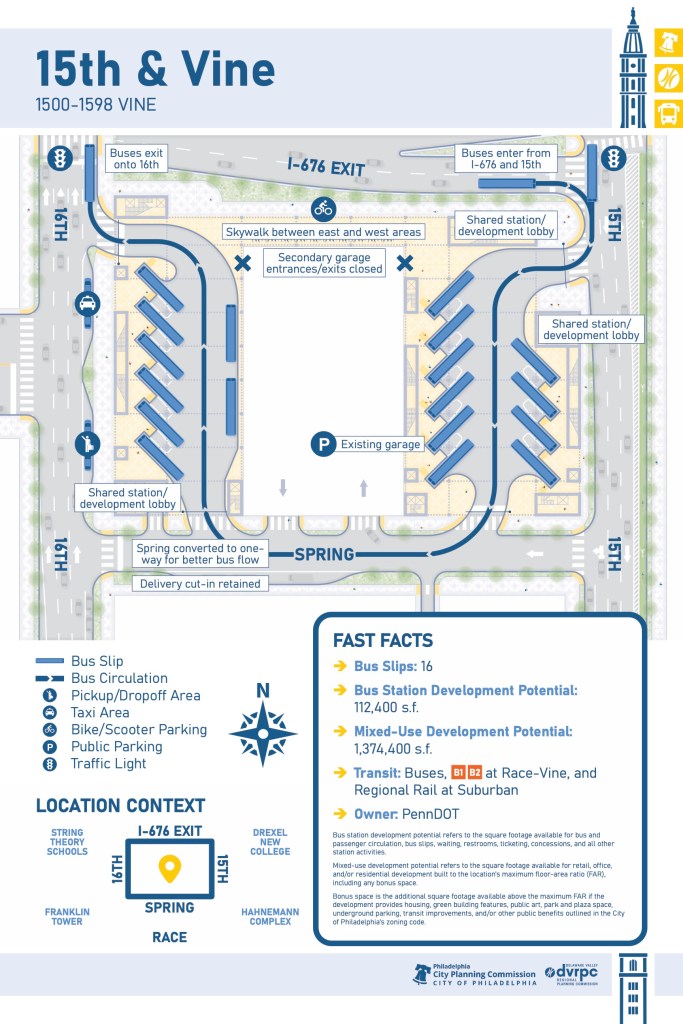 A site at 15th and Vine streets in Philadelphia is one of three locations being considered for permanent intercity bus terminal. (City of Philadelphia)
The 15th and Vine site has room for 16 bus slips, a 112,000-square-foot station, and a 1.37 million-square foot of development, planners say. It’s right next to I-676, so buses would make minimal use of city streets. It’s close to transit and already has a parking garage, and is publicly owned by PennDOT and the PPA.
However, “coordination [would be] needed with several financial stakeholders,” and a station there would impact the adjacent String Theory charter school and nearby medical institutions, the summary says.
In addition, it would be a split station around the garage, impacting bus movement, capacity, and potential development. The adjacent block of Spring Street would need to be converted from two-way to one-way, “with heavy traffic in the area.” Also, there are limited nearby dining options for travelers.
30th Street scenarios
Over the years, many residents have said it would make the most sense to build a terminal near 30th Street Station, to create a sort of super-hub area with close access to intercity buses, Amtrak and multiple SEPTA lines.
The Planning Department offered two options for the 30th and Arch site that could realize that vision.
One option envisions 12 bus slips in a 92,000-square-foot bus station and a $1.4 million-square-foot mixed-use development.
A second option would enlarge the space in a northward direction, apparently by building out the existing deck structure. That would fit 24 bus slips in a 160,000-square-foot station and allow a 2.3 million-square-foot overall development.
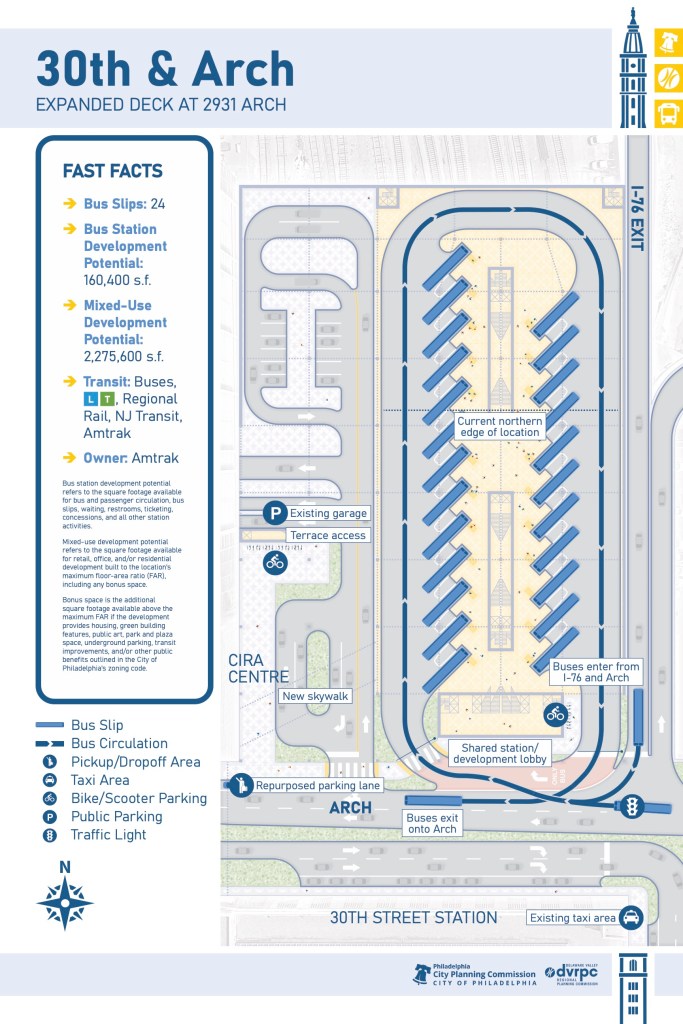 A site at 30th and Arch streets in Philadelphia, next to the Amtrak station and I-76, is one of three locations being considered for permanent intercity bus terminal. (City of Philadelphia)
The site’s advantages are access to SEPTA and NJ Transit stops, Amtrak, and I-76, which it abuts, and little need for buses to use city streets, the planning team said. It could fit a large station, aligns with the multi-entity 30th Street Station District Plan, is next to the Cira Centre parking garage and offers nearby dining options.
The challenges are the need to coordinate with Amtrak “for operations, site control, and developing over the railroad tracks,” and structural upgrades needed to support the weight of buses.
Not mentioned are the potential complexity and cost of reconfiguring the nearby I-76 and I-676 ramps, which PennDOT would have to do to make the site easily accessible to buses and pedestrians, according to the 30th Street Station District Plan that Amtrak and its partners published in 2016. At the time, that work alone would have cost $32 million, the report said.
In 2024, Amtrak declined to comment on the prospect of putting the bus station there, but said it judges such proposals based on whether they’d be useful to its passengers, support Amtrak’s service needs and plans, and “come with adequate investment and fair compensation.”