
What happens to a mural when the building it’s attached to is demolished or expanded?
This is no rhetorical question: It’s destroyed, or at least, covered without hope of being seen again for a long while.
Local news and arts organizations — NEXTpittsburgh included — have mapped out self-guided tours of Pittsburgh’s public art throughout its 90 neighborhoods, but researchers and contributors from Carnegie Mellon University’s CREATE Lab are going the extra mile and creating a living archive of the city’s public art.
Since 2021, Richard Palmer has photographed and mapped more than 200 works for The Pittsburgh Public Art Archive from Ambridge to Braddock and everywhere in between using a Gigapan — a telephoto camera on a robotic arm that creates massive, high-resolution panoramic photos.
“This is meant to be an archive for people to use and to save the images for when they’re no longer extant,” Palmer says. “My smallest images are a couple of hundred megapixels, and they range into the gigapixel.
“Some of those big murals, you can zoom in and see the grout work in the bricks or between pieces of mosaic.”
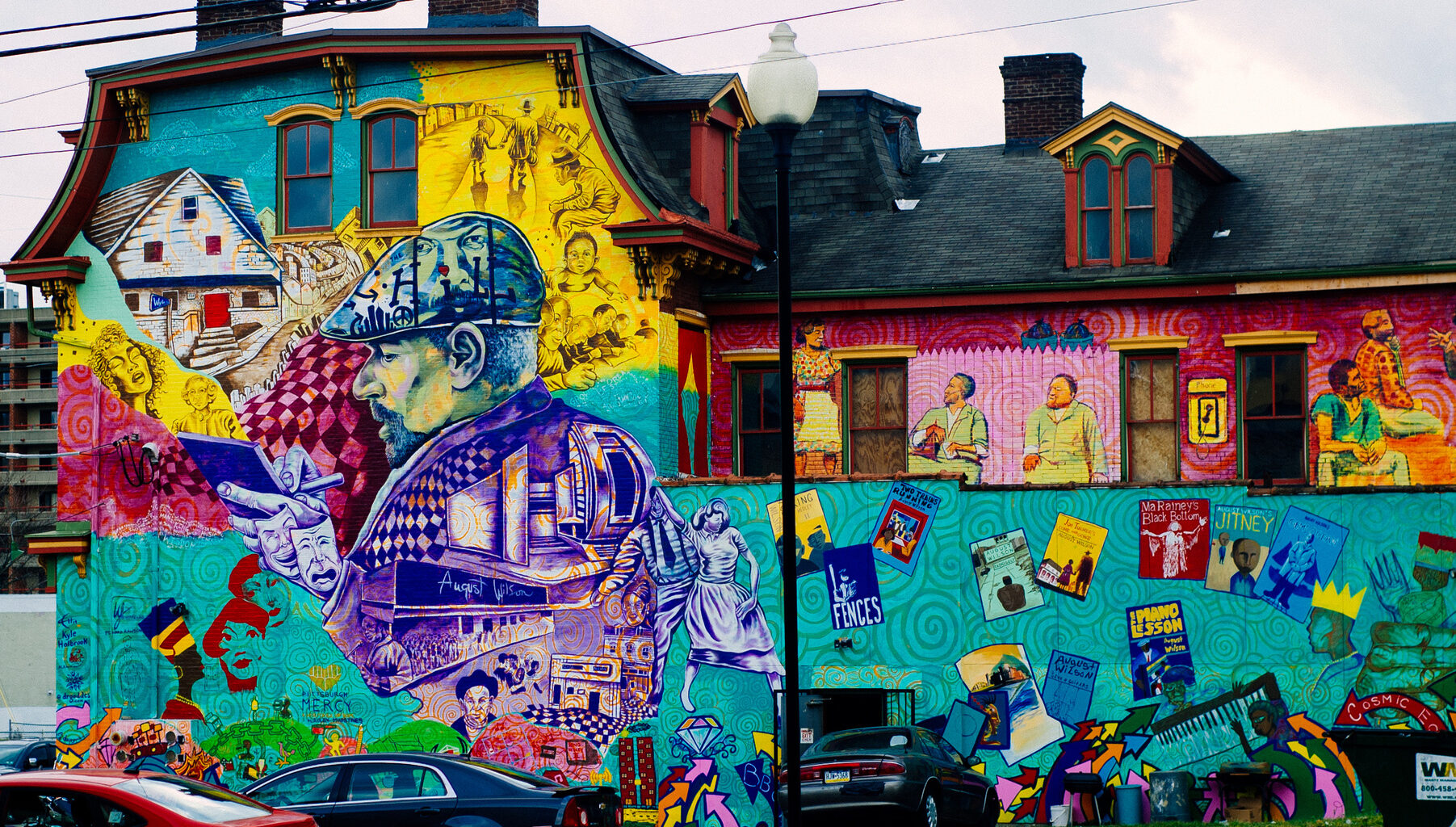
The project had humble beginnings. In 2021, the Hill District Community Development Corporation reached out to the CREATE Lab, asking if someone would photograph the “Looking Through a Keyhole Into a Jazz Club” mural at Wylie Avenue and Erin Street before it was permanently covered up.
“After visiting the site and getting permission and all that, I brought my equipment up and photographed that particular mural, then walked around to the other side of the building, … and the whole side of the building was a mural dedicated to August Wilson,” Palmer says.
Hill residents were quick to point out other murals in the neighborhood, which Palmer also photographed, and, before long, a citywide plan began to take shape.
If you were to judge Palmer by his academic record, you wouldn’t think him much of a photographer. He studied chemistry at CMU and worked myriad roles in the field throughout the 1970s and 1980s before enrolling at University of California, Berkeley in 1988 for a bachelor’s degree in plant molecular biology.
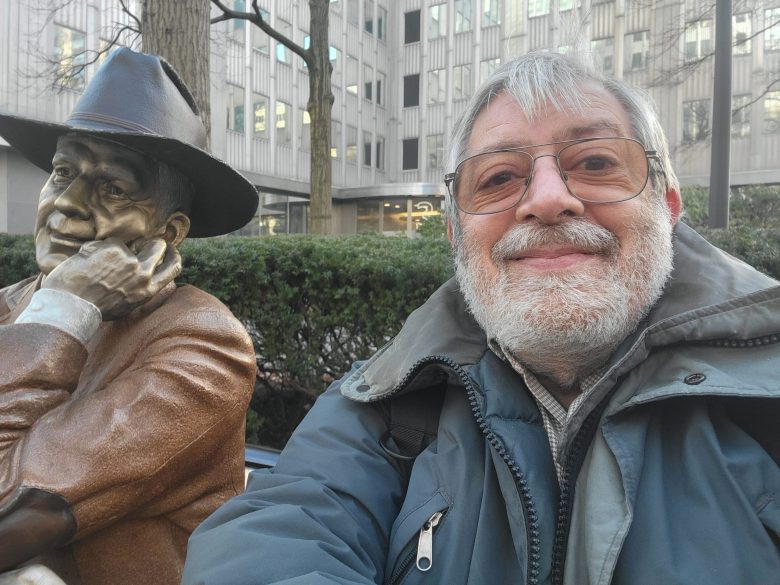 Richard Palmer poses for a selfie with a lifelike sculpture of a man at Gateway Center. The sculpture, alongside 14 others, is the handiwork of New Jersey-based artist Seward Johnson. Photo courtesy of Richard Palmer.
Two years later, he headed to the University of Hawaii for a doctorate in botany and ecology. In the years after his 1996 graduation, he got a job with the Hawaii State Department of Health’s Hazard Evaluation and Emergency Response office.
“My job was, mostly, going around to the islands and searching for and evaluating abandoned sugar mills for environmental cleanup,” Palmer says. “There was always photography involved with that, but it was during my grad school days that I really got involved in photography — out in the field, photographing my study areas, my study plans, trying to photograph Hawaiian birds.”
In February 2007, he was reading the Pittsburgh Post-Gazette and saw a CREATE Lab advertisement seeking alpha testers for their new Gigapan mount. Palmer signed up for more information. Come July, he received the lab’s last alpha unit, and began posting his work to gigapan.com.
Randy Sargent has been the CREATE Lab’s visualization director since 2005, but his work with high-resolution panorama tech dates back to his time as a computer scientist at NASA Ames Research Center, where he developed an interactive viewer for panoramas taken by the Mars rover.
Gigapan is that system’s technological predecessor. It literally brought that technology down to Earth.
Sargent says gigapan is similar to Google Maps’ Street View — it takes photos and stitches them together to create something explorable. But instead of creating a globe-spanning but low-resolution picture like Street View, Gigapan opts for selective, high-quality images.
“The level of resolution of the pictures invites you to just go hunting around because a lot of these panoramas are a billion pixels — a gigapixel — or many gigapixels,” Sargent says.
For example, one Gigapan spinoff, “Project Time Machine,” takes time-lapses of national parks like Yosemite, which are used by geologists studying how rock faces have changed over time.
“Even today, so many years after Gigapan first started, that initial ‘aha’ moment of being able to zoom in on Mars, there’s still something that is important,” Sargent adds.
Sargent says that when Palmer got his Gigapan prototype, he did “amazing things.”
“I took a ‘macro-panorama’ of the side of the shed in my backyard because of the color and texture of the wood and the rope, and they said, ‘We never thought of using it like that before,’” Palmer recalls.
Palmer returned to Pittsburgh in 2011, and has been contributing to the CREATE Lab’s work on Gigapan since.
As the leader of — and chief curator for — the Pittsburgh Public Art Archive, Palmer says he primarily photographs commissioned works including murals, mosaics and sculptures.
Kyle Holbrook, a muralist who was commissioned to work on the “Looking Through a Keyhole Into a Jazz Club” mural with Chris Savido, has painted more than 400 murals in Pittsburgh alone. He says that projects like the Pittsburgh Public Art Archive preserve more than paint on a wall, but culture, memory and stories of neighborhoods that shape the city’s identity.
“I just think it’s so important — documenting the works. I love it. Murals are living public history. They belong to the community. So archiving them, and with high-resolution stuff like Gigapan, it’s preserving history.”
The Jazz Club mural and nearby August Wilson mural — which is also on Palmer’s map — were or still are community gathering points in the Hill District. But even viewing them in person didn’t always give way to the detail Holbrook and Savido put into the piece, he says.
Savido, Holbrook says, was tasked with painting the background figures. He went all-in on small details.
“All those little people have little faces, but they look like little dots,” Holbrook says. “You can probably see it now with the Gigapan.”
But Max Gonzales, another local artist whose works are featured in the archive, finds the project wanting.
Murals, by simply existing, are ephemeral and impermeable, in the sense that they can fade or disappear, Gonzales says. In order to fully “archive” the city’s art, the Pittsburgh Public Art Archive needs more detail and connection with the artists whose work it documents.
For example, the “Looking Through a Keyhole Into a Jazz Club” mural lists both Holbrook’s and Savido’s names but is labeled simply as “Keyhole – Jazz Greats.”
“In no way is it public facing enough, in my opinion, to actually say that it is for the service of those artists, because if the artists don’t even know that it exists, then there is no function for the artist or those communities or those property owners,” Gonzales says.
Gonzales adds that they’re not against documenting murals — they, themself, are an organizer of the Hemispheric Conversations: Urban Art Project, which creates and documents public art in a manner not dissimilar to Palmer’s project — but they think that the artists should be more involved.
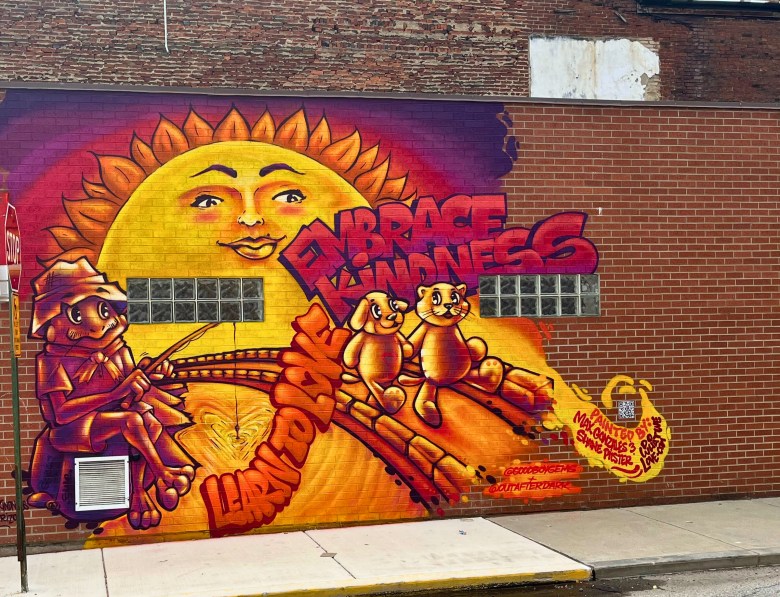 Mural by Shane Pilster and Max “GEMS” Gonzales on the corner of Main and 10th streets. Photo by Cristina Holtzer.
For example, when a piece of public art appears in a film, the production company will attempt to reach out to the artist — whether it was legal or illegal — to secure rights and compensate the artist.
“If it’s to the degree that people are willing to reach out and find the artist behind non-sanctioned works, the bare minimum would be you look up the website or the Instagram handle that’s probably on the signature line on the mural itself, reach out to that artist and say, ‘Hey, we’re going to do this project. Do you consent to your artwork being used?’”
“ I would love to be connected with these people to like help them with that process. I know pretty much every artist that was featured in their whole mapping.”
You can browse the Pittsburgh Public Art Archive on the CREATE Lab’s website.