
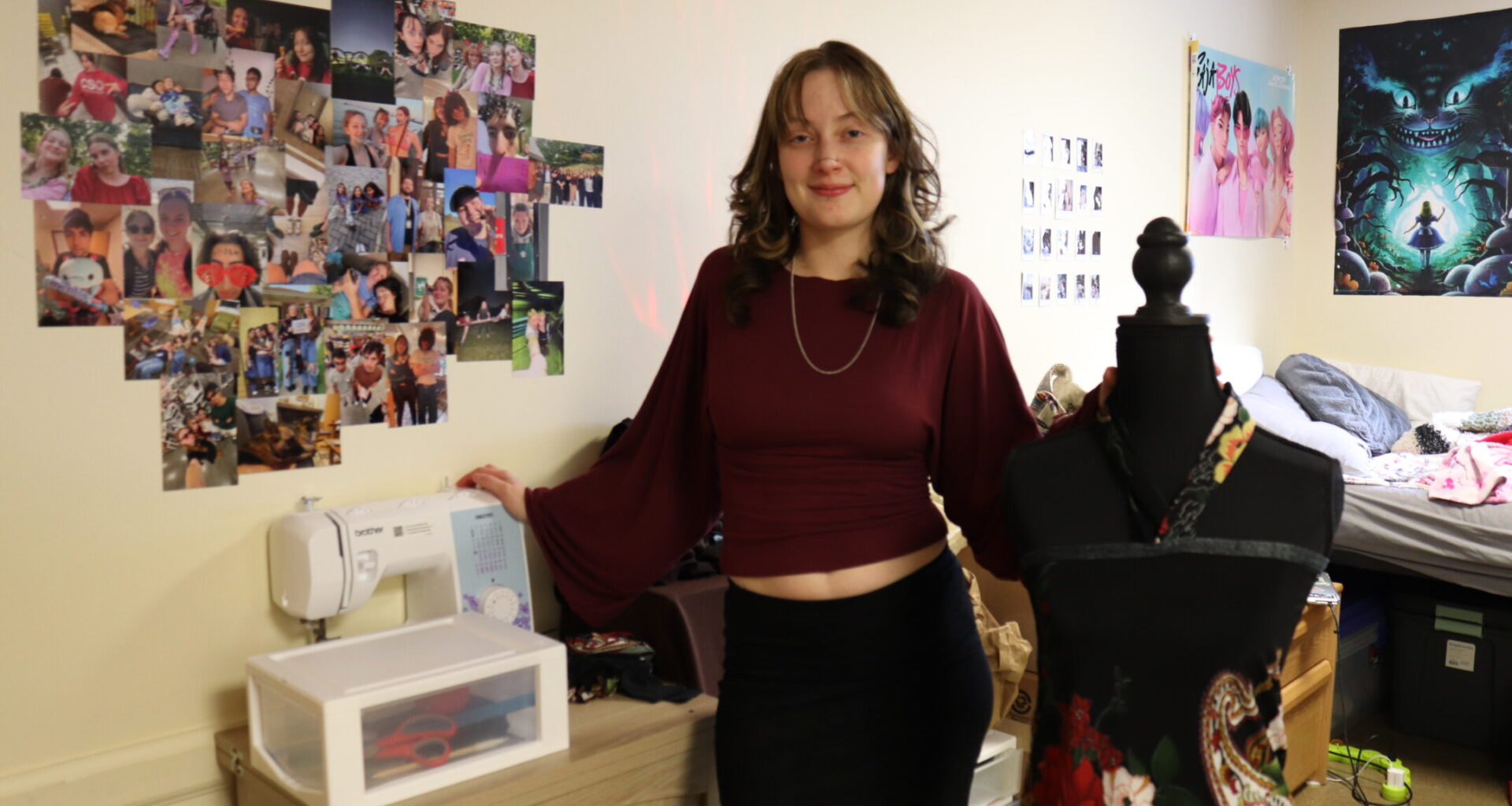
Earthy and elegant — that’s how Alana Shuman, ‘27, describes her outfit every day.
Eclectic jewelry drapes her body, each piece a thrifted treasure. The seams in her platform boots often rip, but she stitches them back together every time.
For Shuman, fashion goes beyond clothing. Her outfits are a daily outlet for self-expression, telling stories about her personality and reflecting her mood.
“My style is a big part of who I am,” Shuman said. “It’s very loud and very chaotic, and I feel like that really represents me.”
But she never sacrifices sustainability for style.
Many items in Shuman’s closet are handmade from fabric she found on sale for $6 a yard. From designing her own pieces to creative thrift flips, she avoids overconsumption while keeping her wardrobe fresh and distinctive.
When she’s not studying political science or earth and environment science, she’s often at her sewing machine, shopping secondhand or posting her outfits on social media.
Though confident in her style now, Shuman said it took experimenting with different aesthetics in high school to find what suits her. Today, she gravitates toward a mix of elegance and streetwear — layers, platform shoes and any clothing that complement her body type.
When she makes her own clothing, she leans toward flowy, street-style pieces that give her creative freedom.
“If I have a screw up in the sewing or something that looks like it isn’t supposed to be there, that’s kind of the point of street style — to be crazy and kind of out there,” she said.
Sewing and sustainability have been a part of Shuman’s life since childhood. At 5, her mother taught her to hand-sew. By high school, she was using her mother’s sewing machine to tailor her clothes for a better fit.
Now she uses a plastic sewing machine but misses her mother’s industrial model from the 1950s, which she said is good for heavyweight fabrics due to its metal build.
Both of Shuman’s parents worked as park rangers, instilling in her a strong sense of environmental responsibility. As she grew older, she began acting on those values.
She said she once shopped at fast-fashion brands such as Shein but noticed how quickly the garments fell apart. The more she learned about the industry, the more committed she became to sustainable shopping.
In high school, her interest in environmentalism deepened. She served on the executive board of her school’s social justice club and donated to thrift stores and organizations such as Habitat for Humanity.
At Lehigh, Shuman designed outfits from scratch for herself and friends for the Modeling Club’s annual fashion show last year. The club allows her to merge her passions for fashion and sustainability, she said, and working with limited materials pushes her creativity.
Once, she made a shirt entirely from neckties for fellow club member E.B. Maultsby, ‘28.
Maultsby said Shuman introduced her to fashion and encouraged her to join the Modeling Club. Though it was outside her comfort zone, Maultsby said she enjoyed experimenting.
“It was really fun because she was open to my idea and what my vision was,” Maultsby said.
On another occasion, Shuman transformed a single pair of pants into a full outfit in less than 24 hours before a show, turning the pants into a skirt and using the excess fabric to make bell sleeves.
She said it was a time crunch, but it came out better than she could’ve imagined.
Gabe Kagwanja, ’27, a friend of Shuman’s, launched his own clothing brand, Sacred Star, during his first year at Lehigh. The two met while living in the same first-year residence hall.
Kagwanja said Shuman supported his brand by modeling and purchasing pieces. Recently, he watched her turn one of his shirts into a dress.
“It’s cool to see her working,” Kagwanja said. “She was taking the seams out, pinning it against her mannequin — just sewing. You can tell that she has a passion for this.”
As a designer himself, Kagwanja said he admires Shuman’s creative process.
“It’s interesting, because for me to design something, I need to draw it, map it out and have pictures of everything,” he said. “She just visualizes it immediately. She’ll write something down, and while you can’t tell what it is on paper, it turns into something great.”
Every night, Shuman devotes at least 30 minutes to sewing. Her goal, she said, is that with each piece she creates or secondhand garment she repurposes, the fast-fashion industry loses another customer.