
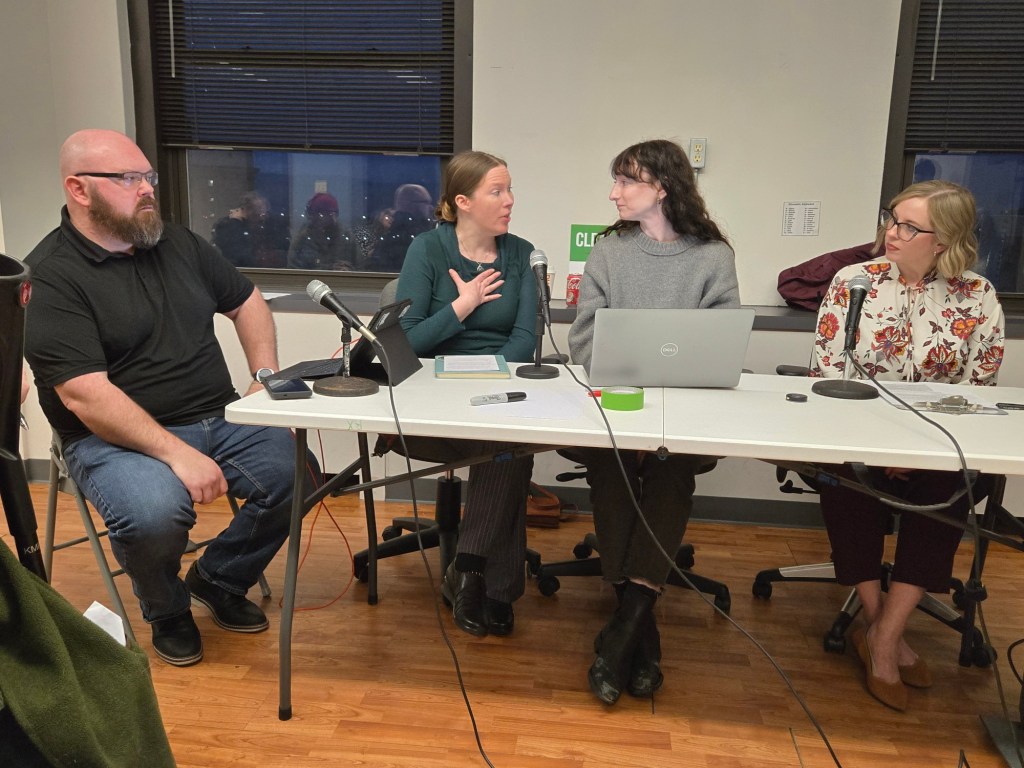
WILKES-BARRE — A nonprofit group working to make life more affordable for Pennsylvanians hosted a roundtable discussion Tuesday on the causes of rising energy costs, how they’re affecting families across the state and what can be done.
About two dozen people listened to two renewable energy advocates and a political science professor discuss the issue and asked questions at the event that Affordable Pennsylvania hosted in a meeting room at the Luzerne Bank building on Public Square.
“We’re hosting the event tonight, and we are bringing this amazing panel together to talk about the rise in energy prices that you’ve seen in our area and what has contributed to that, what’s going to contribute to that in the future, and how as a region and a state we can move forward and protect ourselves,” panel moderator Anthony Gratter, regional organizer for Affordable Pennsylvania, said.
When Gratter asked who has seen their energy bills increase recently, nearly everyone in the room raised a hand.
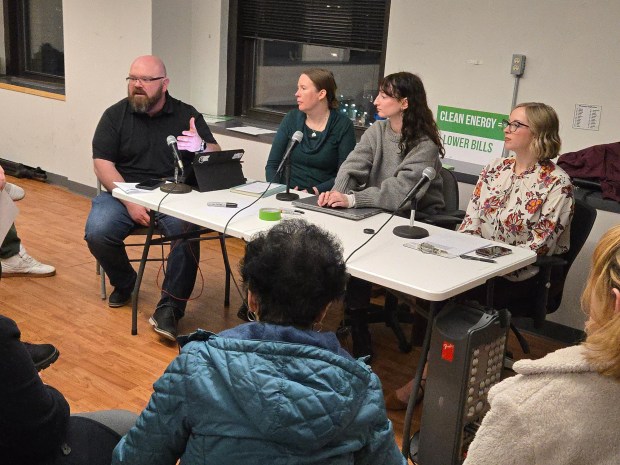 Anthony Gratter, regional organizer for Affordable Pennsylvania, addresses a member of the audience at an energy cost roundtable Tuesday in the Luzerne Bank building in Wilkes-Barre. Listening, from left, are panel members Sarah Corcoran, of the Sierra Club, Annie Regan, of Penn Future, and Joyanna Hopper, a political science professor at the University of Scranton. (STEVE MOCARSKY / STAFF PHOTO)
Annie Regan, senior campaign director at Penn Future, said electricity prices in Pennsylvania are higher than in neighboring states such as Ohio and Virginia.
“Pennsylvania is sort of a loser in a sense of an energy crisis, being less competitive, and the consumers are the ones that are paying the price,” Sarah Corcoran, deputy director for the Pennsylvania chapter of the Sierra Club, added.
Corcoran said Pennsylvania is one of 13 states relying on an electric grid managed by PJM Interconnection, the largest regional transmission organization in the U.S.
Corcoran said climate change is one of the main reasons energy demand has increased over the last few years, with rising extremes in both hot and cold temperatures, and the energy grid doesn’t have adequate capacity to handle peak demand.
Joyanna Hopper, a political science professor at the University of Scranton, said a recent energy auction, PJM’s energy capacity pricing increased 833%, translating into a potential 10% to 20% increase in residential electric bills.
Hopper said the most recent living wage report the university conducted in conjunction with The Institute for Public Policy showed “a massive increase in the cost of utilities, and that it was stretching people’s budgets.”
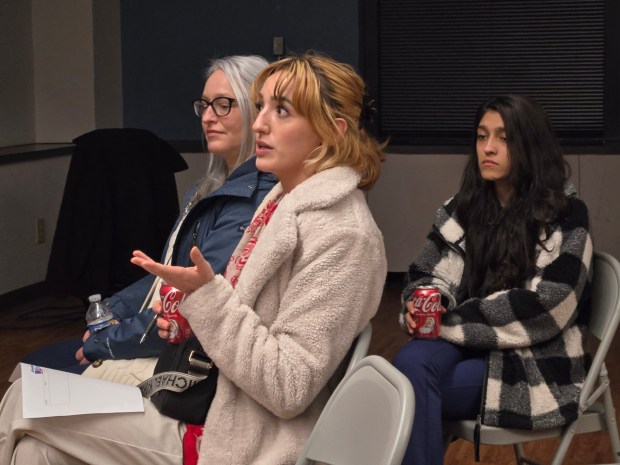 Bianca Mattei, of Wilkes-Barre, talks about her electric bill during a community roundtable on rising energy costs Tuesday in the Luzerne Bank building in Wilkes-Barre. (STEVE MOCARSKY / STAFF PHOTO)
Regan noted that about 70% of the power outages during winter storm Elliott in 2022 were related to natural gas lines, adding that studies by people who monitor the PJM grid and the energy market say more diversity in energy sources.
“So, even if clean energy can come off as a partisan issue, we need a need a balanced grid, because we cannot rely on one power source like natural gas, which is what Pennsylvania’s is mostly made out of, and the coal plants are retiring or trying to retire, but staying (online) longer, and we’re paying more for these inefficient coal plants. So, clean energy plays a major factor here,” Regan said.
“The oil and gas industry has a lot of influence on legislators, so it’s not surprising to see legislators back (fossil fuel) projects” while renewable energy projects for wind and solar power are being bottlenecked,” Regan said.
She attributed much of the problem to misinformation about renewable energy and the need to combat it.
The panel agreed that the public should try to educate themselves more on proposed energy-related legislation and lobby their elected officials, writing letter to them, and especially requesting meetings to voice their opinions in person.
The Sierra Club has a Legislative Tracker took on its website, sierraclub.org/pennsylvania.
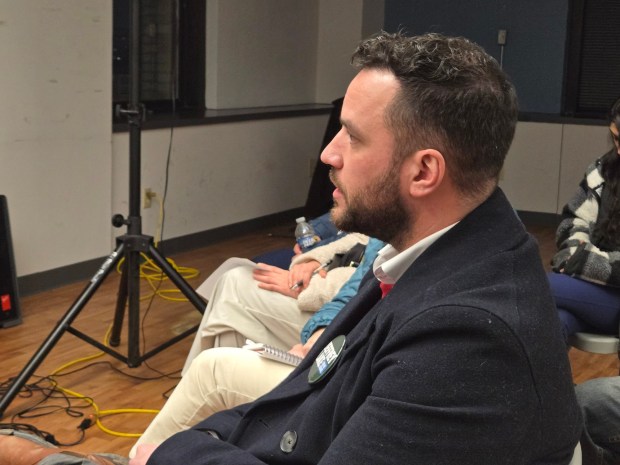 Jeffrey Lake, a candidate challenging Democratic state Sen. Marty Flynn for his seat in the 22nd Senatorial District, poses a question to the panel during a community roundtable on rising energy costs Tuesday in the Luzerne Bank building in Wilkes-Barre. (STEVE MOCARSKY / STAFF PHOTO)
The panel also agreed that data centers will present an even bigger drain on the grid, and the federal government should step in to better regulate those centers. They said legislators should pass laws forbidding data center operators from getting discounted energy at wholesale prices because they are large energy consumers.
Jeffrey Lake, a Democrat who plans to challenge state Sen. Marty Flynn for his seat in the next primary election, told the group there is some good legislation in the works to protect communities from data centers, but there is legislation that he considers harmful, as well.