
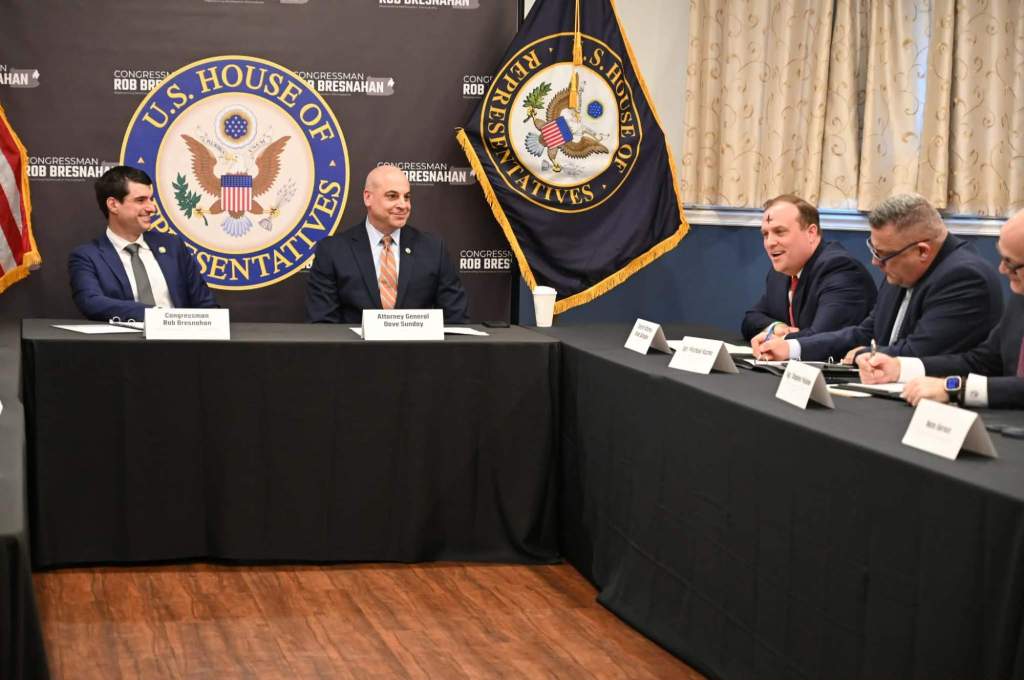
U.S. Rep. Rob Bresnahan hosted a roundtable discussion with Pennsylvania Attorney General Dave Sunday and local leaders Wednesday, focusing on topics that ranged from police officer compensation to technology to addressing gang violence.
Sunday pointed out that, in the United States, one needs only to call 911 and a police officer or other first responder will show up almost immediately.
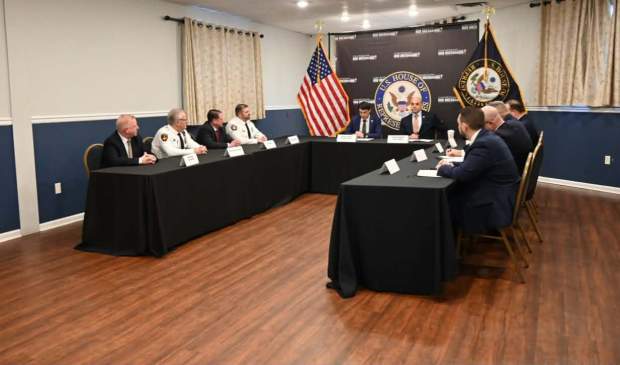 U.S. Rep. Rob Bresnahan hosted State Attorney General Billy Sunday and area leaders for a roundtable discussion on strengthening local law enforcement and advancing public safety on Feb. 18, 2026. (GERI GIBBONS/STAFF PHOTO)
Sunday said he found great reassurance in that, especially as a family man.
But Bresnahan, Sunday and other participants in the roundtable at the E.B. Jermyn Fraternal Order of Police Lodge 2 in Scranton pointed out that those services aren’t cheap or free, and need consistent funding.
One of Bresnahan’s most recent efforts to garner that funding came in the form of $500,000 in federal money for the Scranton Police Department to upgrade equipment and modernize technology to increase officer safety and effectiveness.
Sunday emphasized the importance of law enforcement outpacing criminals when it comes to technology.
His office sees a range of technology-fueled crime, from scamming senior citizens to identifying youth vulnerable to human trafficking.
Technology has “supercharged the bad guys’ ability,” he said.
But law enforcement can counter with state-of-the-art technology that identifies such schemes and addresses them before they become reality.
And if cyber-criminals are caught, technology can be used in their prosecution, often meaning the difference between a plea agreement and a costly trial.
Sunday said often a prosecutor will sit down with a defense attorney, show them video footage and other evidence of their crime, and the defense attorney will realize the weakness of their case.
Technology and community support
Lackawanna County District Attorney Brian Gallagher agreed a detailed record of a crime — made possible by technology — can often result in a guilty plea.
Technology is key in all phases of an investigation, from arrest through court proceedings, he said — the most recent example being that of the investigation into the shooting of Scranton Detective Kyle Gilmartin, which concluded earlier this week, Gallagher said.
Gallagher pointed to a program in which his office partners with the University of Scranton to place criminal justice students in internships during which they analyze cellphone photo data to solve crime.
He emphasized that, when it comes to juvenile crime, technological tools and enforcement must be paired with prevention and education.
Juveniles are often lost to crime during middle school, he said.
After-school programs and youth sports often keep teenagers busy during those years and away from misbehavior.
Tom Schuster, Scranton City Council president, who works in the family service field, agreed.
Children need to be engaged with their community and in activities they feel are important, he said.
“That’s where our worlds collide,” he said, referencing law enforcement. “Keep them engaged and they’ll stay out of trouble.”
Bresnahan, R-8, Dallas Twp., who lost a 16-year-old cousin to addiction, said no one is immune from the impact of crime, in spite of any social or economic status.
Difficult time in history for police
Blakely Police Chief Guy Salerno, who also serves as Lackawanna County Chiefs of Police Association chairman, said small police departments are facing numerous challenges.
During the past several years, police have been vilified in the media, he said. Officers come to work demoralized and feeling unappreciated.
And, although his department is fully staffed, other departments aren’t.
Salerno said departments need to find the money to recruit and retain officers, through decent salary and consistent benefits.
Throop Police Chief Andy Kerecman, who also serves as president of the Northeast Pennsylvania Chiefs of Police Association, said smaller departments are required to use the same technology as larger departments with bigger budgets.
The reality of good policing, he said, is that it costs money.