
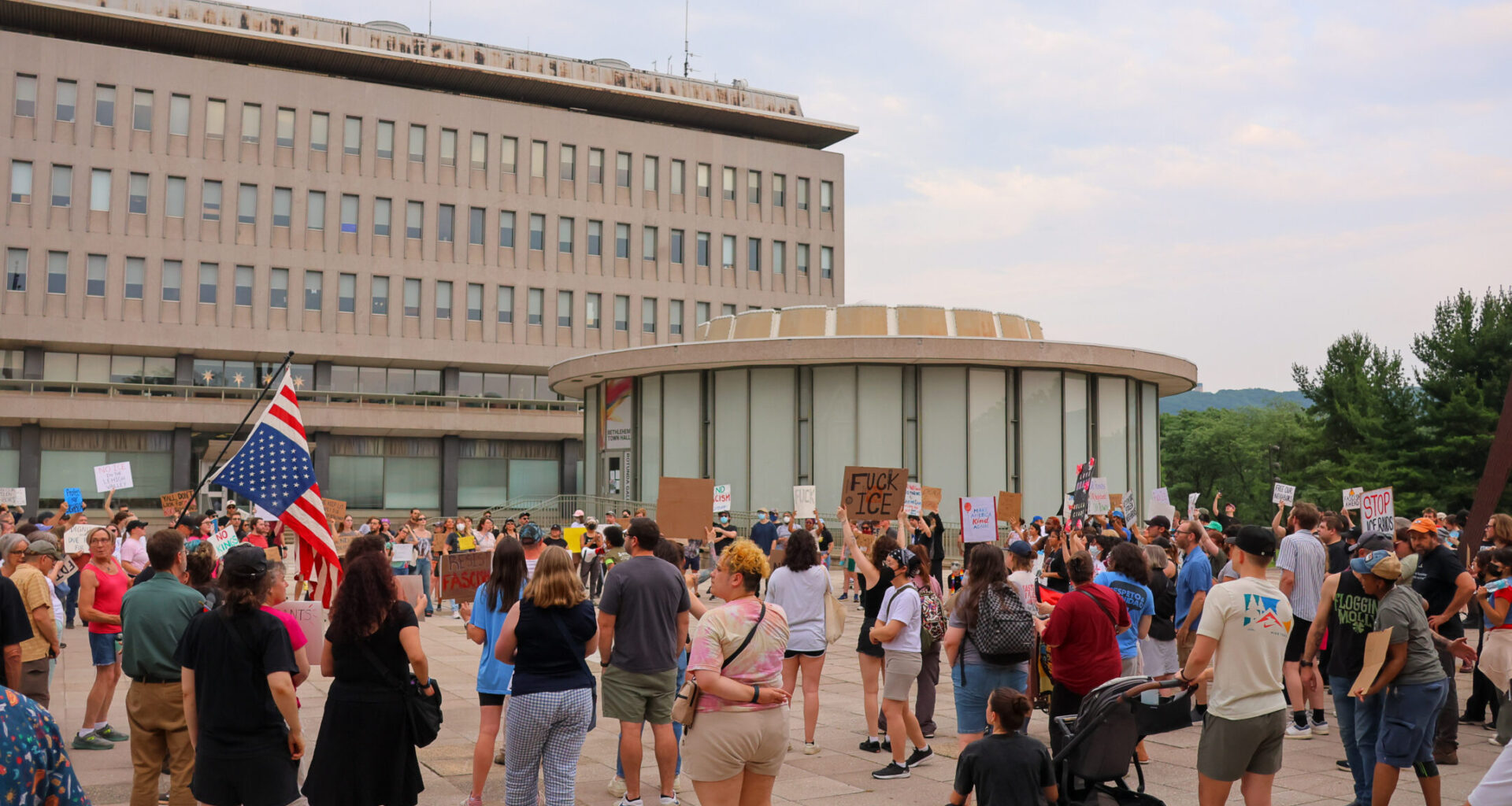
Lehigh Valley community members are publicly opposing the establishment of U.S. Immigration and Customs Enforcement detention facilities in the area, urging industrial property owners not to sell warehouses for use as immigration detention centers.
In a Feb. 6 letter, two dozen Lehigh County officials, school board directors and Allentown Mayor Matt Tuerk asked property owners to refrain from selling to ICE. The appeal follows ICE’s purchase of a 64-acre warehouse in neighboring Berks County in early February.
Lehigh County Commissioner Jon Irons, who signed the letter, said efforts across the country have shown that pressuring warehouses can be effective in preventing ICE from acquiring properties. While local officials can’t control whether a private business sells to the Department of Homeland Security, they can make clear their position and outline the potential impact of such a sale, he said.
The letter states: “ICE detention facilities have a well-documented history of serious human rights concerns, including inadequate medical care, allegations of abuse and deaths in custody; a reprehensible record of cruelty. The establishment of such a facility in Lehigh County would stand in direct opposition to the values of dignity, humanity and mutual respect that define our region.”
Baylee Baker, ‘28, the president of Lehigh College Democrats, said the letter is a step in the right direction but questioned why Tuerk was the only Lehigh Valley mayor to sign.
“It brings into question why the mayors of Bethlehem and Easton didn’t sign the letter when so many of their constituents are at risk of this issue,” Baker said.
According to the U.S. Census Bureau data, 13.2% of Lehigh County residents were born outside the U.S., and 30% identify as Hispanic or Latino.
Irons, who immigrated from Ecuador, said the county’s immigration population strengthens the region.
“Our stance is that our immigrant community makes us stronger,” Irons said. “Immigrants are welcome in the Lehigh Valley, and anything that threatens that or anything that comes between immigrants and prosperity in the U.S. and the Lehigh Valley is not what we’re about, so that’s why it’s important to act and speak up about these things right now.”
Some critics of the letter, including Harrison Smetana, ‘28, the president of Lehigh College Republicans, argue immigration enforcement falls under federal jurisdiction and local officials shouldn’t interfere.
“My opinion is that county officials should be complying with what the federal government says, as immigration is much more of a federal matter than a state matter,” Smetana said.
He said detention facilities are necessary to enforce immigration laws and process individuals in federal custody.
Irons, however, said the rapid expansion and scale of ICE activity doesn’t align with how the U.S. immigration system is intended to function.
Although the Lehigh Valley hasn’t experienced the same level of ICE detentions and raids as some other parts of the country, Irons said the agency’s presence is still felt locally. He said some residents feel fear or mistrust and are afraid to leave their homes.
“When people are detained by ICE, they often disappear into the system,” Irons said. “We’re not supposed to lose people in detention and not know where they are, and we’re seeing families being separated — which is all well outside the scope of what the law states and what law enforcement is supposed to be doing — and I think many people in the area are able to recognize that.”
At Lehigh, about 12.8% of the student population, roughly 1,000, are international students. Baker and Smetana said campus sentiment largely opposes ICE enforcement efforts.
“Many students are friends with other students who could possibly be at risk and I feel like they sympathize with them,” Baker said.
Owen Levan-Uhler, ‘26, from Moravian University, said some students there have organized programming, panels and protests in opposition to ICE and have connected with students at Lehigh.
Baker said she’s seen students display “ICE Out” stickers on campus and use social media to voice dissent.
“We’re really trying to get students invested, because (immigration issues) affect all of us,” Levan-Uhler said.