

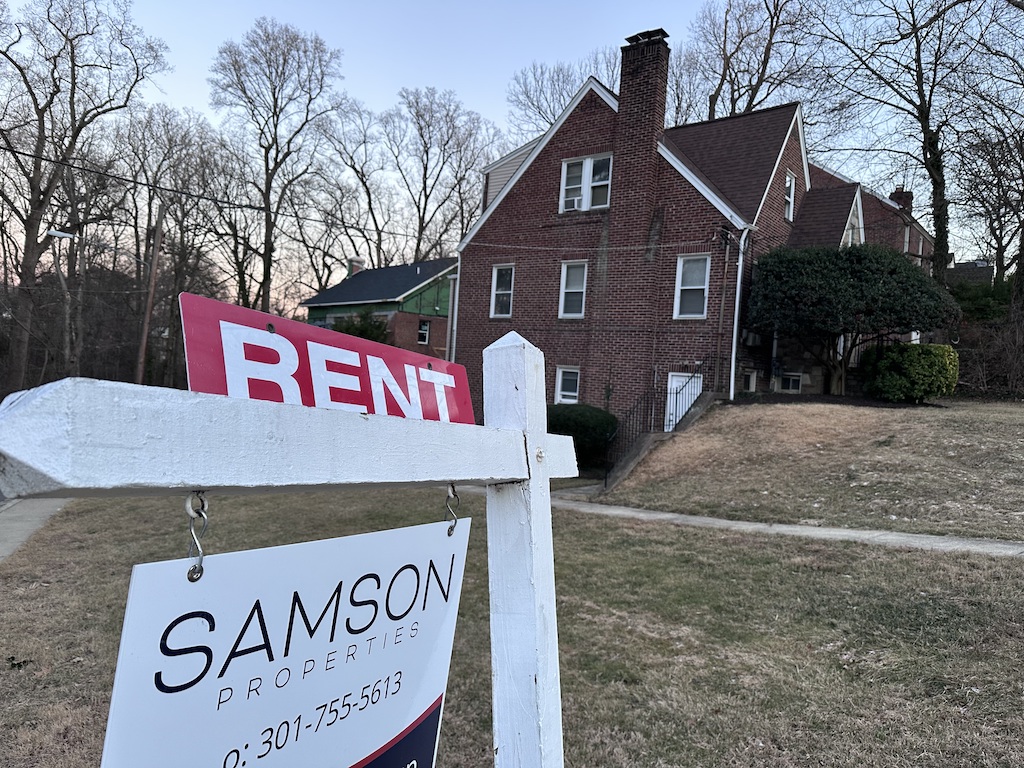
Housing is top of mind for Pennsylvania’s elected officials going into this budget year, from governor down to rank-and-file lawmakers. (Photo by Barbara Barrett/Stateline)
Permitting reform, state grant funding and coordinated zoning approvals would all boost Pennsylvania’s homebuilding industry and revitalize local economies, according to testimony before a panel of state Senate Republicans on Wednesday.
Advocates, elected officials, construction firms and regional economic development groups urged the commonwealth to reduce barriers and incentivize building to increase the number of homes available for potential buyers.
 Robert W. Sleighter, the founder and president of Fayette County-based Sleighter Design, tells senators that the permitting process for homebuilding takes too long on Feb. 18, 2026. (Screenshot from livestream)
“Housing is not failing because there is no interest in building it. It is failing because the process is too long, too expensive and too uncertain,” said Robert W. Sleighter, the founder and president of Fayette County-based Sleighter Design. “In Pennsylvania, each municipality has its own zoning ordinances, subdivision regulations, storm water standards and review procedures.”
According to Sleighter, one project could require: zoning approvals, land development approvals, erosion and sediment control permits, storm water permits, wetland delineations, stream crossing permits, sewage planning modules, state Department of Environmental Protection approvals, utility authority approvals and permits from the state Department of Transportation.
“Each one carries separate fees, consultants, timelines and risk. Before a developer even knows whether a project is viable, they may spend thousands — even tens of thousands — of dollars on legal work just to determine if the project is a go or a no,” he said.
Often, local units of government wouldn’t or couldn’t expedite to accommodate financing deadlines, he added. A conservation district will have a 60-day review period, followed by comments and then another 60-day review period, he said.
“We need statutory review timelines and coordinated permitting, similar to approaches used in states like Texas and Florida, so developers have predictability and certainty,” said Sleighter.
Sen. Patrick Stefano (R-Fayette) said it was his understanding that some state agencies were working to streamline their permitting process and “moving in the right direction.”
“They’re starting to move in that direction, and we’re forcing them that way. Maybe in this next budget coming up, we need a few more permits pushed through that way,” said Stefano.
A case study in Fayette County
In rural Fayette County, along the state’s southern border, stakeholders said people increasingly moved to nearby Morgantown, West Virginia or western Maryland because of the lack of local housing options.
“You can get a building permit in Morgantown, West Virginia, in 60 days. You know that may not be the case here. They are much more aggressive in the permitting field than we are, and it’s very evident,” said Scott Dunn, a Fayette County commissioner. “As you drive back from Morgantown, you’ll see housing on both sides of the road. Get to the Pennsylvania line, and there’s nothing.”
Landlords benefitted from the 99.6% occupancy rate of local rentals, he continued, but that “does not bode well for those looking to relocate” and housing is often unaffordable for low-income renters. Home sales made up less than 1% of the available housing stock — and available houses were often older and required extensive renovations.
SUBSCRIBE: GET THE MORNING HEADLINES DELIVERED TO YOUR INBOX
Dana Kendrick, a manager with construction company K2 Engineering, Inc., shared the story of a newly recruited plant manager who “had the financial means and the professional support” to build a home to suit his family.
Despite that, they still had to live an hour away during construction. Other industries, such as hospitals, have struggled to recruit workers because of the housing shortage.
“Throughout my career, I have seen professionals instead choose to live in nearby Morgantown, West Virginia, not because they preferred it there, but because housing was immediately available,” said Kendrick. “They could not wait a year for construction or manage prolonged, temporary housing while starting their new job.”
What can the state do?
Efforts currently working their way through the House chamber would incentivize communities to adopt “pro-housing” initiatives. Examples include loosening zoning restrictions to allow for townhomes and other multi-family housing or easing limits on non-family cohabitating and accessory dwelling units. Tax incremental financing and funds could also induce local development.
But Wednesday’s meeting also focused on state-level reform, specifically funding for infrastructure improvements to turn “raw land” into sellable lots. Infrastructure can include building out electrical or sewer lines, extending sidewalks and paving roads.
In some cases, existing pots of money weren’t enough to cover the extensive repairs needed for older buildings, said committee Chair Sen. David Argall (R-Schuylkill). In his central Pennsylvania district, a grant was specifically catered to rehabilitating old, vacant buildings in downtown.
“We came up with $2.5 million pilot grants … and no one would touch them,” said Argall, noting that sprinklers and emergency exit requirements were barriers for the intended buildings. “And those damn apartments are still sitting empty on the main streets of some of my largest communities. I thought a half a million would be enough to overcome those hurdles, and all those builders said, ‘No, thank you.’”
Over half of homes in the commonwealth were built before 1960, and half of those were constructed prior to 1939. Phyllis Chamberlain, the executive director of Housing Alliance of Pennsylvania, pointed to the Whole Home Repair Program as a “breakthrough” program that used federal funding to rehabilitate old houses.
Its state-funded successor, the PA Home Preservation grant — of which Argall is a sponsor — hasn’t moved out of committee, however.
“Proactive home repair prevents displacement, reduces health risks and extends the life of existing housing,” said Chamberlain. “The Pennsylvania Home Preservation grant program would provide additional resources to ensure that communities have resources to address our dire home repair need.”
Chamberlain also pointed to a proposal to seal eviction records for tenants who hadn’t been evicted, which was included in Gov. Josh Shapiro’s 10-year housing plan from last week.
In his introduction, Argall alluded to that proposal, saying “while we might not always agree on the multiple paths to get to the solution, I think it’s very good when everyone recognizes that there is a very real problem.”