

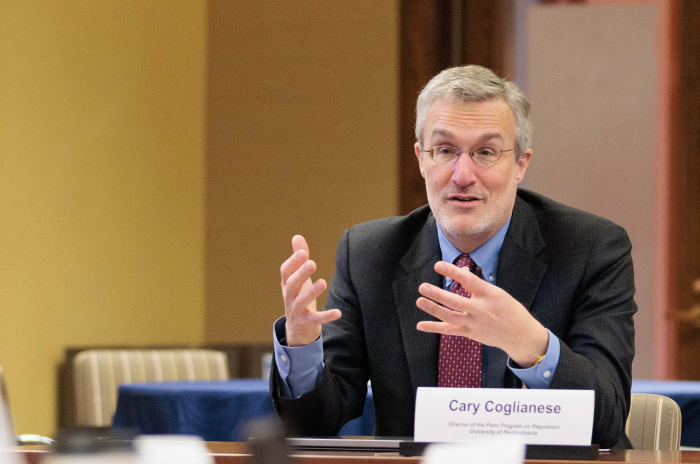
Cary Coglianese, Edward B. Shils Professor of Law and Professor of Political Science
Prof. Cary Coglianese served on the Pennsylvania Joint State Government Commission’s Advisory Committee on artificial intelligence, which delivered policy recommendations to state lawmakers
A new report delivered to the Pennsylvania legislature lays out a roadmap for regulating and adopting AI in the Commonwealth. Cary Coglianese, Edward B. Shils Professor of Law and Professor of Political Science at the University of Pennsylvania Carey Law School, served on the Advisory Committee that helped inform the report’s recommendations.
Titled “Artificial Intelligence: Advisory Committee Recommendations on the Adoption and Use of AI in Pennsylvania,” the 389-page report assesses AI’s rapidly expanding role across major sectors of society, including healthcare, education, government, and law enforcement. It also explores emerging concerns such as deepfakes, the role of chatbots, and protections for children.
Coglianese, founder and director of the Penn Program on Regulation, was among 20 advisors from academia, industry, and government appointed to the Advisory Committee in response to House Resolution 170 of 2023. The committee spent more than a year studying AI’s current and potential future impact on Pennsylvania and examined how other states are responding to the technology.
“It was a privilege to serve on the statewide advisory committee for this project,” said Coglianese. “Few policy issues today are as challenging and important as those related to AI governance.”
An expert on regulatory governance and algorithmic decision-making, Coglianese is a leading voice at the intersection of law, technology, and public policy. He is also affiliated with the Wharton AI & Analytics Initiative and the Wharton Human-AI Research program.
The advisory committee’s recommendations address issues of privacy, transparency, and accountability in AI deployment. They call for standards for the construction and operation of data centers, investments in education and workforce development, and the creation of a Chief Artificial Intelligence Officer within the Governor’s Office of Administration to coordinate statewide strategy and implementation.
Among its more detailed recommendations, the report urges the state to limit and disclose personal data collection for AI systems, create a data broker registry so individuals can track and delete their information, and require AI use disclosures in high-risk areas such as hiring, healthcare decisions, and public services.
The report also emphasizes that AI in schools must be backed by evidence of educational benefit and equitably accessible while supporting — not replacing — student-educator relationships. In addition, it recommends reporting requirements for data center resource use to inform community planning.
The Advisory Committee examined AI use in the legal profession, including efforts by bar associations, courts, public defenders, and district attorneys to regulate AI use. The report highlights initiatives to improve AI literacy among law students, and, underscoring both the potential benefits and risks of AI in legal practice, it discusses some of the high-profile cases of AI “hallucinations.”
“The report’s emphasis on care and vigilance with respect to the use of AI offers valuable lessons for legislators and practicing lawyers alike,” said Coglianese.
As a roadmap for policymakers, the report is designed to help Pennsylvania lawmakers navigate both the opportunities and challenges of AI adoption, while setting a potential model for other states.