
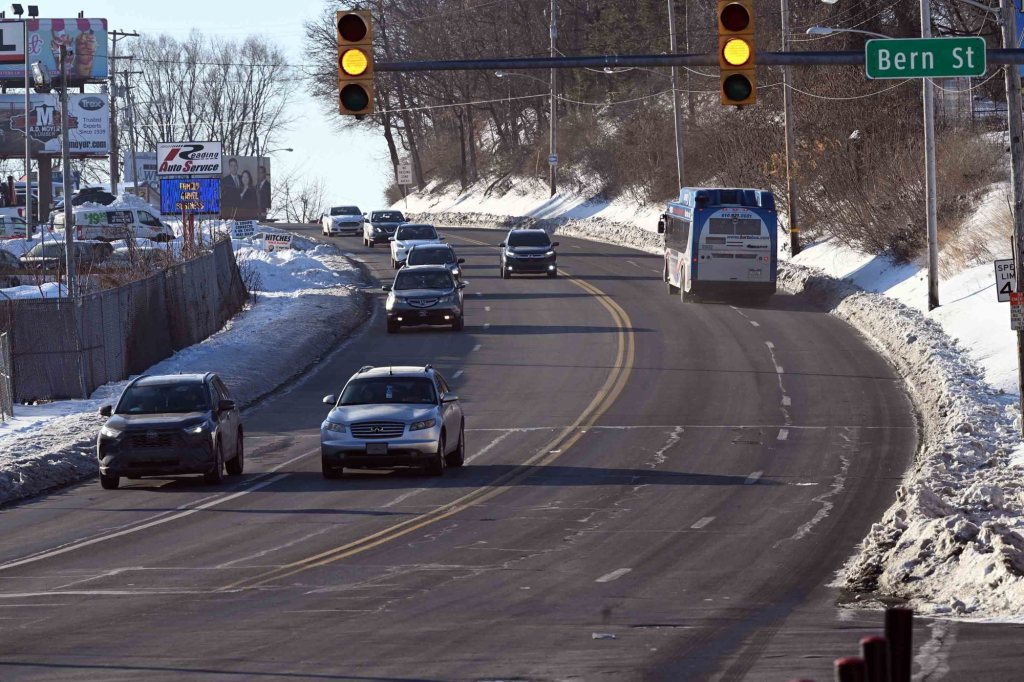
Reading’s commitment to Vision Zero aims to eliminate traffic deaths and serious injuries.
Charles Gushue, a traffic engineer with McCormick Taylor Engineering, the city’s consultant on the effort, recently provided City Council with an update on how a proposed traffic-calming policy and corridor crash analysis could reshape street design and improve safety citywide.
Council and city staff have been working with McCormick Taylor on a draft traffic-calming policy since mid-2024.
“You know, the city of Reading is committed to a Vision Zero pledge,” Gushue said. “So this is part of the traffic-calming policy.”
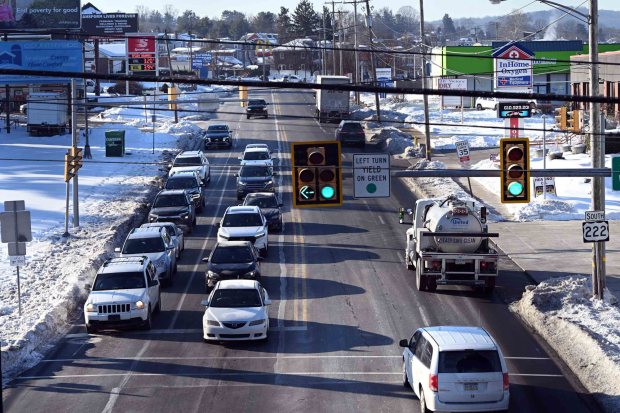 Lancaster Avenue between Route 422 and Kenhorst Boulevard recorded 210 crashes between 2019 and 2023. (BILL UHRICH/READING EAGLE)
The policy and supporting analysis, he said, are intended to provide a structured, data-driven approach to slowing traffic, protecting pedestrians and cyclists, and reducing crashes.
Gushue recommended the city establish a local traffic advisory committee composed of council representatives and city pertinent staff to help identify problem areas and guide implementation.
“This committee would just be an independent body,” he said, noting it would help identify city locations in need of traffic-calming measures.
Timothy Krall, who retired last month as city engineer, said an ad hoc committee, including key staff members and Council President Donna Reed, had been working to identify problem areas before 2020.
Reed noted several high-priority corridors, including Fifth Street and Hampden Boulevard, were identified and noted at regional transportation meetings, bringing them to the attention of county and state officials.
Gushue said 10 key corridors with high-crash density have been identified:
• Fifth Street
• Perkiomen Avenue
• Lancaster Avenue
• Washington Street
• Ninth Street
• Schuylkill Avenue
• Fourth Street
• Franklin Street
• Spring Street
• Greenwich Street
The draft policy, he said, emphasizes low-cost safety improvements to targeted roads where possible and outlines a screening process that considers roadway ownership, speed, traffic volume, land use, crash history and community support.
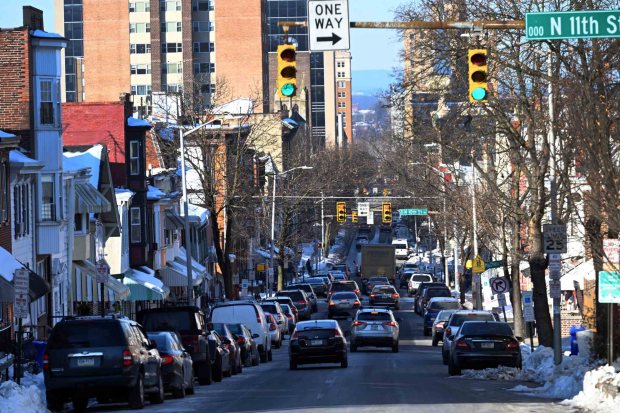 Washington Street from 11th to Front streets recorded 141 crashes between 2019 and 2023. (BILL UHRICH/READING EAGLE)
Projects on state-owned roads would require PennDOT approval, he noted, while improvements on city-owned streets would not.
PennDOT’s “three E’s” approach — education, enforcement and engineering — is built into the framework, Gushue said. Education and enforcement are often the first steps, he said, before physical changes are made to streets.
As part of the effort, McCormick Taylor analyzed crash data for 35 corridors citywide, including 15 identified by council, and highlighted 10 corridors with the highest crash density. The analysis looked at total crashes, fatalities, and pedestrian and bicyclist involvement.
Based on that data, the firm developed recommendations organized into three tiers, he said, reflecting increasing levels of cost and engineering complexity.
“We broke it down into a tier base of how much engineering would be needed in order to implement these recommendations,” Gushue explained.
Tier one includes lower-cost measures such as signage, pavement markings and lighting.
Tier two involves moderate engineering, such as curb extensions, raised crosswalks and speed cushions.
Tier three includes large-scale redesigns such as major intersection changes and so-called road diets, a strategy that physically reduces or reallocates roadway space to slow vehicles and improve safety.
Councilman Jaime Baez Jr. asked city officials how and when the recommendations might move from paper to practice.
“I think that this is crucial and important for the city of Reading to have a traffic-calming policy,” Baez said.
City Managing Director Jack Gombach said the administration is reviewing the proposals with budget constraints and long-term effectiveness in mind.
“Our ultimate goal that we want to see is street design that encourages self-enforcement, not just targeted enforcement,” Gombach said. “We are committed to Vision Zero, so we also want to do it in alignment with that.”
Gombach said the city cannot implement every recommendation at once and would likely take a phased approach, potentially using local funds, PennDOT multimodal transportation grants and liquid fuel funds.
The latter are revenues from the state’s liquid fuels tax dedicated for local road and bridge work.
“We can’t afford to do everything,” Gombach said. “So we have to do it in a phased approach.”