
The state Department of Transportation is hosting an online public meeting Thursday afternoon on the long-sought restoration of passenger rail service between Scranton and New York City.
The project proposes to have Amtrak passenger trains run between Scranton and Manhattan’s Penn Station with stops in Mount Pocono and East Stroudsburg in Pennsylvania, and Blairstown, Dover, Morristown, Montclair and Newark in New Jersey. It would mark the return of passenger rail service between Scranton and NYC for the first time since 1970 and generate $84 million in new economic activity annually, per an Amtrak study released in March 2023.
PennDOT’s virtual public meeting webinar on the project, which started at 4 p.m., is part of the agency’s service development plan. Participants had to register in advance and get an invite for a webinar link and the session filled up, according to the Advancing PA Rail website.
“We have reached the maximum number of registered attendees for this public meeting. We apologize for the inconvenience. A recording will be publicly available on this page after this meeting. Comments and questions can be submitted to ra-pdpassengerrail@pa.gov,” the website said.
A recording of the webinar will be available for viewing on the project website for at least 60 days following the meeting.
The webinar aims to give an overview of the Scranton to New York Rail initiative, a summary of the route options, and locations for potential stations.
PennDOT Secretary Mike Carroll gave an introduction, calling the passenger rail proposal a “historic opportunity,” and this latest step in the process a significant milestone.
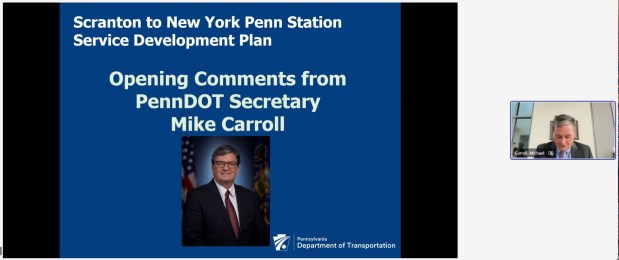 PennDOT Secretary Mike Carroll during a webinar on Thursday, Feb. 19, 2026, on restoring passenger rails between Scranton and New York City. (IMAGE SCREEN COPY / PENNDOT WEBINAR)
Various officials are giving an overview of the aspects of the proposal.
According to the PennDOT and archives of The Times-Tribune:
• The Scranton-to-NYC proposal is one of just five in the nation to have advanced to the second-step milestone of the three-step federal Corridor Identification and Development Program to identify new, viable passenger train routes. The second step involving completion of the “Service Development Plan” is a precursor to the third step.
• If attained, the third step would include additional project development work — engineering, environmental reviews and the preparation of bid documents, budgets and timelines, among other examples — to prepare the proposed passenger rail corridor for construction and eventual service. As a prerequisite to accessing funding, the third stage could potentially deliver hundreds of millions of dollars for rail construction and related work.
• So, while the corridor proposal progresses incrementally, it likely won’t be ready to run passenger trains for at least several years.
• PennDOT’s Service Development Plan includes: stakeholder engagement with railroads, agencies, and the public; service options analysis and transportation planning; capital project identification, conceptualization and cost estimates; environmental analysis; and financial and implementation planning.
• The proposed Amtrak corridor would provide a new passenger service option — three daily round trips — for underserved Northeast Pennsylvania and Northwest New Jersey. Prior studies, including the 2021 Amtrak Connects US Corridor Vision Plan and long-range transportation plans, show growing demand for intercity passenger rail service along a corridor that has heavy auto traffic and unpredictable travel times for commuters and other travelers.
• The proposal calls for using mostly active rail lines and rebuilding an abandoned section. With PennDOT as the lead agency and Amtrak as the proposed operator, the owners of the route — Pennsylvania Northeast Regional Rail Authority (PNRRA), New Jersey Department of Transportation, New Jersey Transit (NJT) and Amtrak — are all project partners in working to restore passenger service to this corridor.
The route from Scranton to New York City last served passenger trains in 1970 as part of the Erie Lackawanna Railroad. The entire right of way remains intact, and various public rail operators use parts of it. Here’s a look at the various segments:
In Pennsylvania:
• Starting in Scranton, the 60-mile segment of the route in Pennsylvania and across the Delaware River is owned by PNRRA and currently used for freight rail service and Steamtown excursion trains between Scranton and Slateford. One mile of track south of Slateford Junction was previously removed and will need to be reconstructed for passenger rail restoration between Scranton and New York City.
In New Jersey:
• The Lackawanna Cutoff, a segment of the route between Slateford and Port Morris, carried its last freight train in 1979 as part of the Conrail network and later had its tracks removed. This segment is owned by the New Jersey Department of Transportation, which is actively reconstructing about 7 miles of track at the east end to extend its commuter service from Port Morris to Andover. The other 20 miles from Andover to the Delaware River also will need to be restored.
• From Port Morris, the route would run over existing NJT commuter lines to Kearny.
• At Kearny, the route connects to Amtrak’s Northeast Corridor for the last 8 miles into New York Penn Station.
After PennDOT’s Service Development Plan is completed and federally approved, the projects would advance to preliminary engineering and environmental review. For information, see PennDOT’s website on passenger rails in Pennsylvania at pa.gov/agencies/penndot/traveling-in-pa/passenger-rail.
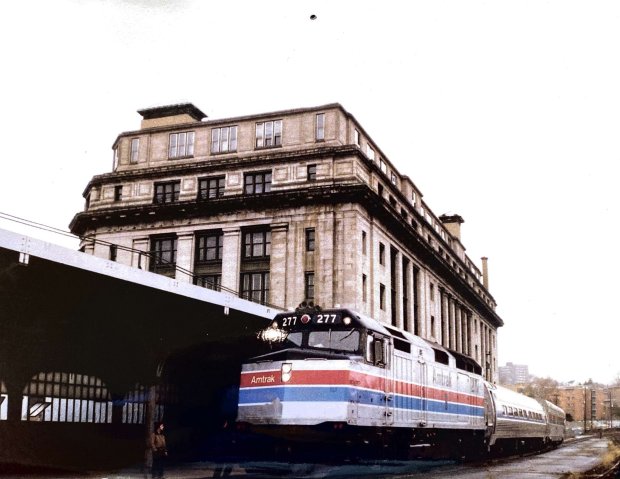 COURTESY OF DOMINIC KEATING This special Amtrak train visited Scranton on Nov. 13, 1979, as part of an inspection of the route between Hoboken, N.J., and the Electric City.