
Housing advocates don’t buy Cohen’s logic. Gray said the city’s “good cause” requirement is intentionally flexible, meaning landlords have considerable latitude when it comes to explaining why they want to stop renting to someone.
“I can’t think of a situation that’s not already provided in the statute. But it’s not exhaustive for that reason,” Gray said.
And while a tenant can file an appeal, a landlord can ask a judge to reject it if they believe the argument to be in “bad faith.” Regardless of the outcome, a landlord could still move forward with an eviction filing after going through the city’s diversion program, a requirement before the matter can proceed to court.
It can now take up to eight months for the Philadelphia Sheriff’s Office to perform a lockout, said Cohen.
Passing the Safe Healthy Homes Act
The debate over “good cause” evictions is part of a broader legislative effort by O’Rourke to better protect renters in Philadelphia, particularly low-income tenants who often fear retaliation for speaking up about their living conditions.
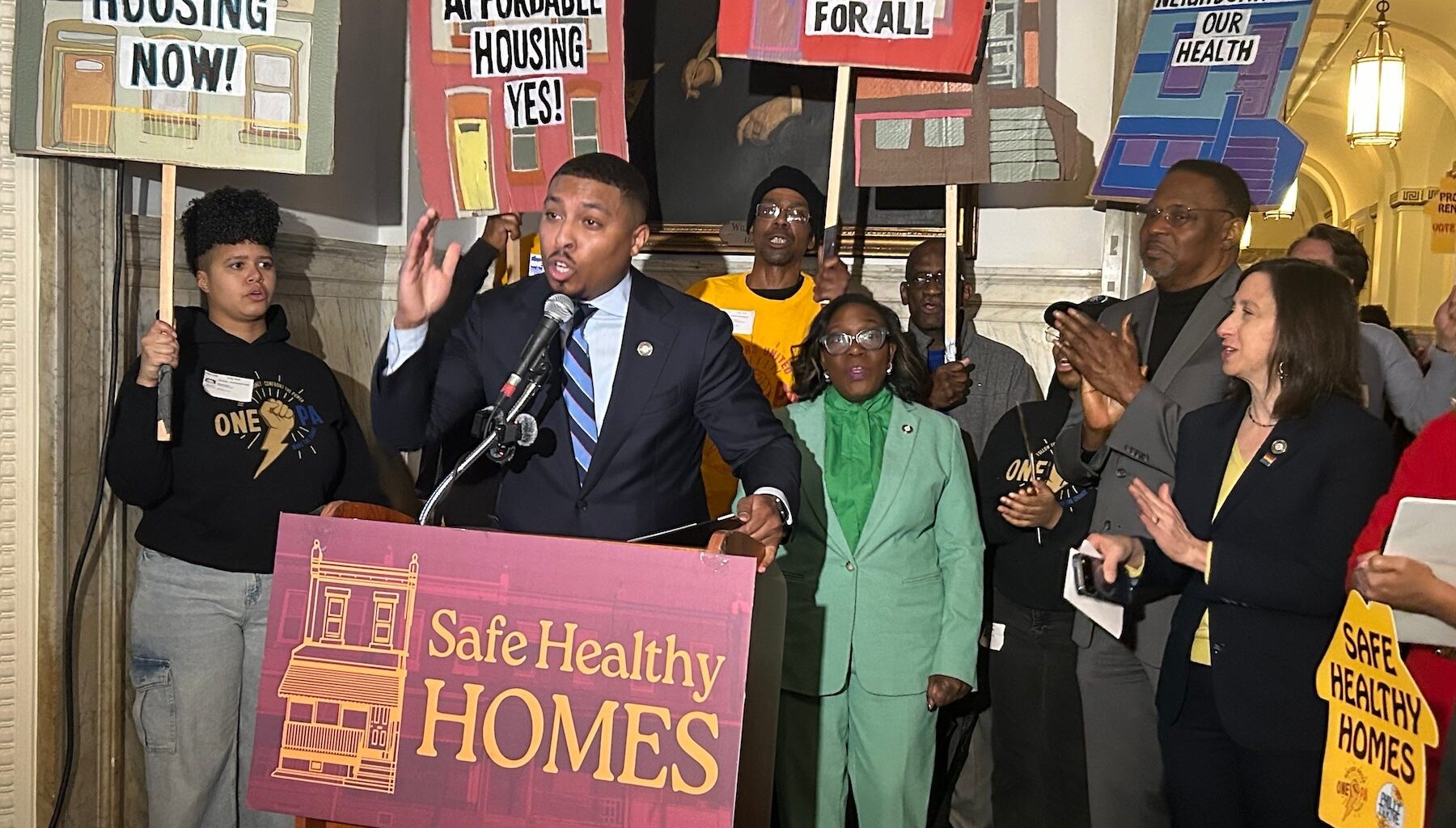
This session, the council member hopes to pass two bills introduced in April through the Safe Healthy Homes Act. The legislative package is guided by three rights the lawmaker says must be preserved for tenants — the right to safety, the right to repairs and the right to relocation — especially at a time when historically high rents continue to put pressure on cost-burdened renters.
The federal government defines “cost-burdened” as spending more than 30% of household income on housing. In Philadelphia, more than half of all renters fit that description.
Last summer, Council passed a measure authorizing the city to create an antidisplacement fund for tenants forced to move because their property has become uninhabitable. Dollars for the fund, which will provide one-time payments to tenants, were added to the first budget for the mayor’s Housing Opportunities Made Easy, or H.O.M.E., initiative.
Following a public hearing last year, O’Rourke agreed to hold two of the three measures comprising the package. Now he’s pushing to get them passed.
“Even affordability isn’t enough if your home is not safe. You should not have to be submitted and subjected to living in accommodations that are unhealthy for you,” said O’Rourke at a Thursday news conference.
Passage would authorize the city to create a program to conduct proactive inspections of rental properties on a “regular cycle,” a longtime priority for advocates seeking tenant displacement protections.
The legislation would also clarify when a tenant can receive a rental rebate. Under the proposal, a tenant could sue for relief if a landlord collected monthly rent without having an active rental license or certificate of rental suitability. Both are required for landlords to legally collect rent.
As it stands, the law only allows a renter to stop paying rent if they find their landlord is in violation. They are not entitled to recoup any rent they have already paid.
HAPCO Philadelphia is strongly opposed to this provision, saying a landlord could be put out of business if multiple tenants sue — and win — over these technical violations.
In Philadelphia, one rental license can cover an entire building. And under O’Rourke’s legislation, the city would have to notify tenants if their landlord has a suspended rental license. The same is true if a landlord is not meeting the requirements for a valid certificate of rental suitability.
“When the city comes up with additional regulations, and the landlord has to pay additional money, that money has to get passed onto the tenant in the form of additional rent,” Cohen said.
O’Rourke said Thursday that every member of Council’s housing committee has verbally committed to advancing the bills for a full Council vote.
A spokesperson for O’Rourke said the council member has enough votes to send the measure to Mayor Cherelle Parker’s desk.