
As the United States approaches its 250th birthday, the spirit that gave rise to our nation feels especially alive in Philadelphia.
At Carpenters’ Hall, colonial leaders gathered in 1774 to debate the economic and political independence that would soon define a new nation. They understood that liberty required more than words — it required the capacity to build, produce and sustain an economy of our own. Independence, in other words, demanded industrial strength.
That belief still animates the National Association of Manufacturers and the millions of Americans who make things in this country today. It’s why we’re gathering at this historic site for the Philadelphia stop of the NAM’s annual State of Manufacturing Tour — a nationwide effort to spotlight the policies, initiatives and innovations shaping the future of manufacturing in the United States.
The theme of this year’s tour — “Then. Now. Tomorrow.” — could not be more fitting for Pennsylvania.
“Then,” this region helped lay the foundation for U.S. enterprise, supplying the steel that built our cities, the equipment that won wars and the ingenuity that fueled economic growth for generations. That foundation carried us into a strong “now,” as manufacturers adapt at warp speed to technological change and an increasingly competitive global landscape.
Pennsylvania’s manufacturing sector continues to meet this moment.
Just last month, Johnson & Johnson announced plans to build a next-generation cell therapy manufacturing facility in the Commonwealth. In the Lehigh Valley, Mack Trucks completed an $84 million expansion to produce its first fully electric heavy-duty trucks — modernizing while preserving its industrial roots. Westinghouse and Google have partnered to deploy custom artificial intelligence platforms to reduce the cost and timeline of nuclear reactor construction. And South Korean defense firm LIG Nex1’s $240 million acquisition of Philadelphia-based Ghost Robotics underscores the region’s role as a global hub for advanced robotics and AI-driven manufacturing.
This Manufacturers’ Accord for the Next 250 Years reflects a simple but powerful conviction: that manufacturing, innovation and enterprise have always been central to America’s strength — and will determine its future.
The Commonwealth is also planning intentionally for “tomorrow.” The Philadelphia Academies and Philadelphia Works are expanding advanced manufacturing pre-apprenticeships and welding programs, recognizing a simple truth: Manufacturing strength ultimately depends on human talent.
Still, tomorrow’s success is not guaranteed.
To compete and lead, manufacturers need policies that deliver speed, scale and certainty. That means implementing the historic, federally ordered 2025 tax reforms of H.R. 1, aka the “One Big Beautiful Act,” so manufacturers can reinvest, expand and raise wages. It means fixing a broken permitting process to get projects moving faster. It means securing U.S. leadership in AI by encouraging innovation — not stifling it with regulatory overreach. And it means achieving energy dominance, using every available source to meet surging demand and power both factories and the digital economy.
Finally, it means tackling the workforce challenge head-on. With nearly 2 million manufacturing jobs projected to go unfilled by 2033, we must expand apprenticeships, modernize training pathways and elevate awareness of high-skill, high-wage manufacturing careers.
As the United States marks its semiquincentennial, manufacturers and business leaders are stepping forward with a renewed sense of responsibility. At Carpenters’ Hall, we will affirm a shared commitment — rooted in free enterprise, competitiveness, individual liberty and equal opportunity — to help guide the nation through its next chapter.
This Manufacturers’ Accord for the Next 250 Years reflects a simple but powerful conviction: that manufacturing, innovation and enterprise have always been central to America’s strength — and will determine its future.
The leaders who gathered here centuries ago gave us a blueprint. American manufacturers built the structure. Now it’s on us to ensure that what we build next honors that legacy — then, now and tomorrow.
Jay Timmons is president and CEO of the National Association of Manufacturers. David N. Taylor is president and CEO of the Pennsylvania Manufacturers’ Association.
The Citizen welcomes guest commentary from community members who represent that it is their own work and their own opinion based on true facts that they know firsthand.
 MORE ON INDUSTRY, JOBS, AND THE PHILADELPHIA ECONOMY
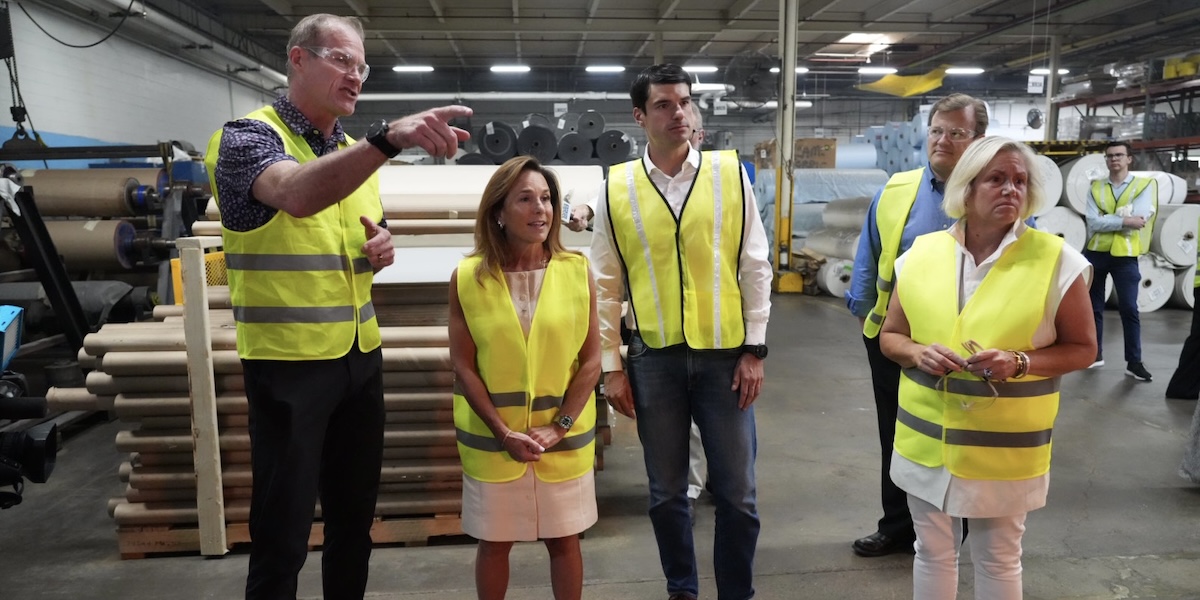
A recent tour of the i2M polymer film manufacturing plant in Mountain Top, PA. Left to right: Jay Timmons, Congresswoman Lisa McClain (R-Michigan) and Republican U.S. Congressman Rob Bresnahan from PA’s 6th District. Photo courtesy of the National Association of Manufacturers.