
Artificial intelligence has exposed structural flaws in higher education, according to one scholar.
Hollis Robbins, a professor of English and special adviser for humanities at the University of Utah, spoke about AI’s effects on higher education to about 50 professors in a lecture on Wednesday evening sponsored by the E3 project. From the Teplitz Memorial Courtroom in Pitt’s School of Law, Robbins said AI is exposing more problems than it’s causing in the structure of higher education.
Universities across the country, including Pitt, are offering free AI services and partnering with AI companies. Pitt recently partnered with Anthropic to provide Claude for Education to all students and faculty. AI’s integration in universities and its high usage among students have sparked a reconsideration of the purpose of higher education.
Through an analysis of different forms of information, Robbins discussed AI versus humans’ capability to produce knowledge, detailed what she believes to be the highly scaled structure of higher education, and emphasized the resulting increasing importance of specialized, expert knowledge. Robbins argued that in an effort to make their course content as transferable across institutions as possible, universities are delivering the same information that generative AI does.
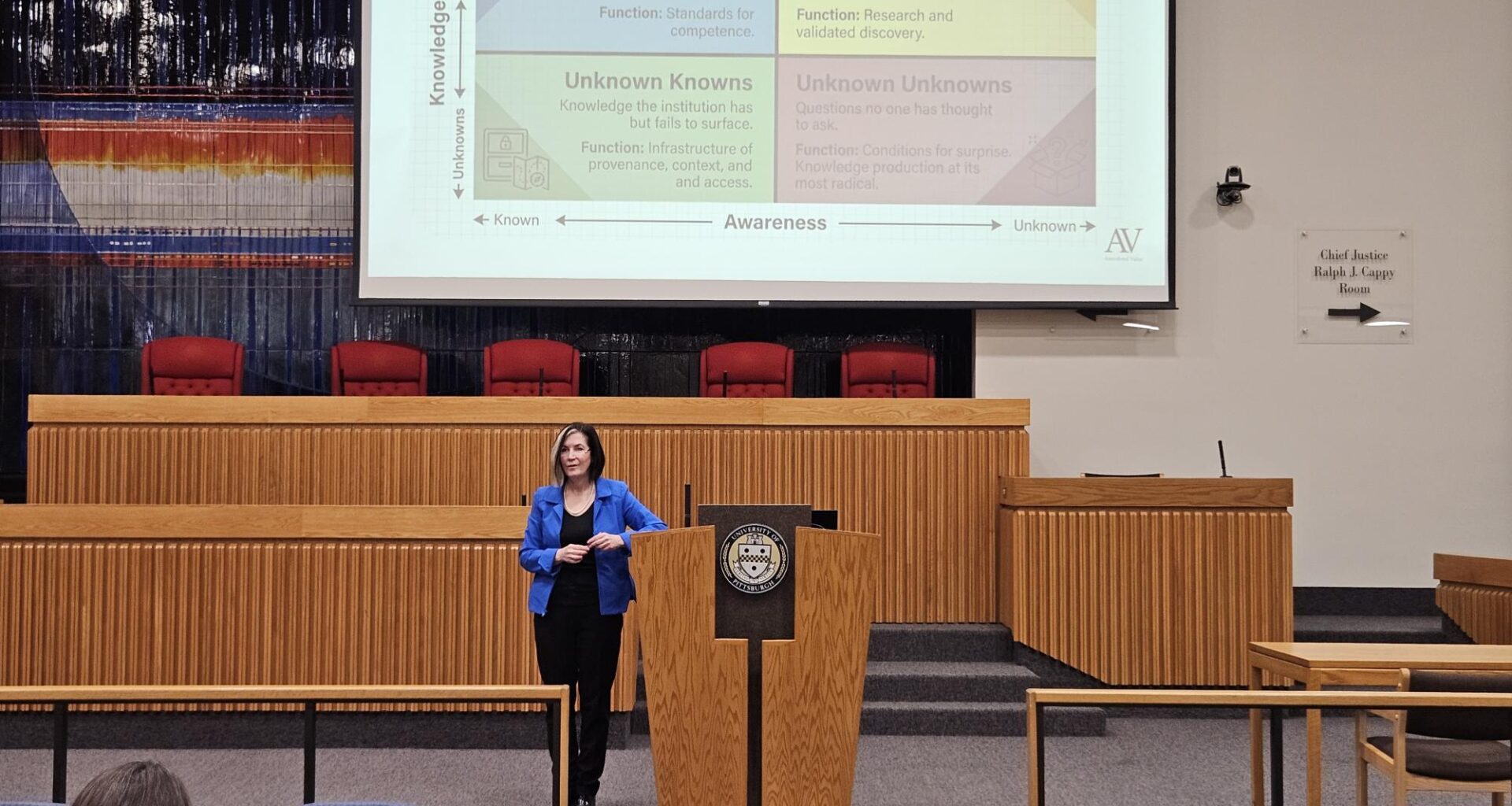
Robbins based her lecture on the Rumsfeld Matrix — a framework dividing information into four categories, including “known knowns,” “known unknowns,” “unknown knowns” and “unknown unknowns.” Robbins said she asked Google Gemini to generate an education-oriented Rumsfeld Matrix. Gemini described the “known known” category as “established knowledge the institution delivers.” In the context of higher education, Robbins said she believes this includes general education classes; survey classes; and memorizable facts, dates and vocabularies.
“This is where almost every dollar in American higher education goes,” Robbins said.
“It scales. Any competent instructor can deliver something from the same syllabus in some general education classes.”
The problem, Robbins believes, is that while universities pour resources into teaching “known known” information, artificial intelligence also specializes in this type of information.
“We’re in the AI era, a period … [of] ‘known known’ abundance. Because of AI, everything is everywhere, so the question is, ‘Should we be teaching it when it’s everywhere?’” Robbins said.
As a representation of her perceived “known known abundance,” Robbins had ChatGPT regenerate Trump’s 1776 Commission Report from 2021. Robbins found the product to be quite accurate to the original, because, she said, the original report did not “demonstrate familiarity with any primary source“, reference any archives, and or include archival scholars in its authorship.
“You can feed [the report] back into a pro model, and it will basically give you some version of the President’s Advisory Report. Why? Because the entire thing is a ‘known known’ document,” Robbins said. “A machine can produce it because a machine is what it sounds like.”
“Unknown unknowns” constitute the fourth quadrant of the matrix, which Robbins said she believes universities should focus more on. Robbins added that in higher education, this category could include “documents in an archive that nobody has cataloged [or] expertise in a retiring professor’s head that’s never been transmitted.”
“The unknown unknowns, I think, are also really important for education — [the] buried assets,” Robbins said.
Robbins said she believes universities are currently focused on delivering the same course to the largest possible number of students at the lowest possible cost. As a result of scaling, Robbins said, instructors, students and assessments are interchangeable across universities, making expertise more rare.
“Expertise is the enemy of scale, because an expert is not interchangeable,” Robbins said.
According to Robbins, 12 states mandated statewide college credit transfer in 1991, compared to at least 44 today. Dubbing it the “transfer industrial complex,” Robbins said this phenomenon has left universities in a situation where large language models can deliver most course content.
“A course designed to transfer is a course whose content an LLM can deliver,” Robbin said. “AI didn’t cause this, but AI is revealing it. AI can do quadrant one better than the university can.”
The solution to this, Robbins explained, is finding the “last mile” of AI — what it cannot generate, leaving the student to conduct individual research. Robbins said the universities that succeed will maintain archives, teach languages and “fund the slow, cumulative, painstaking labor that produces knowledge AI can summarize later, but cannot generate on its own.”
“Universities that organize themselves around the last mile and around the unknown quadrants will survive,” Robbins said. “Universities that stay in quadrant one are competing with a machine, and the machine is faster.”
In an interview with Michael Madison, professor of law and an organizer of the E3 project, said the effect of Pitt offering Claude for Education largely depends on how individual teachers and departments implement it, but that it also poses some risk for learning, specifically in general education classes.
“I do think there is a risk that making Claude or other AI available will increase the disaffection of some students for course material,” Madison said. “The challenge in the gen ed world is how you make the gen ed course content and the course teaching interesting and attractive and valuable to students. That’s a basic problem.”
In an interview with The Pitt News, Robbins elaborated on what she believes are the flaws in higher education that are being exposed by AI.
“Working with your hands has been pushed aside in most universities because it doesn’t scale well. You can’t take a large online asynchronous class that involves working with you like an apprentice,” Robbins said. “It’s the online asynchronous course model that has actually caused the problem, not the AI.”
Robbins said she believes working in the trades might currently be a better option than attending a university, adding that there is a false perception that blue-collar work is incompatible with being an intellectual.
“Why would you think just because you work in a mine, you’re not going to like Dickens?” Robbins said. “Somehow, our education system has produced this elitist idea that you have to go to college to be interested in interesting things.”