
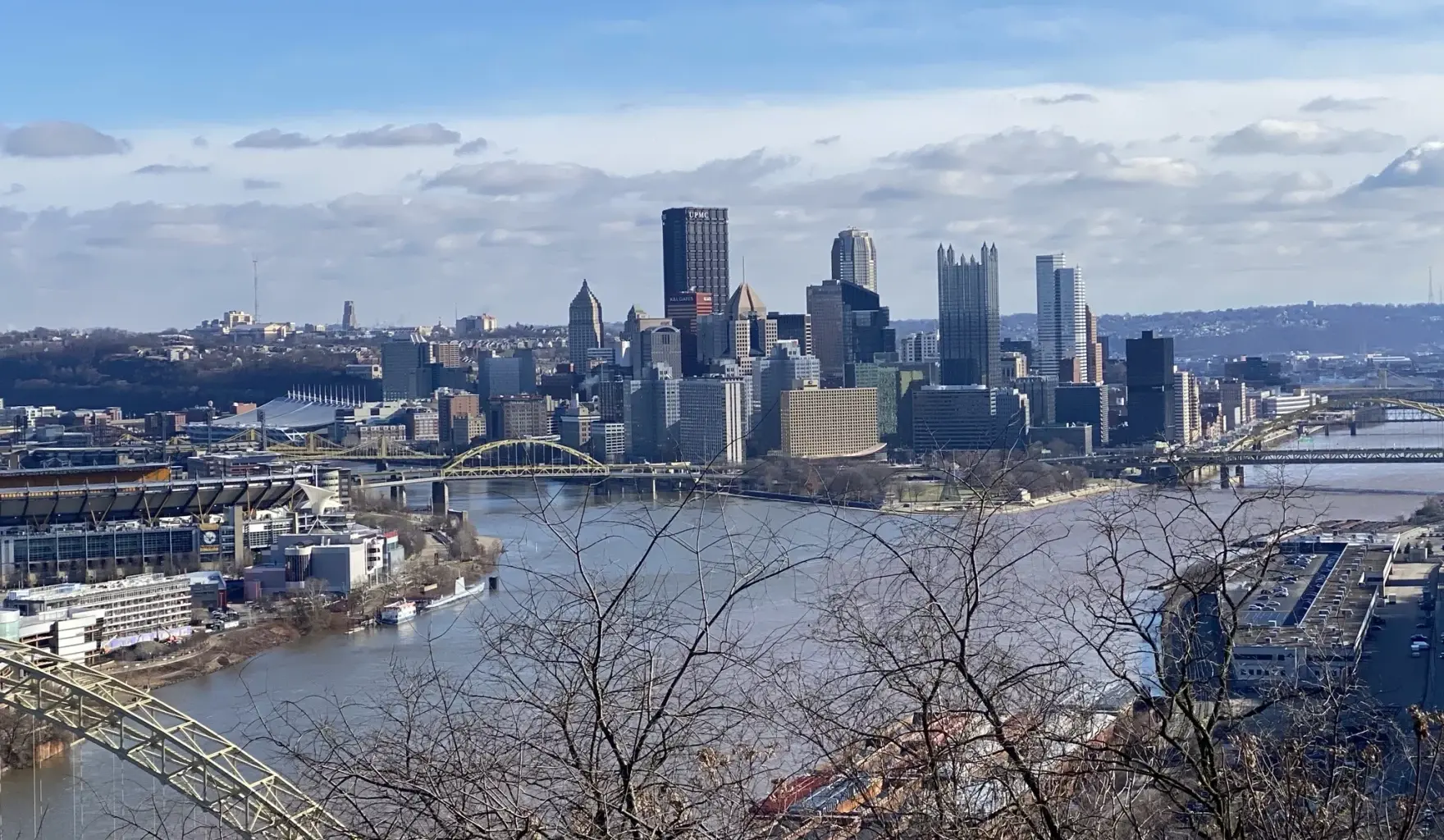
A new study finds air pollution in the Pittsburgh region was responsible for up to 3,500 deaths in 2019. The study found that even air quality considered “safe” by regulators led to premature deaths.
The researchers found that air pollution not only led to increased deaths, but it also had other negative impacts, from lowered IQ in children to adverse birth outcomes.
“People need to recognize that this pollution is causing disease, it’s causing premature death,” said Dr. Philip Landrigan, a pediatrician and public health physician at Boston College, who is one of the study’s authors.
LISTEN to the story
https://s3.us-east-1.amazonaws.com/media.alleghenyfront.org/AF022026_RF_PollutionStudy.mp3
The study calculated the impact of PM 2.5, a class of fine particles small enough to go deep inside the lungs. These particles have been linked to a wide array of health effects.
“Among infants, it’s causing increased low birth weight babies, increased still births. Among adults, it is causing heart disease and stroke,” Landrigan said.
Read More
The study, published in the journal Annals of Global Health last month, was funded by The Heinz Endowments, which also supports The Allegheny Front.
The authors compared satellite imaging for air pollution with death records from the eight-county Pittsburgh metropolitan region.
Landrigan says they then estimated how many of those deaths were linked to air pollution in 2019.
“We’re saying that between 11.1 and 12.5 percent of all deaths in the Pittsburgh metropolitan area are due to air pollution,” Landrigan said. “What I cannot tell you is which particular death is due to air pollution.”
The study found that 229 premature births, 177 low‑weight births, and 12 stillbirths could be attributed to pollution. Among the 24,604 children born in the Pittsburgh region in 2019, the study found that pollution was linked to the loss of 60,668 IQ points, resulting in estimated lifetime economic losses of $2.7 billion.
When it comes to air pollution’s link to IQ, Landrigan says studies from the U.S. and other countries “found that higher levels of PM 2.5 air pollution are associated with lower IQ in children.”
But Jim Fabisiak, director of the University of Pittsburgh’s Center for Healthy Environments and Communities, warned that the role of pollution in children’s IQ is still an evolving corner of public health science.
“There’s a lot of uncertainty when it comes to IQ in terms of the effects of air pollution,” Fabisiak said. “What’s the appropriate exposure window for the effects of pollution on IQ? Is it prenatal? Is it something in early childhood?”
He said putting a “very fine number” on the impact on IQ, as the study had done, would be hard to do given these uncertainties.
Fabisiak said the study was a good example of how science could localize pollution’s impact. Globally, air pollution is responsible for 7 million deaths a year.
“So many times we hear numbers that relate to the global burden, and I think that becomes harder for the average person to wrap their head around,” Fabisiak said.
“I think [this study] puts it into the perspective of, this is what’s happening in my region and to my neighbors.”
Even low levels of air pollution found to be harmful
The study also showed that even at very low levels, air pollution is dangerous.
About half the deaths – 1,500 – calculated by the researchers were for pollution levels at or below 5 micrograms per cubic meter, well below the current federal clean air standard for ambient air of 9 micrograms per cubic meter.
Erika Garcia, assistant professor of population and public health sciences at the University of Southern California, says pollution will never reach zero.
“That’s unrealistic for PM 2.5,” Garcia said. “I don’t think we’re really ever going to get down [to zero]. Even if you look at the cleanest areas across the world, you’re going to have some background level of PM 2.5.”
In recent years, the region’s air has started to come into compliance with federal clean air standards, but still ranks among the country’s dirtiest, in part because of large pollution sources like the steel industry. The American Lung Association ranks the region 12th-worst in the country for year-round particle pollution.
Still, Garcia, who was not involved in the study, said the numbers derived in the study, even if they’re just estimates, give a sense of air pollution’s costs in a region like Pittsburgh.
“I think it is an important demonstration that shows that cleaner air still has a potential to save lives, even in places that are meeting current regulatory standards,” she said.
Karen Clay, an environmental economist at Carnegie Mellon University who was not involved in the research, said the study showed that pollution imposes “real costs” on communities.
“It shows that it’s not free to just let people pollute as much as they want,” Clay said. “Nobody wants their grandmother to die a year earlier. Nobody wants their baby to be stillborn. These are really important societal impacts.”
In an emailed statement, a DEP spokeswoman said the eight-county region currently meets federal air standards, and that it’s monitoring advances in satellite data for pollution detection.
The Allegheny County Health Department, which enforces clean air laws in Allegheny County, said in a statement that particulate matter had decreased 20 to 30 percent from 2016 to 2024, “through cooperative efforts at the local and federal level.” It pointed to its real-time air quality updates and forecasts, which help people take steps to protect themselves, especially on high-pollution days.
The study calls for stronger federal air quality standards, stricter enforcement, and investments in clean energy and electric vehicles.
“The first step is to enforce the federal air pollution control standards,” said Landrigan. “Just as you don’t allow people to drive down the interstate at 120 miles an hour. Pollution is no different.”