
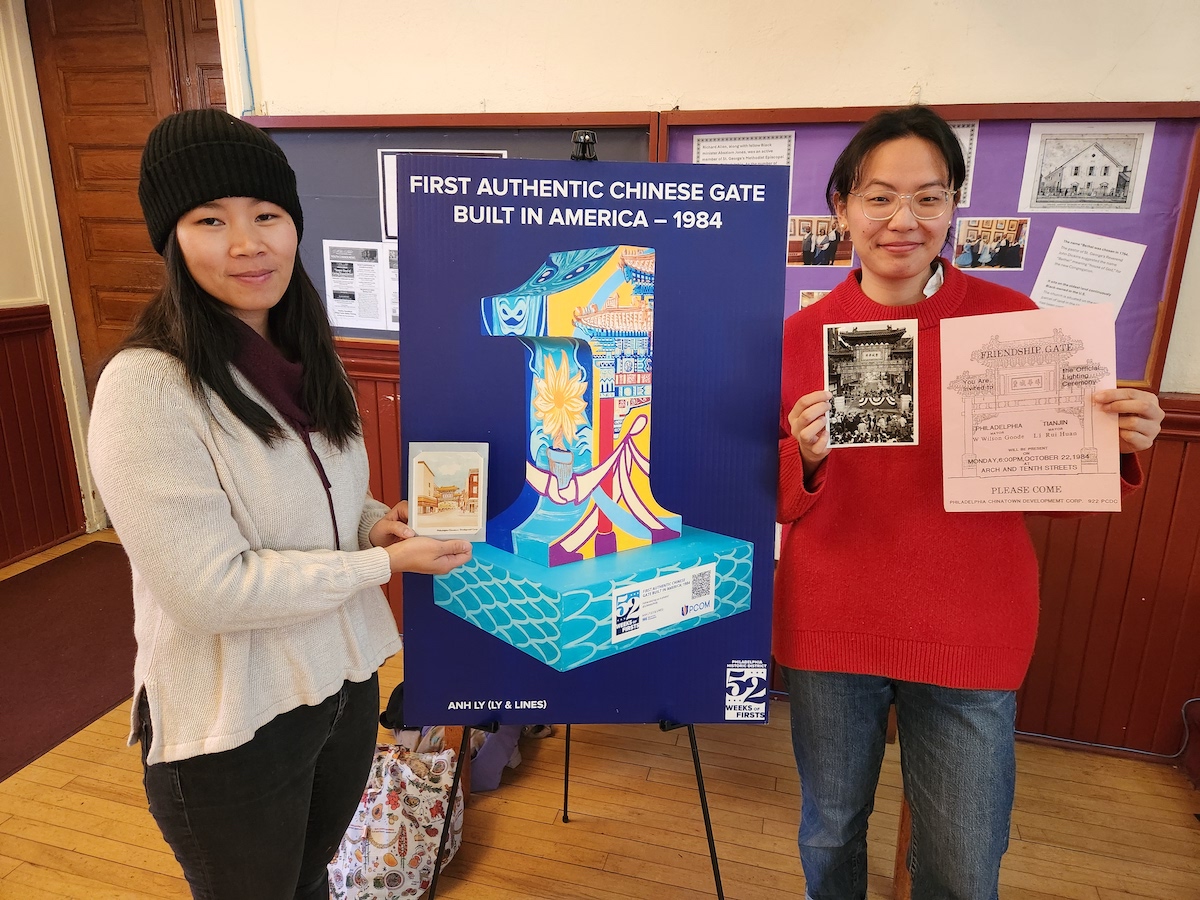
As Lunar New Year celebrations continue across the city and world, the Philadelphia Historic District’s “52 Weeks of Firsts” will reflect on the power of friendship across continents and cultures this Saturday at a “Firstival” recognizing the construction of the first authentic Chinese Friendship Gate built in America, which went up in 1984.
Standing at 10th and Arch streets at the entrance to Philly’s historic Chinatown, itself over 150 years old, the Friendship Arch was designed by Chinese American Philadelphian architect Sabrina Soong and built by artisans in Tianjin, China, Philadelphia’s sister city.
“A powerful symbol of cultural pride and community presence,” the arch “symbolizes international cultural exchange – and proves that friendship, like good architecture, is strongest when built together,” said the Historic District’s 250th Committee, formed to celebrate the U.S. semiquincentennial.
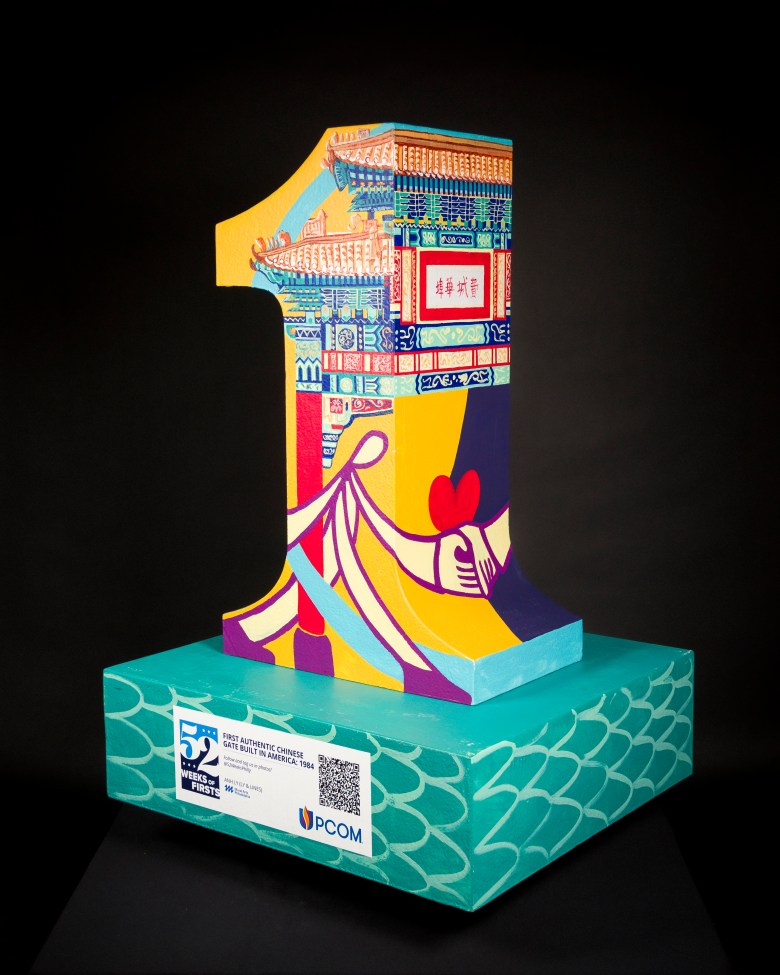
Each “first” celebration is commemorated with a sculpture in the shape of a numeral 1, uniquely painted by one of 25 local artists selected by Mural Arts Philadelphia.
Sculptor and muralist Anh Ly was selected to design Chinatown’s Firstival sculpture that currently sits at the northwest corner of 10th and Arch at the base of the gate, and will stay there all year. Ly also crafted the Mummers Firstival sculpture and the upcoming America’s First University sculpture.
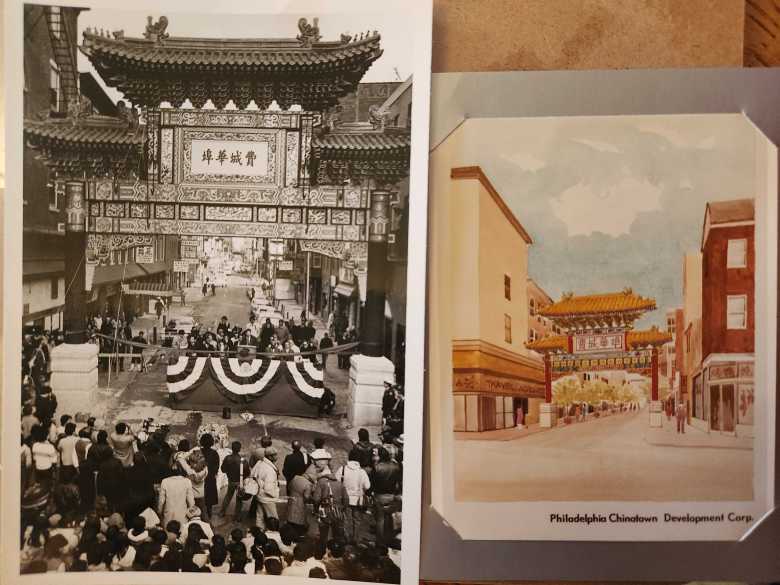 Photos from the 1984 opening ceremony and a promotional postcard of the Philadelphia Chinatown Friendship Gate. (Courtesy PCDC)
Built in Tianjin, then shipped across the Pacific Ocean in pieces before being assembled by a team of visiting artisans from Tianjin and Beijing into an 88-ton, 40-foot tall, brightly colored Qing Dynasty-style arch, the gate essentially serves as a grand welcome sign to the neighborhood and Philadelphia.
“This gate is a monument to show our existence, that “We are here,”” said Ly, herself a Vietnamese immigrant with partial Chinese ancestral roots.
Ly’s sculpture is full of symbolism that resonates across time zones and generations.
“Tianjin is known for specialized bricks. Today, it has a ferris wheel bridge, and on each side has a person. So I used the Chinese character for “person” as a motif,” she explained. “On the other side, it looks exactly the same, but one side it is daytime and the other side is night time because China is in a different time zone.”
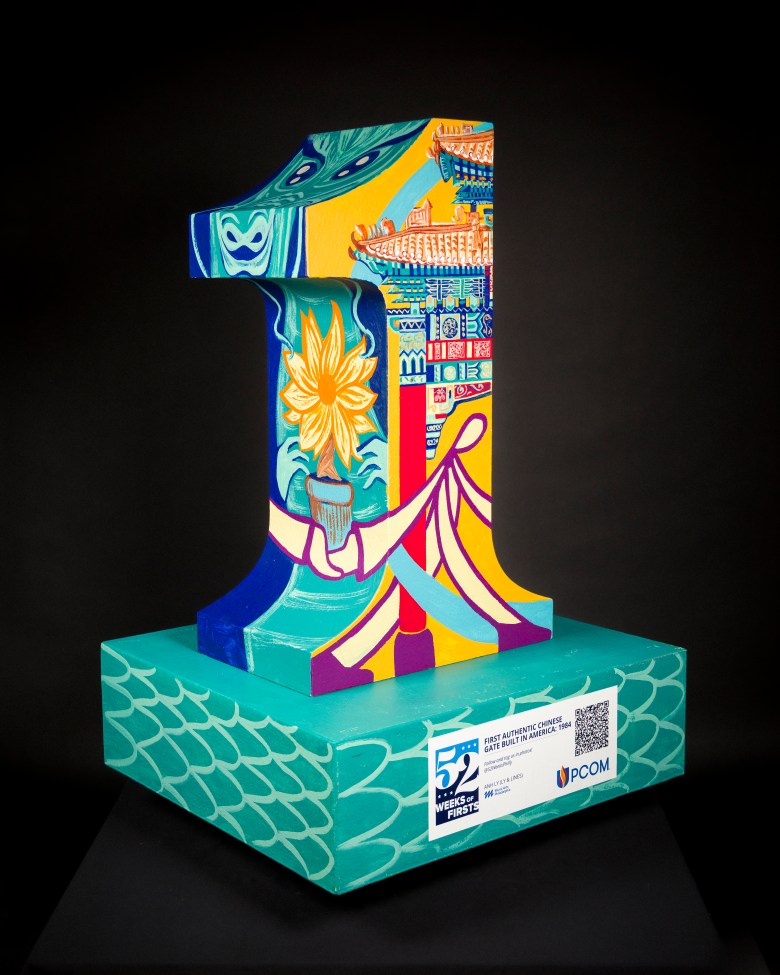
“Then we have holding hands, showing crossing borders,” she continued. “The flower is a sunflower, representing friendships that need two people to nurture with a dragon spiritual guardian and the two humans facing each other.”
How did Philly get the honor of the first authentic Friendship Gate?
The idea was percolating for since the 1960s amongst local Chinatown leaders, but it wasn’t until 1982 that Cecilia Moy Yep and architect James Guo went to China and formalized a Sister City agreement between Philadelphia and Tianjin in northern China.
Yep, who was then executive director of the Philadelphia Chinatown Development Corporation (PCDC), had helped halt the city’s attempted destruction of Holy Redeemer Chinese Catholic Church when building the Vine Street Expressway.
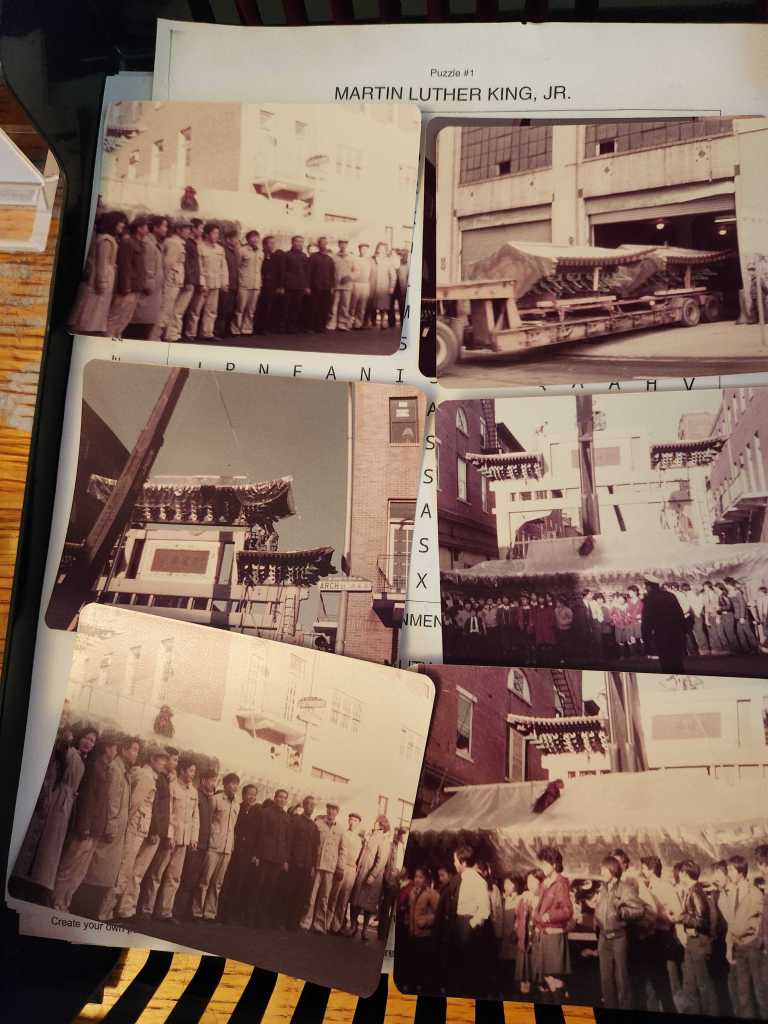 Artisans from China came to Philadelphia in 1984 to erect the Chinatown Friendship Gate. (Courtesy PCDC)
“In the 1960s, the Vine Street Expressway was proposed and people felt relatively unstable, with houses demolished and businesses displaced,” said PCDC’s current commercial corridor manager Haoyi Shang to Billy Penn. “How can we find a way to demonstrate our existence in this city? Also, we saw the Toronto gate and other gates.”
Unlike other gates around the U.S., however, Philadelphia’s is the first to be built with materials from and in China.
Some of those original tiles will be on display during Chinatown’s Firstival ceremony on Saturday, February 21 at 11 a.m. at the Crane Community Center, where there will also be temporary exhibits about the history of the gate, drawings, storytelling, Lunar New Year cultural performances, a calligraphy station, and interactive activities.
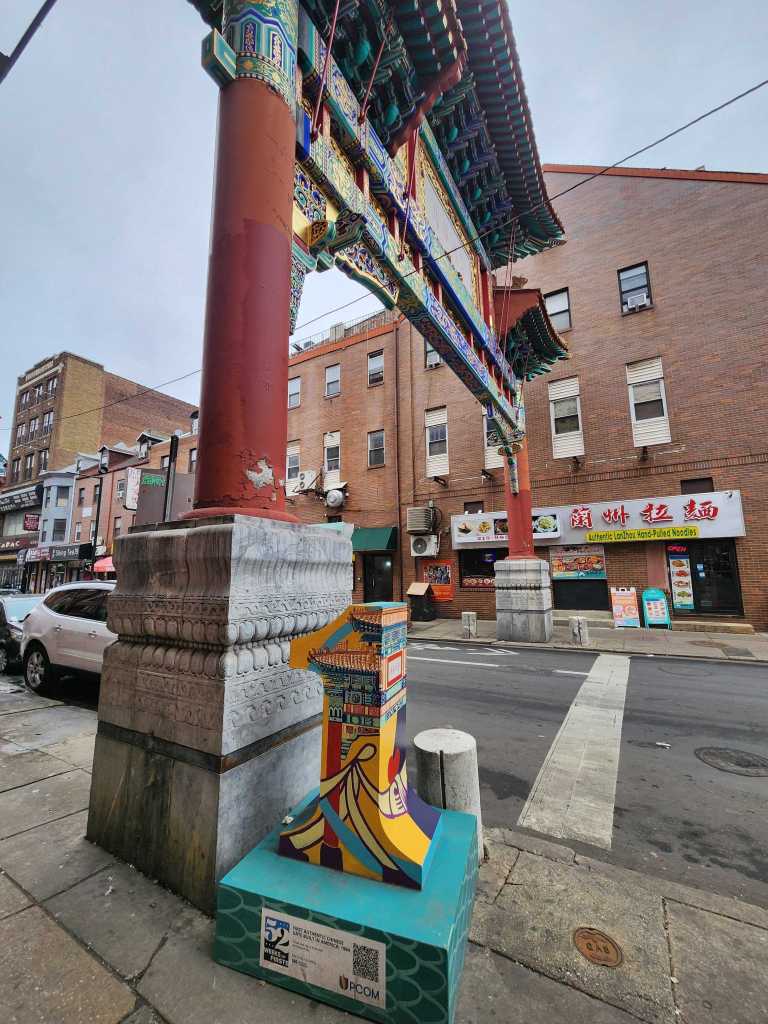 Anh Ly’s “Firstival” sculpture for Philadelphia’s “52 Weeks of Firsts” sits at the base of the Chinatown Friendship Gate. (Heather Chin/Billy Penn)
In the coming weeks
Here is the complete list of other firsts being highlighted this year, along with the upcoming Saturday “firstival” dates and locations.
The first:
Completed
Week 1: Successful balloon flight in America (1793)
Week 2: The Mummers parade, the nation’s first folk parade (1901)
Week 3: Volunteer fire company (1736)
Week 4: Professional basketball league (1898)
Week 5: Public Girl Scout cookie sale (1932)
Week 6: African Methodist Episcopal congregation (1794)
Week 7: Abolitionist society in America (1775)
Week 8: African American Museum in Philadelphia
Week 9: Authentic Chinese gate built in America (1984)
Upcoming
Public protest against slavery in America (1688)
Feb. 28, Historic Germantown Mennonite Meetinghouse, 6119 Germantown Ave.
Flower Show (1829)
March 7, Pennsylvania Convention Center, 1101 Arch St.
Women’s medical college (1850)
March 14, Health Sciences Building, Drexel University, 60 N. 36th St.
Match folder (1892)
March 21, Science History Institute, 315 Chestnut St.
The first medical school in America (1765)
March 28, Perelman School of Medicine, 3400 Civic Center Blvd.
Stadium in America (1895)
April 4, Franklin Field, 235 S. 33rd St.
Circus performance in America (1793)
April 11, Philadelphia School of Circus Arts, 6452 Greene St.
Botanical garden (1728)
April 18, Bartram’s Garden, 5400 Lindbergh Blvd.
Postmaster (1737)
April 25, Franklin Court, 322 Market St.
American-made piano and sousaphone (1775 and 1893)
May 2, Ensemble Arts Philly, 300 S. Broad St.
Mother’s Day (1908)
May 9, Historic St. George’s Museum & Archives, 326 New St.
Hospital in America (1751)
May 16, Pennsylvania Hospital, 800 Spruce St.
World’s Fair on American soil (1876)
May 23, Please Touch Museum, 4231 Avenue of the Republic
Steamboat for passengers and freight (1787)
May 30, Independence Seaport Museum, 211 S. Christopher Columbus Blvd.
American flag (1777)
June 6, Betsy Ross House, 239 Arch St.
U.S. Army (1775)
June 13, Museum of the American Revolution, 101 S. 3rd St.
Annual Reminder demonstration (1965)
June 20, Philly Pride Visitor Center, Lombard St. and S. 12th St.
Paper maker in America (1690)
June 27, Rittenhouse Town, 6034 Wissahickon Ave.
Bank of the United States (1791)
July 4, First Bank of the United States, 120 S. 3rd St.
Organized baseball team (1831)
July 11 (location TBD)
Ice cream soda (Oct. 1874)
July 18, Franklin Fountain, 116 Market St.
American art school (1805)
July 25, Pennsylvania Academy of the Fine Arts, 118-128 N. Broad St.
Scientific Society of Natural History (1812)
Aug. 1, at Academy of Natural Sciences, 1900 Benjamin Franklin Parkway
Zoo in America (1874)
Aug. 8, Philadelphia Zoo, 3400 W. Girard Ave.
U.S. Mint (1793)
Aug. 15 (location TBD)
Selfie (1839)
Aug. 22, Love Park, 1501 John F Kennedy Blvd.
Slinky (1943)
Aug. 29, Philadelphia Art Museum, 2600 Benjamin Franklin Parkway
Signing of the Constitution (1787)
Sept. 5, National Constitution Center, 525 Arch St.
Continental Congress (1774)
Sept. 12 at Carpenters’ Hall, 320 Chestnut St.
Naming of the United States (1776)
Sept. 19, Independence Hall
Ronald McDonald House (1974)
Sept. 26, Ronald McDonald House, 3925 Chestnut St.
Penitentiary in America (1829)
Oct. 3, Eastern State Penitentiary, 2027 Fairmount Ave.
The First Peoples
Oct. 10, Penn Museum, 3260 South St.
U.S. Navy and Marine Corps (1775)
Oct. 17, Arch Street Meeting House, 320 Arch St.
Public showing of a motion picture (1870)
Oct. 24, Philadelphia Film Society, 1412 Chestnut St.
Modern detective story written (1841)
Oct. 31, Edgar Allan Poe House, 532 N. 7th St.
Thanksgiving Day parade in America (1920)
Nov. 7, Benjamin Franklin Parkway
University in America (1740)
Nov. 14, Houston Hall, The University of Pennsylvania, 3417 Spruce St.
Children’s hospital in America (1855)
Nov. 21, Children’s Hospital of Philadelphia, Main Building, 3401 Civic Center Blvd.
Pencil with an attached eraser (1858)
Nov. 28, National Liberty Museum, 321 Chestnut St.
Weather bureau (1870)
Dec. 5, The Franklin Institute, 222 N. 20th St.
Electronic computer (1945)
Dec. 12, The University of Pennsylvania, 3451 Walnut St.
Public lending library in America (1731)
Dec. 19, The Library Company of Philadelphia, 1314 Locust St.
Philly food firsts: Cheesesteaks (1930s), water ice (1932) and bubble gum (1928)
Dec. 26, Reading Terminal Market, 1136 Arch St.