
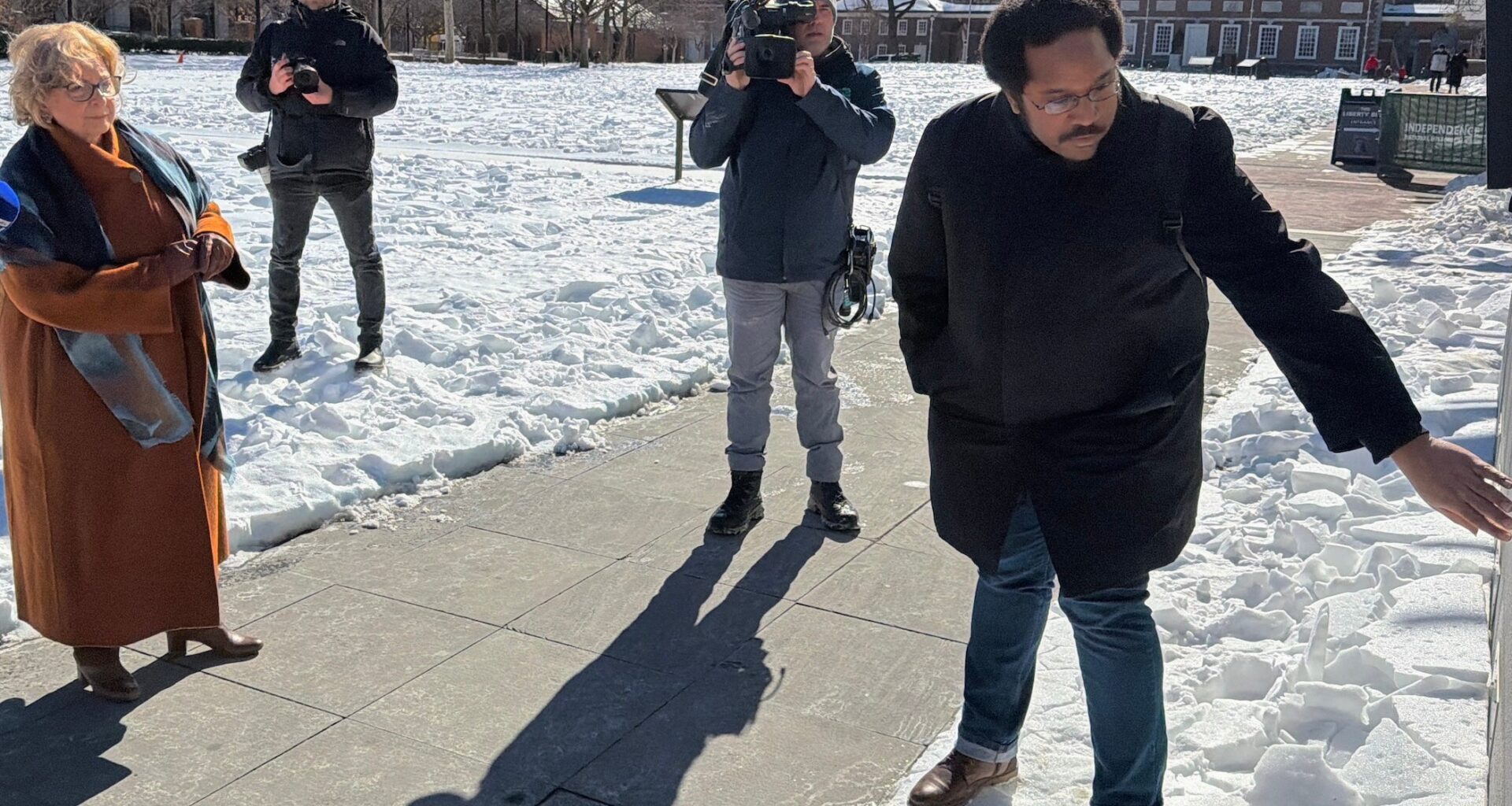
For Cara McClellan, an attorney representing both The Black Journey and the Avenging the Ancestors Coalition, the absence of the panels illustrated precisely why the lawsuit matters.
“Without the interpretive materials, there really is no way to interpret and understand what you’re seeing,” McClellan told WHYY News. “They’re critical.”
McClellan said the site loses much of its educational value without the exhibits and noted that the President’s House memorial is unique among national park sites.
“It’s just a constant reminder of how critical this information is and that it be part of the national record and memory,” she said.
At the center of the legal dispute is a disagreement over ownership and control. Federal officials argue that the National Park Service assumed ownership of the exhibit upon its completion. The city and its partners counter that the project was the result of a three-way collaboration involving the city, the park service and community advocates — and that the public has a lasting stake in its presence.
“To have this about-face after the exhibit has existed since 2010, without any reasoning provided to the public, gets to the core of what this case is about,” McClellan said, noting millions of dollars in financing Philadelphians made in bringing the exhibit to life. “The community has been invested in this from the beginning.”
‘Whitewashing’ history
The removal of the President’s House slavery exhibit traces back to an executive order issued early in President Donald Trump’s second term directing federal agencies to review national park programming and exhibits deemed “disparaging” to American history.
For historians, the directive signaled a fundamental shift in how the federal government approaches public history. Judy Giesberg, a professor of history at Villanova University who specializes in slavery and memory, rejected the notion that such interpretation disparages the nation’s past.
“What we do as historians is look at the evidence in front of us and tell a story that is closely tied to the facts,” she said. “It actually places the United States in conversation with other nations that were built on slaveholding and then course-corrected. You could see this as evidence of a maturing nation.”
Giesberg said the President’s House exhibit reflects decades of historical research documenting how Washington rotated enslaved people in and out of Philadelphia to avoid Pennsylvania’s Gradual Abolition of Slavery Act — a practice that went largely untold at the site until the exhibit was established more than a decade ago.
“That story had not been told at that site until historians and activists worked to make it visible,” she said.
Giesberg said the order fits into a broader pattern of rolling back historical interpretation across federal lands, including the removal of information about climate change, Indigenous peoples and Black military service.
She added that the current events are parallel to other times in history in which the government engaged in “whitewashing.”
“Reconstruction is a great example of that, when the nation committed itself to an expansive definition of citizenship and a federal guarantee of protections for that citizenship, and then when the federal government decided that they were no longer interested in that, they opened the door for a resurgence of white supremacy and a stripping of those individual rights,” she said.
As the nation approaches the 250th anniversary of the American Revolution, Giesberg said the dispute over the President’s House underscores what is at stake.
“This is precisely the moment to tell the truth about where the country began, how it began, and the conflicting ideas that shaped it,” she said. “History doesn’t always move forward. It can go backwards, too — and that’s what makes this fight so important.”
Editor’s note: This article was updated to reflect that the National Constitution Center does not oversee the storage area where the National Park Service currently holds the panels.