
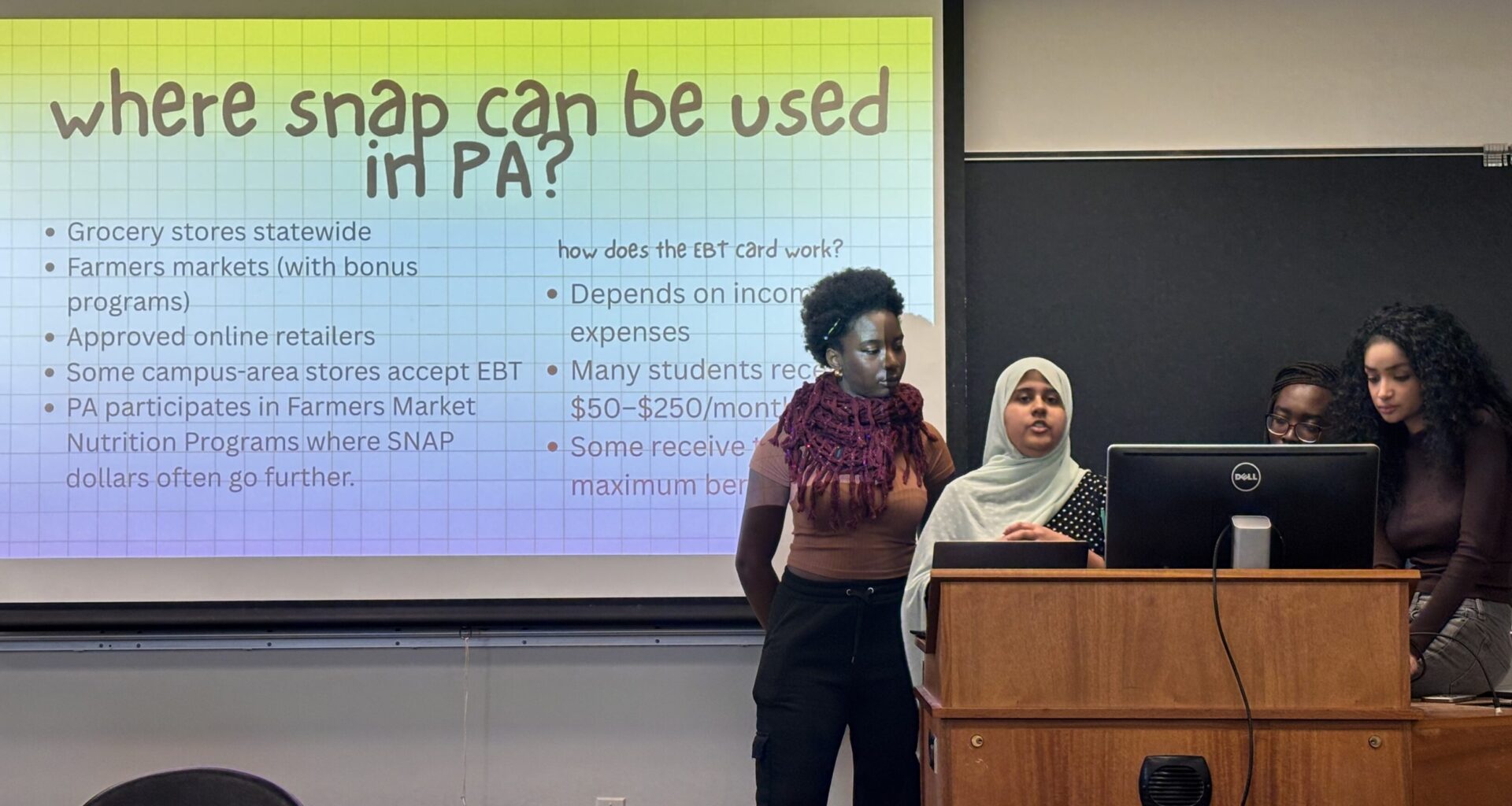
On Tuesday evening, the Lehigh Student Senate collaborated with Lehigh Valley Community Action to discuss SNAP benefits for college students who may be experiencing food insecurity. SNAP, or the Supplemental Nutrition Assistance Program, is a federally funded program that provides food assistance through an electronic benefits transfer card.
According to the Johns Hopkins Bloomberg School of Public Health, families living below 130% of the poverty line typically qualify for SNAP benefits. The program currently assists one in eight Americans.
Tasfia Ahmad, ‘27, the chair of the facilities and services committee of the student senate, said many college students experience food insecurity at expensive, private institutions like Lehigh.
She said students who live off campus may face financial stress from rent, tuition and academic workloads, which can lead to skipped meals or inadequate nutrition.
According to NPR, two in five college students in the U.S. face food insecurity.
“We’re studying, taking classes — and on top of that — have work-study and other jobs, and that doesn’t just affect grades, but also mental health,” Ahmad said. “So we want to make sure (students) have access to this resource that could not only help with food but also grades and mental health.”
Ahmad said there are often misconceptions surrounding SNAP eligibility, and one goal of the event was to address them.
If a student is under 21, family income is considered in determining eligibility. After age 21, a student’s income and work circumstances are also taken into account.
Ahmad said documentation, such as proof of income, expenses and letters from employers, is required to complete a SNAP application.
As part of the event registration, participants were asked to bring documentation and questions about the application process. After the event, attendees were encouraged to seek advice from Anna Smith, the director of Community Action Development Bethlehem, on their applications.
Ahmad said once a SNAP application is submitted, applicants complete a short phone interview. Decisions are typically issued within 30 days.
If approved, funds are loaded onto an electronic benefits transfer card. Ahmad said the amount allocated depends on the individual student’s income and is usually not enough to cover a full month of groceries.
“You honestly won’t get a lot of money at all,” Ahmad said. “It might get you through two weeks of groceries with budgeting, but it could be more or less than that. I only know one person with maximum benefits.”
Ahmad said immigrants and international students are often unsure how to access SNAP benefits.
Smith said eligible individuals generally must have lived in the U.S. for a certain period of time, but the program isn’t limited to citizens. For noncitizens, specific USDA requirements must be met.
She also said SNAP isn’t considered a public charge. According to U.S. Citizenship and Immigration Services, a public charge is a factor that can affect a noncitizen’s immigration status. Being deemed a public charge means an applicant is considered likely to become primarily dependent on federal low-income benefits.
When assessing eligibility for college students, Smith said there may be additional requirements not present in standard household applications. She said applicants might need to provide extra clarification or documentation about their individual circumstances.
“If you’re living with other people, they might ask for letters from them to verify that you are preparing food separately,” Smith said. “It’s challenging for college students to qualify, but just because there are challenges, doesn’t mean it’s not worth trying.”
Ahmad said students with a meal plan may also qualify for SNAP benefits if they receive fewer than 10 meals per week.
Lehigh’s campus has two food pantries aimed at alleviating food insecurity among students.
Yen DeBellis, the director of Lehigh’s Health Advancement and Prevention Strategies, said the goal of the pantries isn’t to replace meal plans but to supplement them. She said the pantries are available to all enrolled students, including graduate students.
Fresh fruit, perishable items, snacks and gluten-free options are available at the pantries Monday through Friday. There are two locations: one in Johnson Hall and another in Iacocca Hall on the Mountaintop Campus.
DeBellis said data from last semester showed that 3% of the Lehigh student body accessed the Johnson Hall food pantry, which she oversees. Out of those students, 75% were undergraduates and the remainder were graduate students.
She said 55% lived on campus and the rest off campus. There were also some meal “swipe-ins” that couldn’t be identified.
“At the beginning of the year, Lehigh was transitioning into a Transact system, so we had some hiccups with technology,” DeBellis said. “We had 140 meal swipes that were unidentifiable.”
Blessen Jolobi, ‘27, said many of her friends use the food pantries, particularly for snacks or supplemental items.
However, she said she doesn’t personally know anyone who needs SNAP benefits.
“I think it would be nice to have food stamps, just to have more resources and because the food at Rathbone can sometimes be pretty bad, with the raw chicken and all,” Jolobi said. “I think the food pantry does a good job to serve as a backup, and my friends usually are able to benefit from it.”
DeBellis said she’s awaiting results of a grant application submitted to the Pennsylvania Department of Education to expand the pantries. To broaden their reach, she said the team has collaborated with Lehigh Dining on a chef series showcasing creative ways students can supplement their meal plans with pantry items.
Ahmad said the Lehigh Student Senate plans to hold one-on-one advising sessions in the future to help students complete SNAP applications.
“At (student) senate, we want to advocate and create a supportive and empathetic community where every student feels seen and heard,” Ahmad said. “And that means just making sure that students’ needs are met in terms of facilities and services.”