
For Scranton-area artist Mark Ciocca, art and teaching go together.
Since childhood he has loved drawing and when he was young, began filling notebooks with black lines. He has spent his adult life teaching art and creating it, an impressive body of work that tells the story of the people of Northeastern Pennsylvania.
Until his recent retirement, Mark taught art for many years in the Pocono Mountain School District and in 2023 was nominated for Pennsylvania Art Teacher of the Year. Today, he continues working with The Armature, a program for expanding quality arts education throughout the Commonwealth. Mark has led residency programs at veterans and senior centers, special needs schools, prisons, and at the Lyceum in Scranton.
Working in pen and ink or linocuts, Mark Ciocca has exhibited his work worldwide, several times in Japan, most recently in 2023. In 2004, he was invited for a solo exhibit at “Kunst Macht Druck” (Art Makes an Impression) in Germany.
Since 1998, Mark has been exhibiting widely in shows and galleries throughout Pennsylvania. In 2021, his color lithograph of Steam Locomotive Engine 6039, one of the first trains to go on display at Steamtown National Historic Site in Scranton, became part of the Great Wall of Honesdale, one of ten works chosen from over 300, in this important annual public art display. In the summer of 2025, this work was on display again at Steamtown NHS as part of the 100th birthday celebration of Engine 6039.
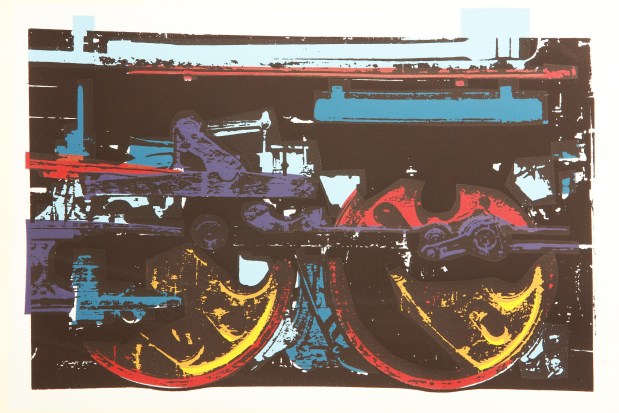 Engine N° 6039, color linocut. (MARK CIOCCA)
As an artist and teacher, Mark Ciocca has already done a lifetime of work, but his continuing desire to create arises from his love of community storytelling. As far back as he can remember, he has sought inspiration in the stories of the coal communities of Northeastern Pennsylvania, using his artistic skills to express regional pride. This has also meant telling his family’s story, an immigrant story typical of the coal region.
In the linocut “Anthracite Heritage,” anyone from the region will recognize the essentials of coal mining. In a rectangle at the center is the coal breaker, an imposing glass-and-wood structure. It is framed by what sustains it: the pillars supporting the galleries; the essential tracks for getting coal out; the steadfast mule who pulled the coal cars and often spent its entire life underground.
There are also the tools: the pick, the shovel, the miner’s drill, here penetrating a vein of coal and through its vertical position, evoking the shafts descending underground. Then, inseparable from the tools, the miner himself, his strength, his grit.
In this case, the miner is none other than Mark Ciocca’s grandfather, an Italian immigrant who arrived in the United States in the 1920’s, entering the country at Boston harbor. He made his way to Philadelphia and opened a bakery. The Great Depression wiped him out.
A man has to work, and Mark’s grandfather headed to one of the rare places where jobs were available, the anthracite region. He became a coal miner and raised his family in Scranton. His son, Mark’s father, entered the US Armed Forces, and after World War II, served in Germany. There, he met a German woman and fell in love. They married and returned to the States in the mid-1950’s with four sons. Five other children would be born in the United States.
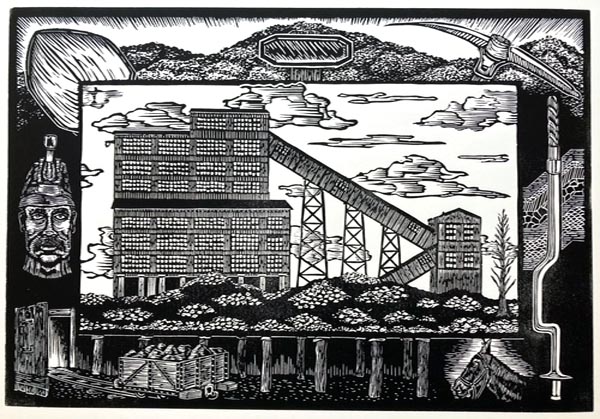 Anthracite Heritage, linocut. (MARK CIOCCA)
The grandson and son of immigrants, Mark Ciocca knows what it means to become an American. He has witnessed and lived the struggle. He knows the hardships of an immigrant’s life. When he tells his story, he is telling the story of everyone in the anthracite region.
As a high school teacher, Ciocca taught the children of immigrants, and some who were immigrants themselves. Through art and storytelling, he instilled in them pride in their heritage and pride in the place where they live today.
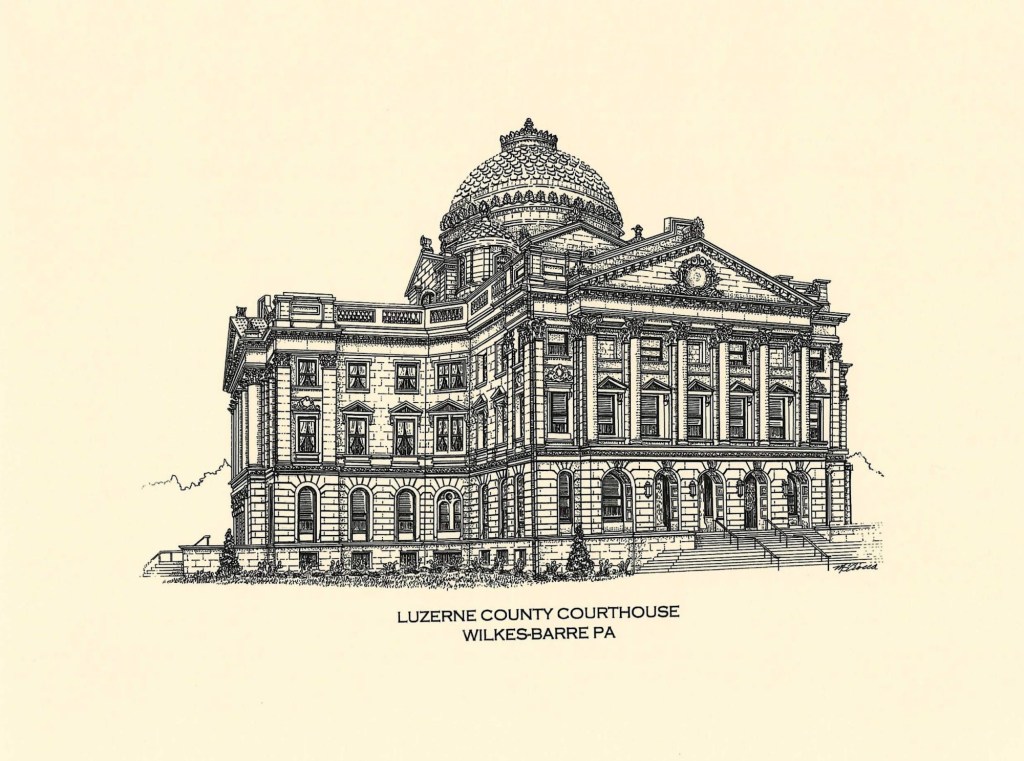
Mark Ciocca, child of immigrants, is most of all an American from Northeastern Pennsylvania. Proud of his region, he has long been attracted to its architectural treasures, be it a breaker or the impressive public buildings that coal money built. He started drawing them in pen and ink, at first because they attracted him, then as gifts for friends, finally as works to sell. Today, he has made over 90 drawings of sites and buildings across the region.
His first ink drawing was of the Electric City Building of Scranton. One of his favorites is the Court House of Luzerne County in Wilkes Barre. He considers it one of the most beautiful public buildings in the United States.
Mark Ciocca also calls himself a public artist and his motto is “Down with blank walls! Up with art!” If you visit the Anthracite Heritage Museum in Scranton, you’ll see one of his murals in the entrance hall. In the town of Taylor, PA, he saw a blank wall and wanted to fill it. The wall’s owner agreed, and up went a mural to honor the town. He has also decorated the Moscow, PA, train station.
They say a picture is worth a thousand words. Mark Ciocca’s storytelling-art speaks volumes about the anthracite region of Northeastern Pennsylvania.
You can see more of Mark Ciocca’s work at www.markciocca.com and purchase it at On&On www.onandonscranton.com in Scranton and Local Fair www.localfairjt.com in Jim Thorpe.