
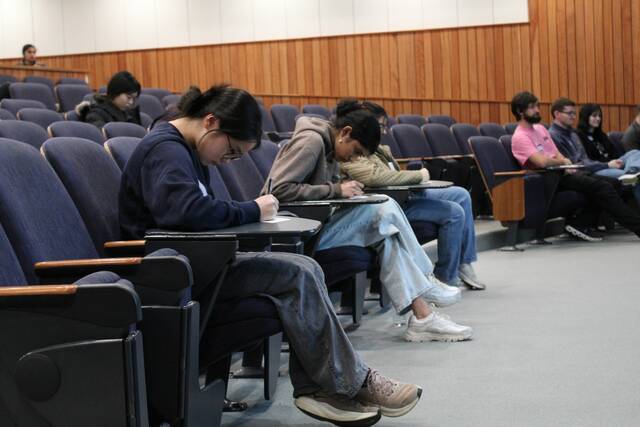
Kimi Kiuchi, a Moravian Academy student, competes in the NEPA Brain Bee at the University of Scranton.
Sydney Allabaugh | Times Leader
Kimi Kiuchi, a Moravian Academy student, competes in the NEPA Brain Bee at the University of Scranton.
Sydney Allabaugh | Times Leader
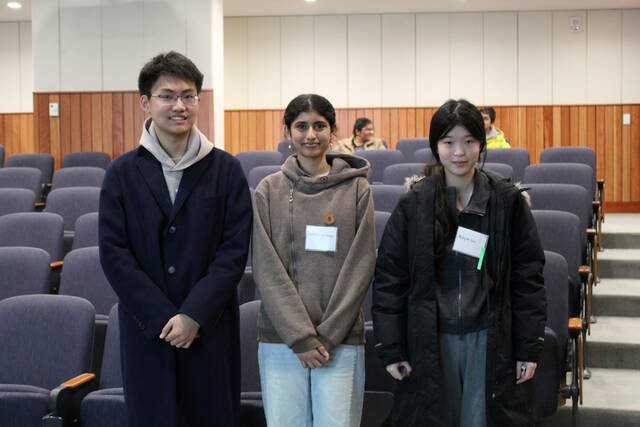
The winners of the NEPA Brain Bee, from left: Ken Zeng of Parkland High School, third place; Kavineha Perumal of Moravian Academy, second place; and Muyan Liu of Germantown Friends School, first place.
Sydney Allabaugh | Times Leader
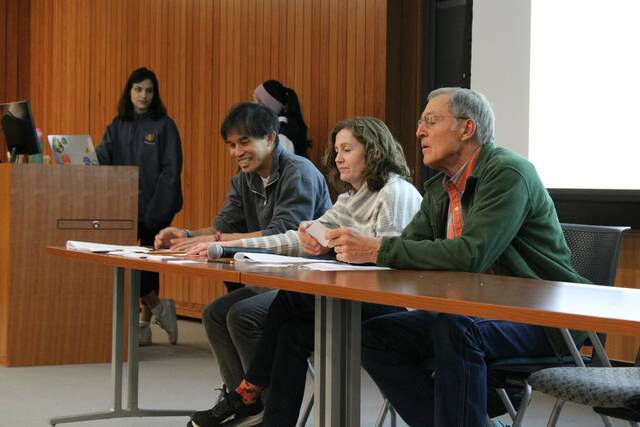
University of Scranton Biology Associate Professor Marc Seid, Psychology Assistant Professor Jill Warker, and Biology Professor Gary Kwiecinski judge responses.
Sydney Allabaugh | Times Leader
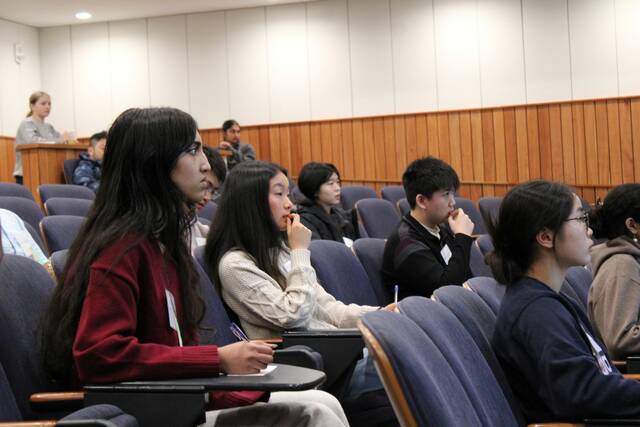
Laahya Guvvala, a Downingtown STEM Academy student, Olivia Kim, an Abington Heights student, and other regional high school students compete in the NEPA Brain Bee.
Sydney Allabaugh | Times Leader
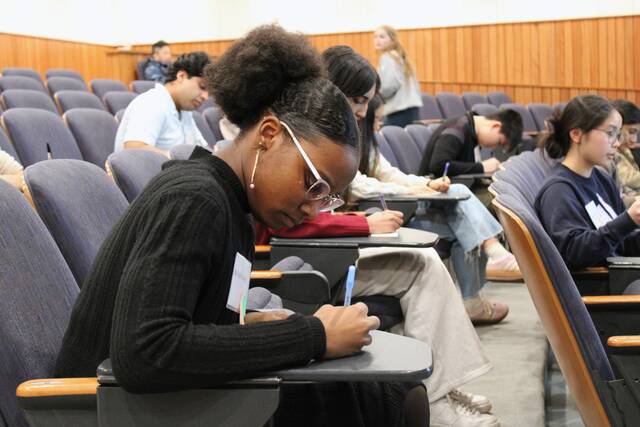
Aaliyah Richards, a Pocono Mountain School District student, competes in the NEPA Brain Bee.
Sydney Allabaugh | Times Leader
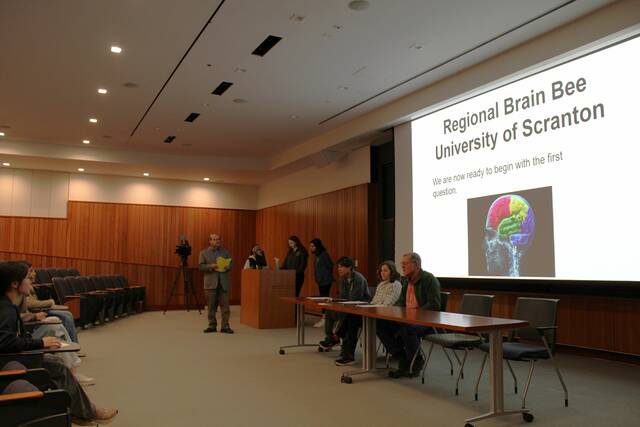
Robert F. Waldeck, the University of Scranton neuroscience program director and NEPA Brain Bee coordinator, prepares to read the first question.
Sydney Allabaugh | Times Leader
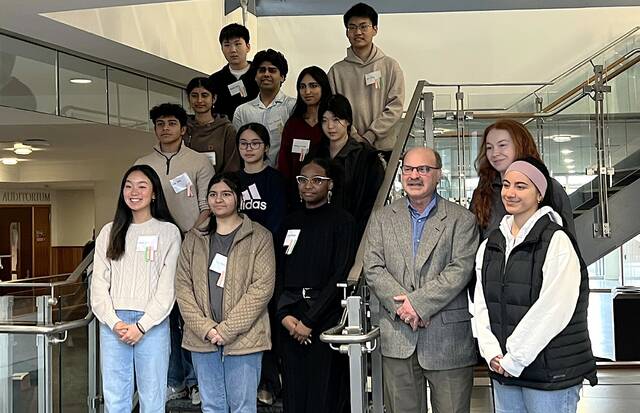
Robert F. Waldeck, neuroscience program director and NEPA Brain Bee coordinator, is joined by University of Scranton student event organizers and high school student contestants.
Sydney Allabaugh | Times Leader
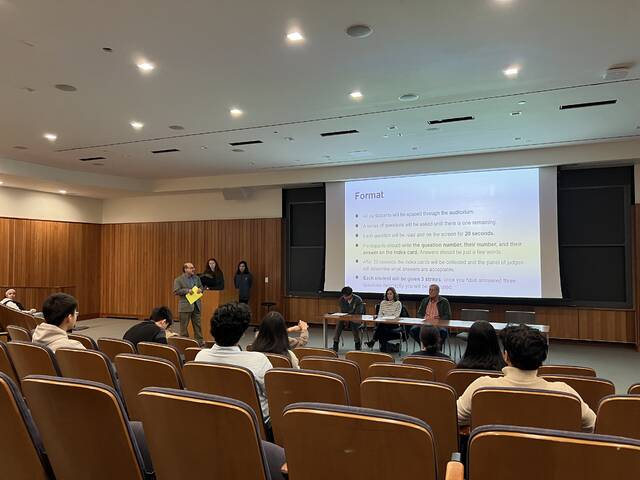
Robert F. Waldeck, neuroscience program director and NEPA Brain Bee coordinator, explains the competition format.
Sydney Allabaugh | Times Leader
Muyan Liu, a junior at Germantown Friends School in Philadelphia, traveled to Northeast Pennsylvania to test her neuroscience knowledge in the 25th annual NEPA Brain Bee hosted at the University of Scranton on Saturday.
Liu earned first place after advancing through 28 rounds of questions on the nervous system, neurological disorders, and sleep, and will move on to the USA National Brain Bee Championship at the University of California, Irvine.
“I feel really excited but also really thankful because neuroscience has always been my interest since middle school,” Liu said.
Robert F. Waldeck, the University of Scranton neuroscience program director and NEPA Brain Bee coordinator, said few students study neuroscience before college.
“Most people take biology in high school. Maybe they’ve had psychology, but generally, they don’t have neuroscience,” Waldeck said. “So it seems like a really complicated topic, and they don’t really know much about it, because they don’t know anybody doing it.”
He said a bee is a fun way to introduce high school students to neuroscience and to provide an opportunity to meet with faculty and college students studying it.
“They are getting a chance of dipping their toe on a very informal basis, which I think is what’s really important,” Waldeck said.
The NEPA Brain Bee is one of the longest-running regional Brain Bees. One of only about 60 nationwide, the University of Scranton bee attracts students from the area and beyond, including those from Pocono Mountain School District, Abington Heights, and Wyoming Area in previous years.
Prior to this year’s competition, contestants received a free book to study, from which competition questions were derived. Participants had three strikes before they were eliminated. The winners were those who stayed in the competition the longest.
Kavineha Perumal of Moravian Academy won second place, and Ken Zeng of Parkland High School won third place this year.
In addition to moving on to the national competition, Liu, the first place winner, received a $400 prize for travel expenses and will receive a $1,000 scholarship to the University of Scranton if she decides to go there.
Liu said she read the “Brain Facts” book three times and copied it in her notes twice to prepare for the competition.
“It’s a difficult thing to prepare for,” said University of Scranton Biology Professor Gary Kwiecinski, a judge of the bee. “When you’re sitting like that in front of the judges, nerves play a role in student performance.”
Kwiecinski said he is a judge because he enjoys encouraging students.
“We would like to see more people in neuroscience,” Kwiecinski said, noting that it is an area of research and medical need. “We all know mental health is important. It’s becoming an increasing problem, particularly in our urban areas. The more we can expand knowledge of neuroscience, the better it is for everyone.”
Eleven students competed this year, down from upwards of 70 in previous years.
Waldeck said competition registration has declined over the years due to budget cuts, creating a lack of coordinators in local schools. He hopes interested students or schools reach out to him to participate next year.
“We try to do as much outreach as possible because it’s an exciting thing,” Waldeck said. “Neuroscience is just really cool.”
It’s a sentiment the first place winner of the NEPA Brain Bee resonates with.
“In middle school, I was really interested in science. I learned that the brain is the only thing that can study itself,” Liu said, noting her interest grew from there.
Liu plans to study psychology and neuroscience in college. She also plans to study for the national competition.
“I’ll keep learning this,” Liu said.