
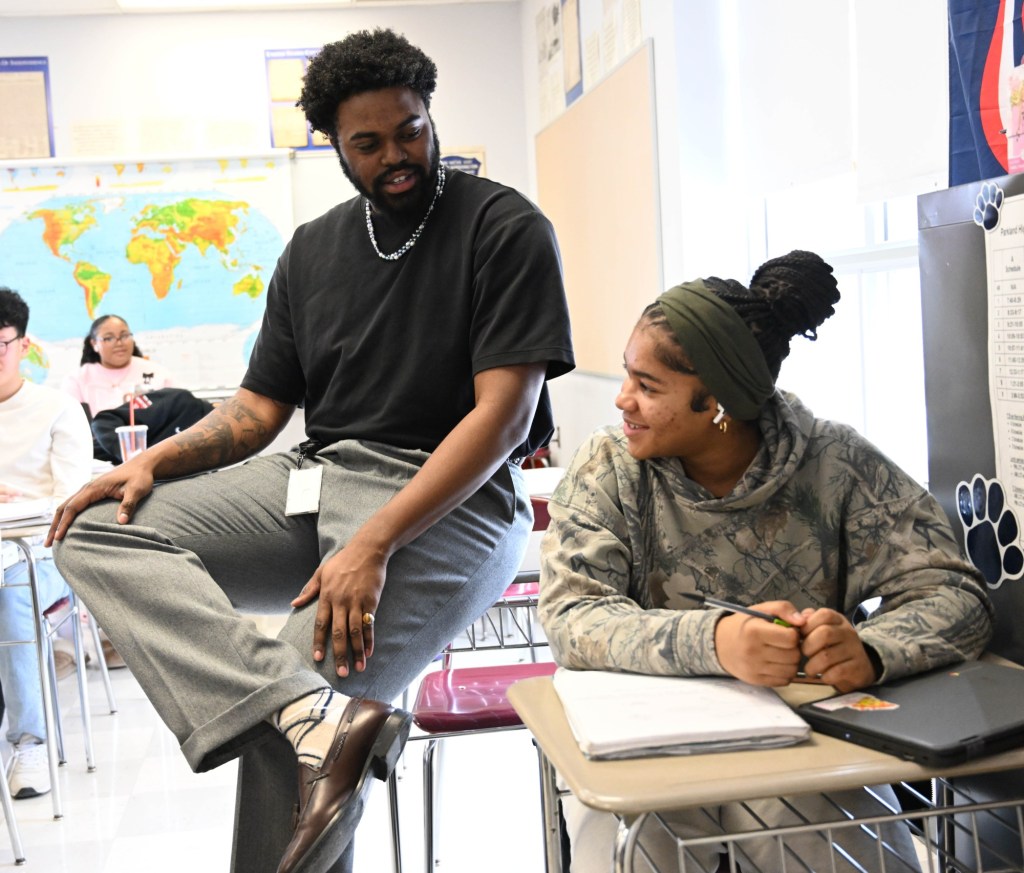
From the history of slave rebellions to modern media perceptions of Black people, students in Parkland High School’s new AP African American Studies course say they’re enjoying in-depth study of topics too often ignored.
The 22 students enrolled in the course’s first year are exploring a curriculum that is expanding across the United States while facing bans and challenges in states like Florida, South Carolina and Arkansas.
“There’s no reason why somebody should not be able to learn about the history of African American people if they can learn about the history of just American people and European people,” Parkland senior Ellie Zuber said.
Zuber said she enrolled in AP African American Studies in part to understand more about the culture and traditions of her Black relatives.
She said the course has already taught her a lot about how history connects to the present day, a theme she is exploring in a research project about segregation.
“I just want to get an understanding of how it developed and how it does, in aspects, continue to develop,” Zuber said.
Connecting history to the present day is also top of mind for junior Arielle Brown, who is hoping to pursue a career in medicine and is researching medical racism and the myth of Black biological difference.
Knowing more about how medical misconceptions form will help her avoid employing biases against future patients, Brown said.
The course is “an opportunity to learn deeper about myself and the community that I surround myself with,” Brown said. “I think that it granted me an opportunity to learn about how others also see the world that I live in daily.”
People who lack historical knowledge are more prone to stereotyping particular groups of people, senior Kaley Seide said, adding that the course offers chances to change perspective. She’s debating whether to focus her research project on the Haitian Revolution or the perception of Black women in the United States.
Seide serves as president of Parkland High School’s Black Student Union, and she said material from AP African American Studies has formed the backbone of presentations that have engaged club members in subjects such as media portrayals of Black people.
“The kids are really interested,” Seide said, adding that the club aims to provide a safe space for students of color. It has approximately 30 active members.
Resistance to teaching AP African American Studies is “crazy” and “bogus,” junior Cheryllana Cunningham said.
“It’s still a history course, just like all the other history classes, it’s just digging deeper into the African American part,” said Cunningham, who is researching how resistance is connected to social change.
The college-level curriculum for AP African American Studies includes four units, starting with the origins of the African diaspora and ending with present-day movements and debates.
The course begins by essentially debunking everything students think they know about Africa, social studies teacher Akello Mosby said. Moving toward the present day, the curriculum provides students with the full set of viewpoints they need to understand American history, he added.
“We can’t always rely on one truth to exist,” Mosby said. “There are many truths that are going to exist in this world, and this course offers us more truth to understand what happened throughout history.”
Mosby plans to take advantage of out-of-the-classroom experiences as well, with a trip planned to Lehigh University to tour a virtual reality exhibit set in the historic Ben’s Chili Bowl diner in Washington.
Students are excited to see where the course goes, Seide said.
“It’s fun being the guinea pig,” Seide said.