
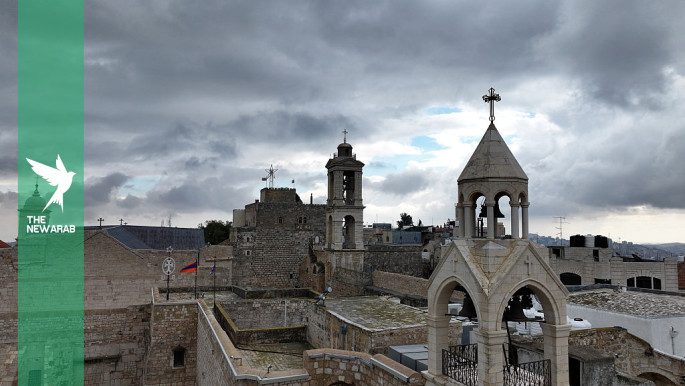
Palestinian Christians are increasingly being prevented from accessing their holy places [Getty]
As Lent begins and Palestinian Christians mark a season of repentance and prayer in the run-up to Easter, many are doing so under the shadow of intensifying settler violence and deepening Israeli control across the occupied West Bank, with their journeys to church, access to holy sites, and even daily routines increasingly constrained.
“We are approaching Lent season with so much concern, anxiety, and fear over the future, we are beginning to seriously think if there will be one day no Christian presence in Palestine”, Reverend Munther Isaac, one of the most prominent representatives of Palestinian Christians, told The New Arab.
Reverend Isaac spoke of a tightening regime of permits and checkpoints and limits on worshippers, saying that the Palestinian Christian community as a whole feels this most acutely during the holiest periods of the year.
While in the past it was common to organise walks from Bethlehem to Jerusalem on certain feasts, including on Palm Sunday, Isaac said that now “we live in a new reality in which Jerusalem is isolated from the rest of Palestinian towns, including the Christian towns”.
“As a member of the clergy, I need a permit from the Israeli military to be able to go to Jerusalem. The majority of my congregation don’t have that permit, and when we have permits, you still have to go through the checkpoint, and it’s not guaranteed if you even will be allowed in”.
Even inside his own community, the arbitrariness is palpable: when his church installed a new bishop in January, the bishop’s mother was only allowed to enter Jerusalem at the last minute despite holding a permit.
“This is the first time in history that Bethlehem and Jerusalem are separated”, he says, describing how a once-lived ritual geography has been broken up by walls and military control.
“It was common to organise for a walk from Bethlehem to Jerusalem on certain feasts”, he recalls. “For example, on Palm Sunday, you pray in Bethlehem, then go for the march in Jerusalem. You pray in Ramallah, go to Jerusalem for Sabt an-Nour, the Saturday before Easter, in which we celebrate the light coming out from the Church of the Holy Sepulchre and going all over, not just Historic Palestine, but beyond in the Middle East”.
“In fact, if you talk to people in Jerusalem, they will tell you how they remember years ago when people from other neighbouring Arab countries would come from Lebanon and Syria to celebrate the feast”.
Today, he says, “We live in a new reality in which Jerusalem is isolated from the rest of Palestinian towns, including the Christian towns”, and those processions are no longer possible.
The restrictions reach their peak on the holiest days of the Christian calendar. On the Saturday before Easter, Reverend Isaac notes, “a church that can take up to 10,000 people, Israel limits the number of worshippers to 1,500”.
He insists this policy is not about safety, as Israeli authorities claim, but control: “This is illegal. The Church of the Holy Sepulchre is in East Jerusalem and they have no legal jurisdiction over East Jerusalem and the Old City; they are an occupying power”.
Alongside physical limits come daily humiliations against members of the Palestinian Christian community, ranging from hateful graffiti daubed on church walls in Jerusalem to members of the clergy being spat on in the streets.
“What’s happening here is clear. Israel wants to change the identity of Jerusalem into an exclusively Jewish city”, he says.
For Isaac, there is also a deep psychological toll in being physically close to his faith’s most sacred sites yet effectively barred from them, with Palestinians living a two-minute walk from churches unable to enter due to Israeli military restrictions.
He argues that Israeli authorities try to “paint an idea that they allow Christians and freedom of religion by inviting clergy and monks from outside to come and pray, while seriously restricting access of the local Christian community”.
“Restrictions are the same against Christians and Muslims”, he says, with Muslim worshippers likewise facing major restrictions on their ability to access the al-Aqsa Mosque Compound during the holy month of Ramadan.
An exodus of Palestinian Christians
Even in Bethlehem, where Reverend Munther Isaac is based, daily life is hemmed in by two main checkpoints – one to the north and one to the south – that are frequently closed, forcing residents into complete isolation.
“It’s become common now to spend hours at the checkpoint”, he says.
“The plan is clear. These checkpoints, we know too well, they are not there for security; they are there to make our lives harder and harder. They are there to control, to intimidate, to push us out… the laws are a means to serve the system, to serve the settler colonial movement”.
The continuing restrictions and pressure, he says, are fuelling an exodus. “Increasingly, people are choosing to leave. They think of their future, the future of their children”.
“The common thinking that we keep hearing as clergy, as someone who spent time with family, is we survived. We chose to stay, but we don’t think our children will, and we will encourage our children to study abroad and not come back. And that’s a pattern right now”.
The Reverend says during Lent, churches are full of the few faithful left but reveal gaping absences: “You notice a pattern that we have so many elderly people who are committed in their faith, but their children or grandchildren are not there anymore. They have left the country. And that’s the real existential threat right now that we are facing.”
Settler violence fuelling demographic change
The rise in settler violence and settlement expansion, Reverend Munther Isaac says, is forcing families to leave their homes in fear of their safety.
The demographic shift in Bethlehem underscores the peril: “There is almost the same amount of Jewish settlers in the Bethlehem area as there are Palestinians”.
“Everybody is affected by it”, he says, referring to the acceleration of settlement expansion and intensity of the settler attacks.
In late January, Israeli settlers celebrated the building of a new illegal settlement known as Yatziv near the Palestinian Christian town of Beit Sahour in the Bethlehem area.
The increasingly expanding settler colonial project has the full backing of the Israeli government.
Israel’s extremist Finance Minister and settler leader Bezalel Smotrich during the inauguration of the illegal town, claimed “We’re going to be here forever. We will never establish a Palestinian state here”.
“The fear is that there is no one to protect us”, Reverend Isaac says. “They committed a genocide in Gaza, and the world did nothing. So now, what will stop them from ethnically cleansing these villages?”
He speaks of at least two families he knows in the Christian town of Taybeh, near Ramallah, who have chosen to leave because of settler attacks.
When settlers carried out an incursion into the town to burn their cars and paint threatening messages on their walls, Isaac says, the family made the difficult decision to move to the city because they feared risking the lives of their little children if they chose to stay.
“Annexation is a fact. Annexation is a reality. It’s interesting to me that it’s being discussed as a possibility, when, in fact, it’s already happening”.
He points to a growing number of Israeli government officials choosing to live in settlements as the project continues to expand through the building of universities and a system of roads connecting the settlements to Israel proper.
Yet amid this suffocation, Reverend Isaac sees Easter as a time of hope, renewal, and defiance.
“Easter is a season of renewed hope, because Easter in our Christian faith is about resurrection”, he says.
“It’s about the fact that tyranny and injustice did not have the final word, that the tomb is empty, even death did not have the final word.”
Though “right now, it seems we live in a very, very dark Friday and Saturday, using the Christian metaphor”, he insists that “we know too well: if we have faith that Sunday will come, and because we know that Sunday will come, our hope is in you to be more resilient.”