
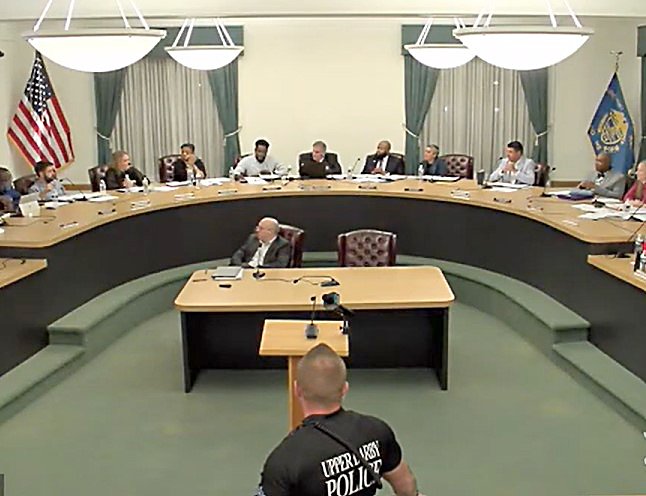
Upper Darby Council gave final approval this week to a 1% earned income tax in the township for 2025.
The tax would impact salaries, wages, commissions, bonuses, incentive payments, fees, tips and other compensation.
The EIT excludes retirement income as well for people who are already paying a similar tax in another municipality or the Philadelphia wage tax.
Gordon Mann, managing director of the consulting firm Public Financial Management, was on hand to answer questions, on the township’s financial standing and the reason the administration believes an EIT is needed.
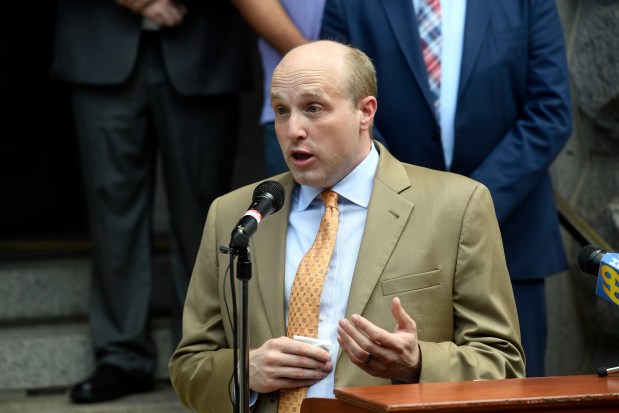 Gordon Mann in 2022 (MEDIANEWS GROUP)
The new tax is expected to bring in $18 million. According to calculations, by 2027 if nothing is done, a budget deficit would grow to over $16 million.
Mann said real estate taxes are assessed on an amount that stays flat year to year while the EIT tax can grow as residents’ incomes grow, which he says happens in communities across the board.
Most members of the public who spoke were against the tax. Most were also against a resolution council approved earlier in the meeting that limits the time that members of the public could speak during the public hearing section of a meeting to five minutes per speaker for a total of 30 minutes.
Opponents complained that resolution restricted their free speech and is also against the home rule charter. They noted that the restrictions could mean as few as six people would be able to speak on a resolution.
One resident questioned if she would have to pay on her IRA accounts. They are exempt, officials said.
At the end of the 30 minutes of public hearing section of the meeting on the EIT ordinance, speakers were still waiting their turn.
Council President Hafiz Tuniz signaled the end of the time. Members of the public voiced their objections and council went into recess.
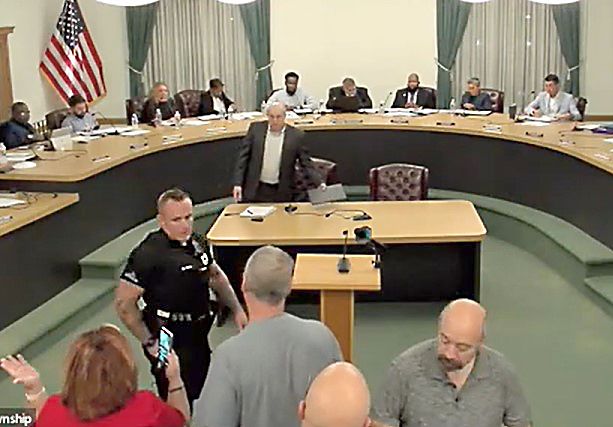
A police officer was needed to tell residents to sit down.
When council came back, two council members, Matt Silva and Laura Wentz, asked to allow everyone to speak. But they were voted down.
Wentz also protested that the implementation of council’s actions, saying they were not legal because the resolution had not been signed. Solicitor Sean Kilkenney said that was not accurate and the discussion went on.
Tunis said the EIT is a pathway to financial stability for the township, which he said has been mismanaged for decades.

SUBMITTED PHOTO
The Upper Darby Municipal Building. Officials pass the EIT in big to close a growing budget deficit that is expected to be critical in a couple years, but the residents at the meeting didn’t like it. (DAILY TIMES)
He said he understands residents’ frustrations.
Third district Brian Andruszko said he had spoken numerous times against the tax and said if it does pass, it should cover the deficit, fund liabilities and build back a fund balance for the township.
He asked whether it is the best thing for the township.
At-large council member Marion Minick said he believes council is building for the future of the township and at times council members have to have the courage to make difficult decisions, adding that the EIT should have been enacted years ago.
He noted 93 percent of municipalities in the state have the tax and with and the township needs multiples income streams.
The measure passed with six of the 11 members in favor.
Mann previously reviewed what the new tax will mean to residents:
• If you are one of the 3,000 Upper Darby residents working in the township you will pay more.
• If you are one of the 10,000 people who live in Upper Darby and work in a town without the tax, such as Haverford Township, you would pay the 1% tax.
• For about 9,100 people who live in Upper Darby and work in a place where there is already a 1% EIT tax that tax would revert to Upper Darby.
• Two groups that won’t be impacted are those living in Upper Darby and working in Philadelphia and residents with no income, such as those who are retired or active military.
Mann said more people in the township will not be impacted by the tax than are impacted.
In other action, council approved a resolution regulating film and video production permitting in the township. Aspects included 30 days notice, a $300 application fee and the applicant must have a $1 million insurance rider.