
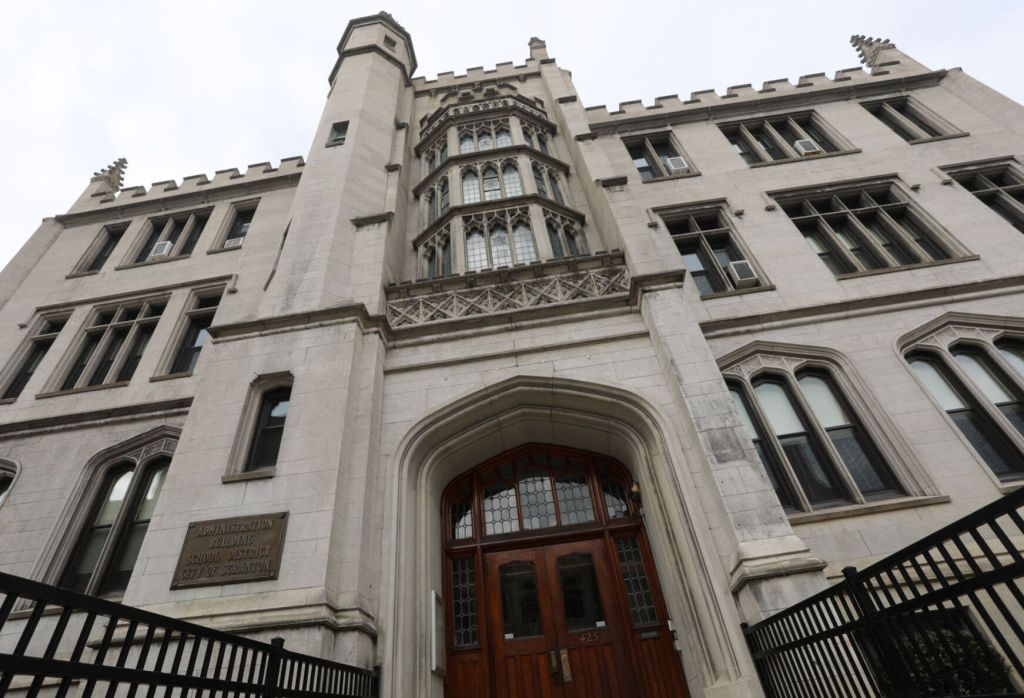
The Scranton School District sent a letter last week to residents reminding them that the district did not increase school taxes during the past three years.
The letter dated Feb. 18 was prompted by residents recently receiving their property tax bills that reflect new values from the countywide property tax reassessment completed last year and that took effect this year, Scranton School Board President Tom Borthwick said Friday.
Board members have been getting phone calls from residents about the school tax they are seeing in their 2026 property tax bills, he said. In many cases, the amounts owed on property tax bills have increased as a result of the reassessment, and the largest portion of a total property tax bill is the school tax, he said. So, while the school district has not raised taxes in three years, a resident’s amount owed in school taxes might have gone up as a result of the reassessment, Borthwick said.
“What people are now seeing are the hard numbers (in tax bills resulting from the reassessment) and some of the hard numbers are scary for some of the residents,” Borthwick said. “We wanted to let everyone know we didn’t change anything. Three years — zero tax increases. We are trying to help Scrantonians deal with pocketbook issues.”
The school board at its March 2 meeting at 7 p.m. will have on the agenda a discussion about possibly allocating the district’s state property tax equity supplement of about $1 million this year to a property tax rebate program for 2027, Borthwick said. The district operates on a calendar year and the 2026 budget is already set, he said.
Two separate bills make up total property tax amount owed
Scranton property taxpayers are getting two separate tax bills this month for county and city/school taxes owed for 2026, the Scranton Single Tax Office announced Feb. 6. Arriving via mail starting in mid-February, the first tax bill has just the Lackawanna County property tax portion of a taxpayer’s total annual obligation. The second bill that followed about a week later contains the city of Scranton municipal tax, the city refuse-collection fee and the Scranton School District tax.
The county tax portion was split off into its own bill for 2026, because the county this year offers an option of paying the county tax in four installments, as has been done previously with the city/school tax portions, Scranton Tax Collector Cathy Nealon Wechsler had said in announcing there would be two bills. Scranton’s Single Tax Office collects taxes in the city for the municipality, school district and county.
Changes in tax bills this year include:
• Tax bills reflect new values from the first countywide property tax reassessment since 1968, completed last year. The 2026 real estate tax bills contain the new assessed value for each property. Any questions regarding reassessment values should be directed to the Lackawanna County assessment office at 570-963-6728.
• Scranton taxpayers are getting two separate tax bills: one with just the county tax, and the other with the city/school taxes and city trash-collection fee of $300. As in the past, taxpayers will have the option to pay the Scranton city and school taxes and refuse fee in full or in four installments, due by March 31, June 30, Aug. 31 and Oct. 30. Nonpayment of an installment by a due date will result in a penalty. No other partial payments will be accepted. Four coupons for installment payments are at the bottom the tax bill.
• Lackawanna County also now offers the same option, to pay the county real estate tax bill in full or in four installments. Four coupons for installment payments also are at the bottom of the county tax bill. The installments also will be due by March 31, June 30, Aug. 31 and Oct. 30. Nonpayment of an installment by a due date will result in a penalty, and no other partial payments will be accepted. The county tax bill also includes a county educational tax and a county library tax.
• The payment periods for getting a discount, incurring a penalty, or neither by paying the face value will remain the same, as follows: The discount period runs until April 15; the face-value period runs from April 16 through June 30; and the penalty phase runs from July 1 through Dec. 31.
• The city of Scranton and the Scranton School District each now have one millage rate, instead of the prior split millages of one for land and the other for improvements. The countywide reassessment completed last year to take effect this year gave the opportunity to end the split property tax rates that dated to 1913, and instead have one, as do nearly all other municipalities in the state.
Where and how to pay your taxes
• In person: The Single Tax Office is in the Lackawanna County Department of Health and Human Services Building at 315 Franklin Ave., which has free parking. Residents can walk in and pay their taxes or use a drive-through window at the back of the building.
• Drop boxes: There are two. One is in the vestibule of the Lackawanna County Government Center at 123 Wyoming Ave.; the other is the night deposit drop box in the first drive-through window at 315 Franklin Ave.
• Online: Taxes also can be paid online at scrantontaxoffice.org/make-a-payment/.
For information, contact the Single Tax Office at 570-963-6756 or via email at singletaxoffice@lackawannacounty.org, or see the STO website at Scrantontaxoffice.org.
Scranton School District letter to residents
The following is the text of the letter the Scranton School Board sent to residents:
“February 18, 2026
City of Scranton Residents,
As tax bills are released, it is essential for Scranton residents to understand the specific factors influencing their statements. The Scranton School Board has not raised property taxes for three (3) consecutive years. Any increase currently reflected on a resident’s bill is the direct result of the Lackawanna County reassessment and county-level tax adjustments. This is not a school district tax hike. That distinction is vital for a community where every dollar counts. The Board remains committed to responsible stewardship while moving the District forward. By securing state adequacy funding, we have stabilized our tax structure while expanding STEM programming and literacy initiatives aligned with the Science of Reading. We are also prioritizing early learning by reestablishing Pre-Kindergarten opportunities through local partnerships, ensuring our youngest learners are positioned for long-term success. Furthermore, the District is finally addressing years of deferred maintenance with major capital improvements at West Scranton Intermediate and Neil Armstrong Elementary. These essential safety and modernization projects, along with the expansion of specialized autistic support classrooms for our 9,300 students, are being funded without shifting the burden onto local taxpayers. The bottom line is steady leadership and disciplined budgeting. We have held school taxes flat, academic investments are growing, and long-delayed facility repairs are moving forward. That is the balance this Board continues to strike for the people of Scranton. Thank you.
Sincerely,
Members of the Scranton School Board”