
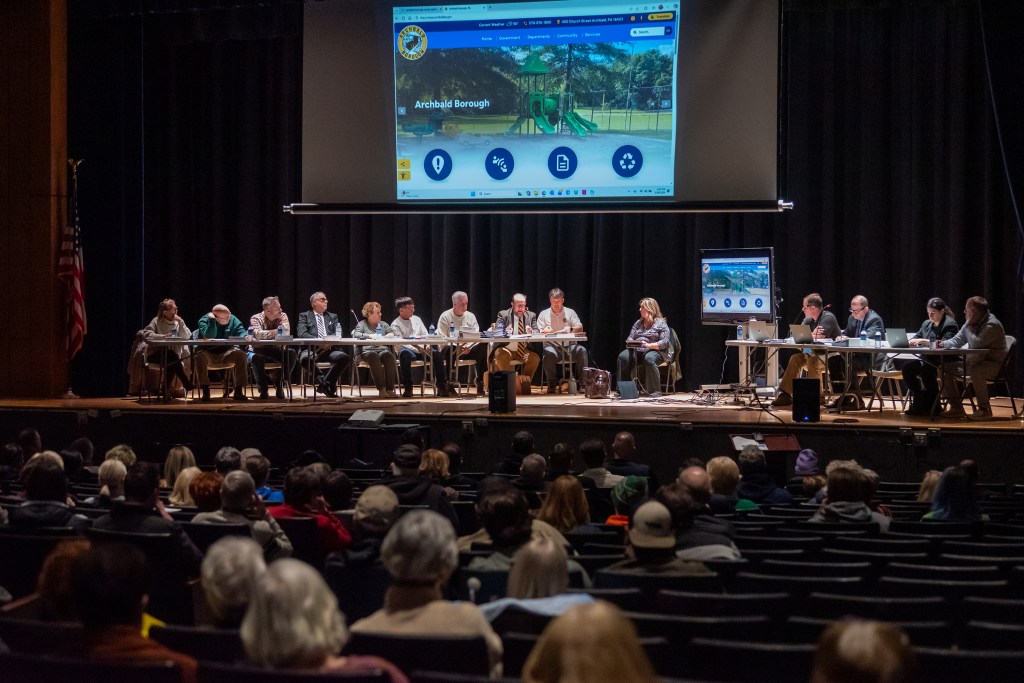
A data center proposal in Archbald opposed by county and state lawmakers will have a second hearing in March, giving residents more information on a campus that could use up to 3.3 million gallons of water per day and 1.6 gigawatts of power.
Archbald will hold the public hearing March 10 at 5 p.m. in the Valley View High School auditorium, 1 Columbus Drive, Archbald, as borough officials consider a conditional use application from Cornell Realty Management LLC, according to a public notice published Sunday in The Times-Tribune.
Cornell Realty seeks approval from borough council to build 14 data centers above Archbald’s Eynon and Sturges sections.
The borough held its first public hearing on the Brooklyn-based developer’s application Jan. 28 in front of 300-plus residents in Valley View’s high school auditorium. After two hours of testimony, Archbald officials and an attorney for the developer agreed to reconvene the hearing at a later date. The initial hearing included testimony from one of five expert witnesses for the developer.
Near the end of the January hearing, Cornell Realty Management attorney Edmund J. Campbell Jr. told Archbald Solicitor James J. O’Connor that his second witness would take about as much as time as the first witness, whose testimony and subsequent cross examination encompassed much of the meeting.
Wildcat Ridge is one of six data center campuses proposed in Archbald, totaling 51 individual buildings. If all six campuses move forward, they would encompass at least 14% of Archbald, or about 2.44 square miles — roughly the same size as the neighboring borough of Mayfield.
About the project
Wildcat Ridge became Lackawanna County’s first proposed data center campus last year when officials approached Archbald council during a January 2025 work session touting a $2.1 billion investment for a data center campus with additional commercial and office space spanning 574.2 mountainside acres along Business Route 6 and extending up Route 247, or Wildcat Road.
Plans for the project became clearer in December when Cornell Realty Management’s managing partner, Isaac Hagar, 347 Flushing Ave., Suite 800, Brooklyn, New York, filed a conditional use application Dec. 15.
With a campus covering just over 25 million square feet, Wildcat Ridge’s developers look to build 14 two-story data centers, each with a 202,340-square-foot footprint,, plus 316,000 square feet of commercial space. The commercial space would include a 50,000-square-foot grocery store with 1,800 square feet of retail space, with a tenant that could be “Trader Joe’s, or something like that,” according to testimony from project manager AJ Magnotta. It would also include two four-story, 85,000-square-foot buildings, with one mixed use and the other an office; and a 96,000-square-foot surface parking lot with about 360 spaces.
The campus’s water and electricity needs generated the most fervor among residents.
Wildcat Ridge projects it will use a daily average of 598,000 gallons of water from Lake Scranton for cooling, with a daily maximum of 3,310,149 gallons — enough to fill five 660,000-gallon Olympic-sized swimming pools every day during Northeast Pennsylvania’s hottest summer weather.
By consuming just over 3.3 million gallons per day, the data center campus will use more water per minute than the average American family uses in a week, or just shy of 2,300 gallons per minute when an American family uses about 300-plus gallons per day, according to the U.S. Environmental Protection Agency.
To offset its water demands, the developer is exploring tapping into the mine water below the data center for cooling, although that isn’t essential for the project to move forward.
To power the data centers, Wildcat Ridge received a will-serve letter from PPL Electric Utilities committing to provide 1,600 megawatts of power once the developer completes $93 million-plus of infrastructure upgrades.
At full power, the data center campus would consume more electricity than the entire 1,485-megawatt Lackawanna Energy Center could produce, if the campus were connected directly to the power plant in Jessup.
If power fails, the campus would have 41 backup generators for each data center, totaling 574 generators, though the developers have the generators facing up the mountain and away from Archbald to reduce noise.
What to expect
The one Wildcat Ridge data center campus witness who testified at the first hearing was Project Manager AJ Magnotta, an associate vice president at LaBella Associates in Dunmore. There are four more data center witnesses slated to speak.
Following each witness’s testimony, members of Archbald council, attorney Nathan C. Favreau, who represents a group of Archbald residents challenging the borough’s data center zoning; and resident Tamara Misewicz-Healey will all have the opportunity to ask questions and cross-examine witnesses.
Misewicz-Healey, who formed the “Stop Archbald Data Centers” Facebook group with her husband, was recognized as a party to the hearing by the borough, granting her the ability to cross-examine, despite the data center campus’s attorney objecting because she lived more than 200 feet from the site.
Archbald residents will then have time to address borough officials and offer testimony.
The borough also allowed Democratic Lackawanna County Commissioner Bill Gaughan, Lackawanna County Controller Gary DiBileo and state Rep. Kyle Mullins, D-112, Blakely, to speak at the January public hearing.
The three men sharply criticized data centers. Gaughan and DiBileo later attended a Dickson City zoning hearing two weeks later to offer similar remarks.
Gaughan, who last week sent a letter to Gov. Josh Shapiro and state legislators requesting a three-year moratorium on the development of large-scale artificial intelligence data centers, compared data centers to the anthracite coal industry while urging borough officials during the meeting to consider the countywide effects of the facilities.
“I am opposed to a future where communities like Archbald are once again told, ‘Trust us, be patient. It will be worth it in the end.’ We have heard that before. Coal was supposed to be worth it, it wasn’t,” Gaughan said at the hearing. “This time, we are not powerless, because the people in this room and throughout the county who are fighting this data center development, are not obstacles to progress. They are the guardians of this place.”
Mullins told borough officials to deny the project.
“Let me be abundantly clear: This Wildcat data center proposal is inappropriate and unacceptable, from its sheer size to its proposed water and power usage, to the deforestation it would involve, to the unknown runoff of stormwater,” Mullins said at the hearing. “This is why I oppose it and why people feel overwhelmed.”