
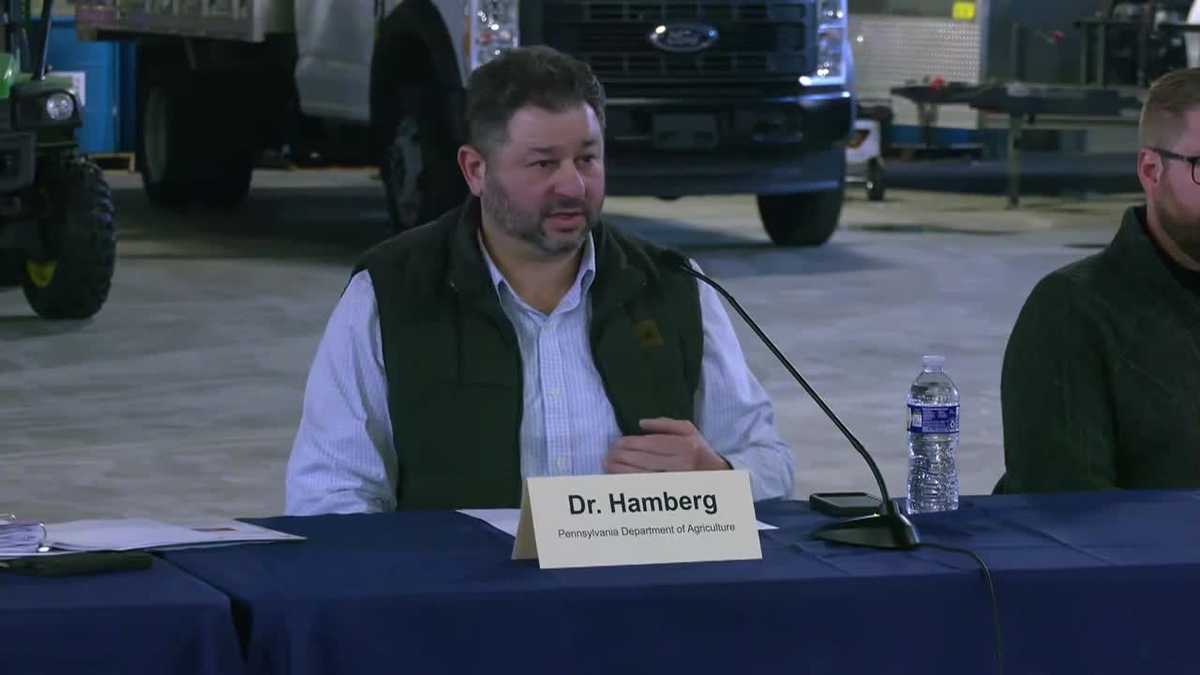
Why is avian flu so bad in Lancaster County?
Um, there’s *** lot that we know about this virus. I’m sure there’s stuff out there we don’t know yet, so we need more research on how to do it even better than what we’re doing. But I think we need to contrast *** little bit. Um, we talked just now about the 1983, 1984 outbreak. Um, just now, even with this large uptick that we’ve had in cases, we are now approaching the number of birds that were lost in 1983-198984, so. You know, we’re now 4 years into this and we’re now approaching, approaching what was lost in *** year and three quarters back in the 80s. You got to remember we have one farm with 3 million birds that went down and when you talk about 7 million birds that go down, that may be two farms. You know, there’s thousands of farms in PA, but the numbers are different since ’83 that’s what we lost in ’83 in today’s standards would be 3 or 4 farms. Absolutely, the farms are bigger, the density is higher. Lancaster County is the most densely populated poultry county in the country, and if not the most, it’s up there in the top 1 or 2. Um, so that density is, is *** real big challenge here. We also have diversity, right? We’ve got everything from our live bird market, our plain sex, our modern, uh, farms of every sector, and you brought up that link between the live bird market system and our poultry health here in Pennsylvania. Um, you know, I do agree testing is helpful, um, with the introduction of the current strain that blood test, which tests for antibodies is now largely invalidated. So *** lot of all of our control programs up until 2022 focused on if you can. Control low path avian influenza, you can then control high path avian influenza because you needed to have *** resident low path strain in that flock to recombine with *** wild bird high path strain in order to cause disease. The strain that came over the Eurasian goose strain that came over in 2022. That is the first time that high path AI is directly infectious from our wild waterfowl to our domestic chickens and turkeys and things of that nature. So for that reason, PCR is going to be *** much more valuable tool going forward to help break that cycle of what happens in the markets leading back into Pennsylvania. We came up with *** live bird market system biosecurity assurance program. We issued it. There was some pushback on it, so we’ve pulled it back for *** bit. We’re revising it, revamping it, but I agree we need biosecurity to be much more widespread. All of those farms that don’t have biosecurity, they are *** risk to their neighbors.
Pennsylvania State Veterinarian Dr. Alex Hamberg spoke at an avian flu roundtable on Tuesday at the Lancaster County Rapid Response Center amid an outbreak that is being called the worst since the 1980s. Tracking avian flu in Pennsylvania | What you need to knowHamberg addressed a number of topics, including why Lancaster County is the epicenter of the most recent bird flu outbreak. As of Feb. 23, 9.42 million bird flu cases have been identified nationwide. Of those, 7.48 million were in Pennsylvania with the majority of the cases in Lancaster County. Unique avian flu challenges in Lancaster County”The farms are bigger. The density is higher. Lancaster County is the most densely populated poultry county in the country, or at least in the top one or two,” Hamberg said. Hamberg said the density poses a “real big challenge,” along with another aspect that makes Lancaster County unique.”We also have diversity,” he said. “We’ve got everything from our live bird market, our plain sects, our modern farms of every sector.”On top of that, the blood test used for avian flu, which tests for antibodies, is largely invalidated after a new Eurasian strain moved into the area in 2022, according to Hamberg.”So a lot of our control programs up until 2022 focused on: if you can control low-path avian influenza, you can then control high-path avian influenza, because you needed to have a resident low-path strain in that flock to recombine with a wild bird high-path strain in order to cause disease,” Hamberg said. “The strain that came over—the Eurasian goose strain—in 2022: that is the first time that high-path AI is directly infectious from wild waterfowl to domestic chickens and turkeys.”Because of that, Hamberg said PCR testing is going to be a much more valuable tool moving forward. PCR tests can detect a virus’s genetic material, rather than identifying antibodies in the blood.Farms not using biosecurity are a ‘risk to their neighbors’Hamberg also stressed the importance of the need for farms to embrace biosecurity to prevent the spread of avian flu.”We need biosecurity to be much more widespread. All of those farms that don’t have biosecurity, they are a risk to their neighbors,” Hamberg said.You can listen to more of Hamberg’s remarks in the video player above.
LANCASTER, Pa. —
Pennsylvania State Veterinarian Dr. Alex Hamberg spoke at an avian flu roundtable on Tuesday at the Lancaster County Rapid Response Center amid an outbreak that is being called the worst since the 1980s.
Hamberg addressed a number of topics, including why Lancaster County is the epicenter of the most recent bird flu outbreak.
As of Feb. 23, 9.42 million bird flu cases have been identified nationwide. Of those, 7.48 million were in Pennsylvania with the majority of the cases in Lancaster County.
Unique avian flu challenges in Lancaster County
WGAL
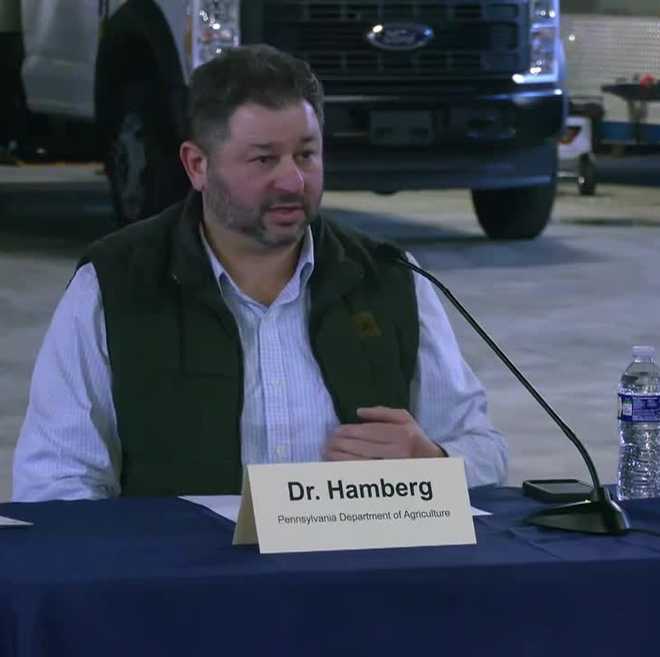
Pennsylvania State Veterinarian Dr. Alex Hamberg.
“The farms are bigger. The density is higher. Lancaster County is the most densely populated poultry county in the country, or at least in the top one or two,” Hamberg said.
Hamberg said the density poses a “real big challenge,” along with another aspect that makes Lancaster County unique.
“We also have diversity,” he said. “We’ve got everything from our live bird market, our plain sects, our modern farms of every sector.”
On top of that, the blood test used for avian flu, which tests for antibodies, is largely invalidated after a new Eurasian strain moved into the area in 2022, according to Hamberg.

WGAL
Pa. is dealing with the worst avian flu outbreak since the 1980s.
“So a lot of our control programs up until 2022 focused on: if you can control low-path avian influenza, you can then control high-path avian influenza, because you needed to have a resident low-path strain in that flock to recombine with a wild bird high-path strain in order to cause disease,” Hamberg said. “The strain that came over—the Eurasian goose strain—in 2022: that is the first time that high-path AI is directly infectious from wild waterfowl to domestic chickens and turkeys.”
Because of that, Hamberg said PCR testing is going to be a much more valuable tool moving forward. PCR tests can detect a virus’s genetic material, rather than identifying antibodies in the blood.