
Erie County is pulling funds from the opioid addiction treatment program in light of audits that uncovered fiscal mismanagement and other problems. Its founder, who recently stepped down, denies any wrongdoing.
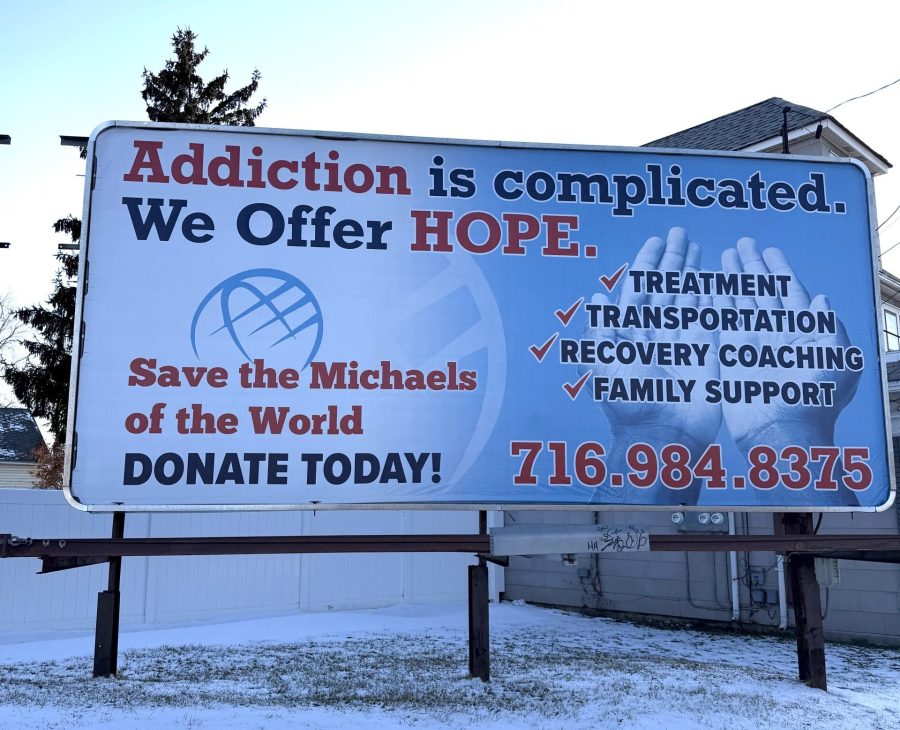
A Save the Michaels billboard on Broadway Street in Sloan. Photo: Adam Smith-Perez.
Save the Michaels, a prominent addiction services provider, will lose its Erie County funding this summer following a state audit that identified years of fiscal mismanagement.
The county’s decision to pull its support coincides with an Investigative Post investigation into the nonprofit agency that found slipshod financial practices, a hostile work environment and inaction by state and local regulators.
It also comes on the heels of Save the Michaels founder Avi Israel’s resignation as chief executive, two years after an Erie County official first sounded alarms about the organization.
The Erie County Department of Mental Health told Investigative Post that it will not renew contracts with the nonprofit next year due to “ongoing concerns” with its management.
A spokesperson for the department said the decision was “based on findings from site visits” and a 2024 audit conducted by the state’s Office of Addiction Services and Supports. That office oversees the distribution of state grants to fight the opioid epidemic and is the main regulatory agency overseeing Save the Michaels’ operations.
The findings include:
Poor oversight of Israel’s use of the nonprofit’s money — including a loan, a raise and out-of-state travel.
Improper tracking of employee hours.
Failure to provide financial information to auditors.
Auditors noted that Israel and his wife were both paid employees and voting board members for Save the Michaels, in violation of state policy.
The audit found that Israel had given himself a $25,000 raise, charged Save the Michaels for out-of-state travel and loaned himself $39,522 from company accounts — all without required approvals.
“At this point, we do not have sufficient assurance that the state-identified deficiencies have been fully resolved in a manner that meets accountability standards required for continued contracting,” a spokesperson for the Department of Mental Health said in a statement.
The county provided $715,893 in funds to Save the Michaels in 2025, according to the latest budget. That’s more than 16 percent of its total revenue of about $4 million last year. The rest of its funding comes from state contracts, private donations and Medicaid reimbursements. Israel offered no comment when asked about the loss of county funding.
He announced his retirement in a Facebook post on Dec. 26, effective Jan. 1. On Jan. 2, the organization announced that Jessica Petty, Israel’s executive assistant and a Save the Michaels employee since 2019, would take over as CEO.
Investigative Post has been looking into Save the Michaels management and performance for over four months. The inquiry entailed reviews of audits, contracts and other public records, as well as interviews with government officials and more than a dozen former employees.
Many of those former employees described Save the Michaels as poorly run, and Israel as a “tyrant” who cursed at and bullied his staff. Several claimed Israel made false promises and unreasonable demands.
Some said Israel — who started Save the Michaels in 2011 with his wife Julie following the suicide of their son Michael during drug withdrawal — was more interested in how much money Save the Michaels could obtain for treating addicts than he was in the outcome of that treatment.
“Avi wanted all the money. When he found out other people were getting grants, he took it as a personal affront,” said Chuck Notaro, a transportation coordinator who worked at the organization from 2018 to 2020. “He thought he was the best opportunity for everybody. And that’s not the truth.”
Israel told Investigative Post criticisms come from “disgruntled employees who will make up stories.” He denied wrongdoing and said all of the organization’s practices and uses of company accounts “are legal and above board.”
Israel defends Save the Michaels’ record
Israel told Investigative Post that Save the Michaels was founded in 2011 as an advocacy organization, meant to raise awareness about overdose deaths and suicides.
While rates are declining nationwide, overdose was the leading cause of death last year for Americans ages 18 to 44, according to the federal Centers for Disease Control. From 2020 to the first half of 2025, a data analysis by Investigative Post of provisional CDC data found that at least 2,395 people died of overdoses in Erie and Niagara counties.
The Israel family’s advocacy work began after the loss of their son, when they and other advocates — including other families who lost loved ones — pushed for a bill limiting and monitoring the overprescription of painkillers. The Internet System for Tracking Over-Prescribing Act, also known as “I-STOP” was signed into state law in June 2012.
In recent years, Save the Michaels has run family and peer support programs through its Buffalo office. With the help of state grants, the organization also started a nonmedical transportation program, offering rides for individuals to get to drug court, rehab facilities, and the county jail.
Save the Michaels opened a community center in Lockport and a residential reintegration program for men in Newfane in 2019 and 2022, respectively.
Israel said his Newfane program has a 98 percent recovery rate, meaning almost all residents who go through it do “not go back to using drugs.”
“We lowered the overdose deaths,” Israel said. “And even though certain people take credit for it, it was really, believe it or not, the not-for-profit and families who have lost loved ones who did the hard work.”
He did not offer evidence to support his 98 percent claim. But a 2021 report on Buffalo’s drug court system praised the organization’s nonmedical transportation program, saying it “assists greatly” in getting participants to and from court.
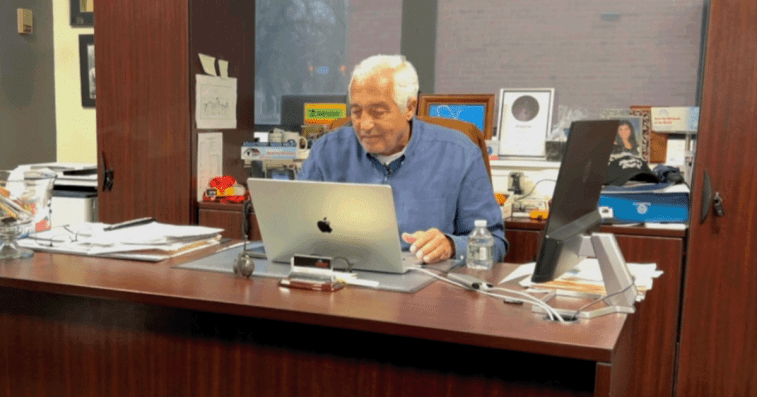
Save the Michaels founder Avi Israel. Photo: WKBW 7 News.
Israel estimated that at its peak, Save the Michaels had over 60 employees, but the organization now has “nowhere near that” because Save the Michaels “has gotten no funding.”
He told Investigative Post he stepped down as CEO in part because he hoped his retirement would result in less scrutiny from state regulators.
“To me, maybe if I announce that I’m retiring and stay in the background … maybe they’ll stop picking on Save the Michaels,” Israel said.
He said he will continue to be involved with Save the Michaels as “an advisor and a founder.”
Israel said he resigned two years ago from a state advisory board that recommends state funding for agencies like his because “nothing was being done right.” He felt officials overseeing the state’s response to the opioid epidemic cared more about “counting beans” than “about people who are attempting to recover from a disease.”
An unfinished project
It’s been over four years since Save the Michaels announced a plan to renovate an East Side building to provide transitional housing and services to women who completed inpatient addiction treatment.
The project, meant to be completed by winter 2023, has yet to open.
In August 2022, Save the Michaels purchased 228 Brinkman Ave. near the intersection of Walden and Bailey avenues, for $1. Shortly thereafter, the organization hired 34 Group — operated by former Buffalo Bill Thurman Thomas — as the project’s contractor. By the end of 2023, Save the Michaels had paid 34 Group $224,444, according to a 2023 filing with the Internal Revenue Service, but the project still wasn’t up and running.
In 2024, Save the Michaels applied to the City of Buffalo for funding for the program. The city recently had received over $2.4 million from the state — a portion of its share of opioid lawsuit settlements — and was looking for proposals to put that money to use.
Save the Michaels in its application committed to hire five staff members and complete “needed renovations” to the building. The application said the project, known as Brinkman House of Hope, would house 15 women for six months at a time.
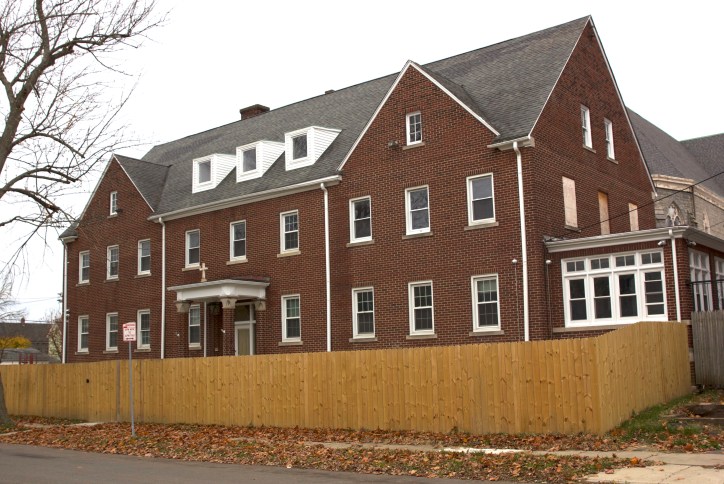
The Brinkman House of Hope at 228 Brinkman Ave. in Buffalo. Photo: Adam Smith-Perez.
The Common Council approved $500,000 in funding in September 2024.
Save the Michaels has spent more than $1 million on the project, according to a presentation the organization gave to a county subcommittee in June. But that wasn’t enough to finish it, either.
Representatives from two subcontractors, MLP Plumbing and Frey Electric, told Investigative Post that work was stalled at various points because Save the Michaels didn’t have money to pay them.
Israel confirmed that Save the Michaels still owed contractors payments and said 34 Group is no longer working on the project. He told Investigative Post he’d hired two former clients of a Save the Michaels treatment program to finish the job.
“34 Group decided that they’re going to quit because they’re looking for money,” Israel said. “And I said, ‘Good, because I’m not happy with some of the work.’ ”
34 Group did not respond to requests for comment.
Israel conceded that some of the grant money for the Brinkman project might have been redirected to meet payroll.
“I don’t know. I’m not the bookkeeper. And if it did go to payroll, it’s because we needed it. Because we didn’t have the money.”
He said any money diverted to payroll “will be replaced.”
Financial mismanagement
Investigative Post reviewed a half dozen assessments of Save the Michaels made over the last four years. They include two audits by a private accounting firm and one by the state Office of Addiction Services and Supports. The most critical review was the state’s, issued in August 2024.
Its key findings include:
Segregation of duties — a crucial accounting practice to protect against fraud — was found “absent, or inadequate, over significant accounts and processes.”
Israel and his wife Julie served as voting members of the board of directors, despite also being paid employees. The dual roles violated state policy.
Israel failed to get agency approval for out-of-state travel and for a $25,000 raise he gave himself.
Israel took out a $39,522 loan without board approval.
Employee timesheets were checked by an outside consultant rather than a supervisor.
Save the Michaels’ private auditor, the accounting firm Tronconi Segarra & Associates, also flagged the loan Israel took from his company as a violation of the organization’s bylaws. The board forgave the loan in 2023.
An Erie County spokesperson told Investigative Post that improper filing of timesheets and payroll by upper management were among the irregularities county examiners discovered during site visits earlier this month. Former employees, including a former bookkeeper, also raised the issue with Investigative Post.
“You’ve got the husband, the wife, the daughter … The mother, she controls the time clock. She punches them all in,” the former bookkeeper said, on condition they not be identified.
Save the Michaels also failed to provide mandatory annual reports to the state oversight board in a timely manner, according to the audit, to the point that the Office of Addiction Services and Supports threatened to withhold funding in 2024.
An October 2025 review by the Office of Addiction Services and Supports found Save the Michaels’ Newfane facility in Niagara County was in partial compliance in service management and substantial compliance in record keeping. The Newfane site is a residential program for men leaving inpatient treatment.
Erie County’s concerns
The state’s findings aligned with longstanding concerns held by Erie County.
In January 2024, Mark O’Brien, Erie County’s then-mental health commissioner, wrote an email to the state comptroller’s office, copying a number of state and county officials, in which he refers to Save the Michaels’ “non-compliance … in providing required documents” to the Office of Addiction Services and Supports.
O’Brien, since retired, wrote that his office had “the same concerns” about the nonprofit’s failure to share financial records. O’Brien referred to a 2022 audit of Save the Michaels that cited “material concerns related to their fiscal practices and controls.”
In a separate correspondence, O’Brien wrote that the state attorney general’s office sent his office an anonymous complaint containing “allegations they received regarding fiscal mismanagement, alleged fraud and abuse as well as workplace human rights violations toward employees.”
O’Brien ended his email by asking the state comptroller to investigate Save the Michaels.
The state comptroller’s office told O’Brien that the Office of Addiction Services and Supports was in midst of reviewing Save the Michaels’ finances and the comptroller would await the results of that audit before deciding whether to launch its own.
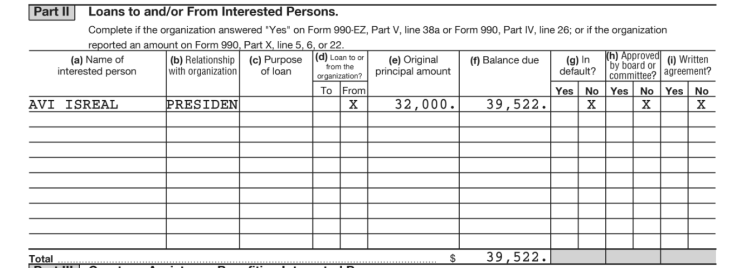
Avi Israel’s loan from Save the Michaels described in a filing with the Internal Revenue Service.
Similarly, Erie County Deputy Comptroller Mary Nytz-Hosler told O’Brien that after consulting with Israel, the comptroller’s office was considering putting “their own review on pause” to see the results of other audits and reviews already underway.
The state comptroller never conducted an audit. Neither did the county comptroller — until now.
Deputy Comptroller Jessica Schuster confirmed that the comptroller’s office last week opened an audit examining contracts between the Department of Mental Health and its vendors, including Save the Michaels.
Israel refused to discuss the findings from the Office of Addiction Services and Supports audit.
“I’m not talking about any of that stuff because I don’t know a lot of that stuff,” Israel said. “The only thing they came up with was nepotism.”
Subscribe to our free weekly newsletters
The nepotism finding related to his wife drawing a salary from Save the Michaels. Israel said the state agency’s general counsel had advised him that was okay so long as her salary was in line with those at similar nonprofits.
Julie Israel’s salary increased from $59,220 to $87,121 between 2021 and 2025, according to Save the Michaels’ IRS filing.
During that same period, Avi Israel’s salary more than doubled — from $64,423 to $130,577.
A spokesperson said the county is “actively implementing alternative arrangements to ensure continuity of care for residents who rely on these services,” specifically nonmedical transportation and recovery services.
Adam Smith-Perez, who covers urban affairs for Investigative Post, is a Report For America corps member.

posted 12 minutes ago – February 25, 2026