
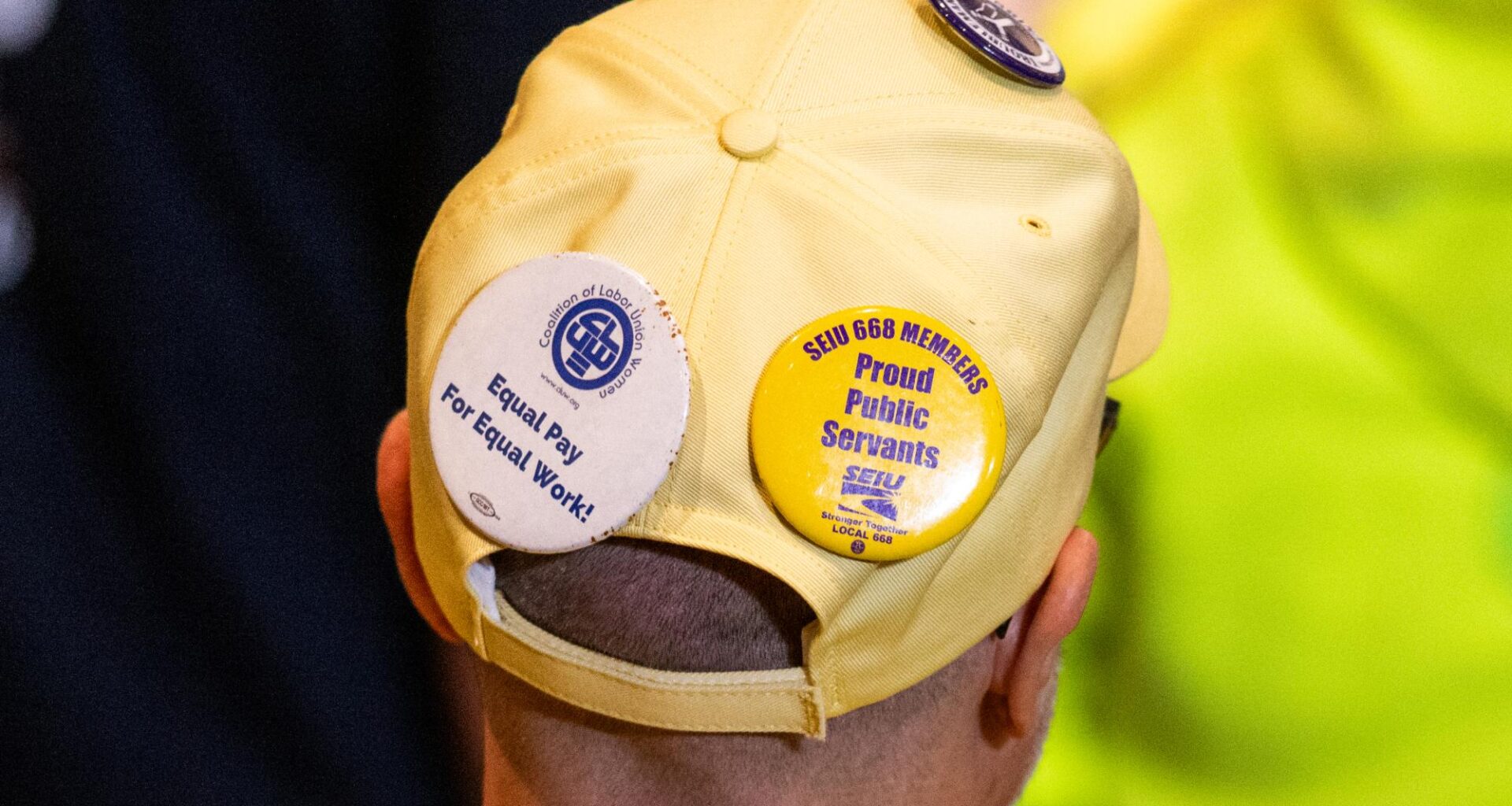
In snowy conditions, Pitt service workers rallied on the corner of Bigelow Boulevard and Forbes Avenue to demand better pay and health care benefit packages on Tuesday morning.
Service Employees International Union Local 32BJ, which represents around 400 employees at Pitt including movers, cleaners and grounds crew, is currently negotiating a new union contract. Bargaining began in early February to follow their current one-year contract that ends in March. Tuesday morning’s rally had around 45 attendees and was followed by a second rally in the afternoon.
According to a SEIU Local 32BJ press release, cleaners at Pitt make $21.95 per hour while cleaners at Duquesne University and Carnegie Mellon University make over $22 per hour, with some upper-level cleaning positions paying over $23 per hour.
According to the press release, workers believe the University’s proposed 1% raise does not accommodate the price of groceries, gas and other necessities. Tim Finucan, Pennsylvania state director and vice president of SEIU Local 32BJ, said the previous contract was short because of federal funding concerns, but now is the time to direct attention back to workers and their wages.
“Fortunately, Pitt is being spared, so the focus should be on offering a competitive and fair contract to the workers who are the foundation of this university,” Finucan said in the press release.
Pete Schmidt, the Western Pennsylvania district director for SEIU Local 32BJ, said union leadership has only done two negotiating sessions with the University as of Feb. 24. In future negotiations, Schmidt said he’s hoping for a satisfactory counteroffer from the University in response to the union’s demands for higher raises.
“We are not satisfied with the offer that’s on the table,” Schmidt said. “We’ve made some movement, and we hope to see better movement on the University’s part.”
University spokesperson Jared Stonesifer said the University is “grateful” for SEIU Local 32BJ employees’ contributions to the Pitt community and described them as a “critical part of the University’s campus operations.”
“We have continued to negotiate in good faith over the past few weeks and will meet again on Feb. 25,” Stonesifer said.
Albert Simon, an employee in facilities, said he finds it “hurtful” that the University is paying him and other employees lower wages compared to other universities in the area. He wants a raise that will align with the current cost of living.
“Everybody understands that money can be tight, but you have to still be fair to your [workers],” Simon said.
Kevin Craig, a custodian who’s worked at Pitt for over 10 years, said he has to work more than one job and is fighting for higher wages because the cost of living is increasing.
“I’m working three jobs just to make it right now, so they need to get on the ball and step up to the plate,” Craig said.
Pamela Rall-Johnston, a janitor who’s been at Pitt for 34 years, said the custodial staff is working “all the time” and deserves better than a 1% raise, especially considering recent increased enrollment and raises for upper management.
“Buildings are going up, but they’re going to tell us that we’re not worth the 1% raise or better?” Rall-Johnston said. “It’s ridiculous. We work hard.”
Demonstrators also raised concerns about their benefits packages, which include health care. Jason Kiley, who’s been a custodian for Pitt since 2012, said he recently had to go through his insurance provider to get medication and could not afford it.
“I understand that University pays a significant portion of our health care, but I’m paying $300 plus a month just to keep my three-person family insured, on top of a $600 deductible, on top of co-pay, on top of prescription drugs,” Kiley said.
The staff and graduate student unions recently ended a monthslong negotiation that resulted in a 2.5% raise without health care costs rising.
Rall-Johnston believes the current benefits package is “too expensive.” She said higher raises could help families cover health care costs rather than relying on government programs like the Children’s Health Insurance Program.
“We can’t afford it. People are putting their kids on CHIP,” Rall-Johnston said. “They work at the University of Pittsburgh for years, but their kids have to be on CHIP because the health care is unaffordable.”