
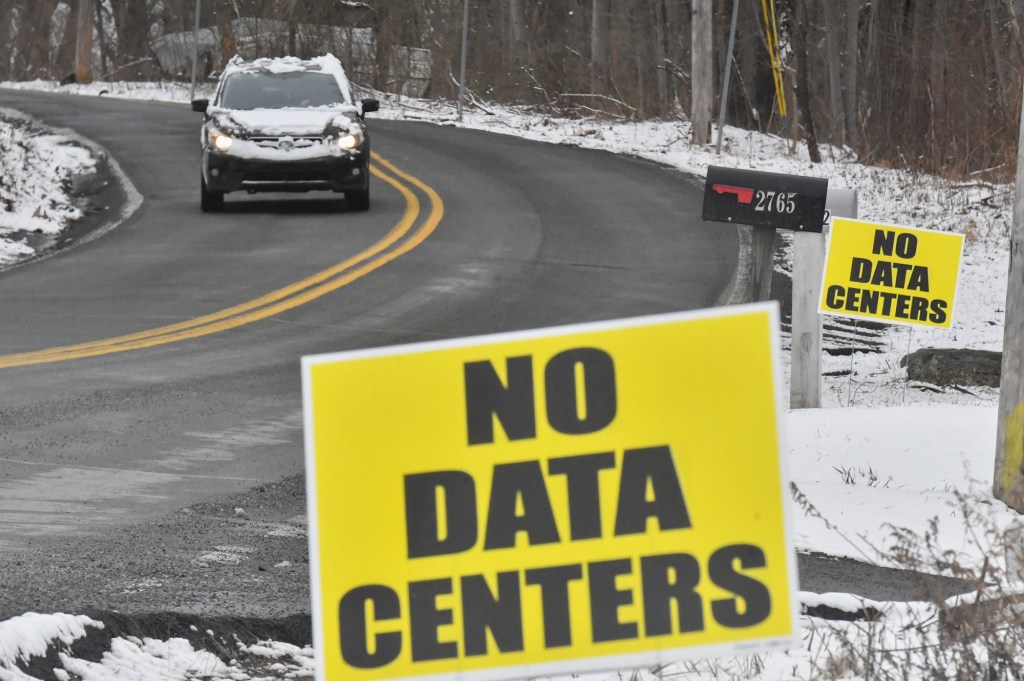
State Sen. Rosemary Brown announced her support Tuesday for a moratorium on the data center industry and unveiled a legislative package that would restrict data centers to industrial zones.
Brown joins state Reps. Kyle Mullins and Kyle Donahue in backing legislation intended to place guardrails and enforce transparency on the rapidly proliferating industry looking to build data centers across thousands of acres of Northeast Pennsylvania.
“During the past several months, our region has increasingly been targeted for large-scale data center development,” Brown, R-40, Middle Smithfield Twp., said in a statement. “While Pennsylvania law grants final land use authority to local governments, I believe state-level legislative action is appropriate to protect the interests of our communities.”
What’s in the ‘Residents First’ legislation?
A moratorium on data centers has gained momentum locally, driven by Democratic Lackawanna County Commissioner Bill Gaughan’s calls for a pause on developments, which culminated last week when he sent a letter to Gov. Josh Shapiro and state lawmakers advocating for a three-year moratorium. In her announcement Tuesday, Brown said she is co-sponsoring legislation to establish a moratorium on data center developments statewide.
“I have listened carefully to concerns about water usage, utility capacity, zoning protections, and the long-term viability of this rapidly evolving technology,” she said in a statement. “This package is designed to answer the important questions residents and I share and to provide the much-needed clarity the people I serve deserve regarding any proposed data center development. I have said since the beginning of this issue that everyone should be focused on doing things right. For that reason, I support a temporary moratorium.”
In addition to pausing developments, Brown, who co-chaired a Senate Majority Policy Committee hearing on data centers in August at Valley View High School, released her “Residents First” legislative package. The proposed legislation would limit large-scale data center development to zoned industrial areas and require data center developers to provide “will-serve” letters confirming utilities can handle a project at full build-out before a formal application is submitted.
By limiting large-scale data center developments to industrial zones, Brown’s legislation addresses one of the most common concerns among Lackawanna County residents: The construction of data centers near homes.
By mandating will-serve letters and water impact studies, Brown’s legislative package would codify at the state level two criteria frequently required by municipal governments in Lackawanna County who already adopted standards for data centers.
Brown also previously introduced legislation establishing pre-application requirements for data centers, which she said was to ensure transparency and accountability before a project can formally begin.
Here’s what other lawmakers say
As an early advocate for a moratorium, Gaughan praised Brown’s support. The county commissioner recently called for the moratorium at public hearings in Archbald and Dickson City.
“I think it’s really powerful,” he said. “The people in the Midvalley — all over Lackawanna County — are really crying out for help on this issue.”
There are too many unanswered questions on the environmental impacts of data centers and how they would impact utility bills, he said.
“We never want to sell out to these developers,” Gaughan said. “We better make sure that all environmental concerns and questions have been answered, that there have been independent studies done, and to make sure that we are holding these data center developers’ feet to the fire, and that we protect our assets, we protect our people, we protect our neighborhoods, and we protect our land and our homes and the value of our homes before we agree to do anything.”
Both Mullins, D-112, Blakely, and Donahue, D-113, Scranton, are jointly sponsoring House bills addressing data centers. On Tuesday, both lawmakers backed moratoriums, though they emphasized the importance of ensuring the moratorium is carefully written to withstand inevitable legal challenges.
“It has to be done the right way to pass that legal muster because, otherwise, it’s false protection,” Donahue said. “We have to do it in a way that at least gets us as close as possible to making it a slam dunk on the legal front. … They have so much money that we need to be able to defend this in front of trainloads of lawyers.”
The two lawmakers sponsored recent House bills that would mandate accountability and transparency from data centers while also providing community standards for zoning to shift some of the burden from local governments.
They would work diligently to build community protections to have in place whenever a moratorium were to expire, Mullins said when reached by phone Tuesday.
“Through this whole process, we’ve heard from our neighbors, we’ve heard from our constituents that there are real quality-of-life concerns about data centers,” he said.
Mullins recently urged Archbald Borough Council to deny the Wildcat Ridge Data Center Campus proposing to build 14 data centers along Business Route 6 and Route 247. He cited its substantial water and power use of up to 3.3 million gallons per day while needing 1.6 gigawatts of electricity, as well as stormwater runoff concerns due to its mountainous terrain.
House Bill 2150 would require data center developers and end users to disclose the nature of their operations and report energy and water usage to the state Department of Conservation and Natural Resources, which would prepare an impact report and make recommendations to the General Assembly on how to address environmental concerns posed by data centers, according to a memo on the legislation. Mullins is the bill’s prime sponsor.
“The potential collective impact on our water or power supply is unprecedented,” Mullins said. “If these data centers truly wish to come to our area — or anywhere in Pennsylvania — and be responsible and responsive neighbors and utilize our resources, our water and our power grid, the very least they can do is be transparent about just how much they plan on using and routinely report those amounts to the public.”
Another bill Mullins co-sponsored, House Bill 1924, addressed data centers and the PJM, which is a regional transmission organization that coordinates the movement of wholesale electricity throughout the eastern United States, including Pennsylvania. Standards for forecasting electricity demand, which were signed into law as part of the state’s budget, will ensure speculation from data centers does not drive up energy costs with the PJM, he said. His bill additionally called for transparency as to how PJM forecasts electricity demands.
Donahue is also the prime sponsor of House Bill 2151, with Mullins serving as a co-sponsor, to provide a model zoning ordinance for municipalities looking to regulate data centers. Municipalities are required to provide for every type of lawful land use somewhere within their borders, including data centers, and failing to do so exposes local governments to legal challenges if their zoning is exclusionary by not providing for a certain use.
“One of the local protections is having a strong data center ordinance,” Donahue said in a phone interview Tuesday, noting the bill is intended to “give municipalities that tool in their toolbox that they might not be able to afford on their own.”
The model ordinance would include standards for items like noise, water, electricity and light pollution, he said, explaining it would receive annual updates to keep pace with new technology and new developments.
State Sen. Marty Flynn, D-22, Dunmore, said a moratorium “doesn’t sound like a bad idea,” though he questioned the legality of one and noted Constitutional concerns. Flynn co-chaired a Democratic Policy Committee Hearing on data centers in September at Marywood University.
He previously co-sponsored the bi-partisan Senate Bill 939, which aimed to fast track permitting for data centers while placing limits on local zoning to maintain uniformity across towns. However, on Tuesday, Flynn said he would vote against the legislation unless it removes language taking away local control.
Flynn said he had to look further into Brown’s newly announced legislative package, though items like restricting data centers to industrial zones seem like common sense.
“Nobody wants data centers in their backyard, affecting their property value, 200, 300 and 400 feet from their house,” Flynn said.
The Residents First legislative package would:
• Require data center developers to provide “will-serve” letters confirming utilities can handle a project at full build-out before a formal application is submitted.
• Limit large-scale data center development to zoned industrial areas.
• Mandate an independent, third-party water impact study and analysis at least 30 days prior to any formal application and require long-term follow-up.
• Direct the Legislative Budget and Finance Committee to study emerging data storage technology and evaluate its long-term viability, including whether current technology may become obsolete and whether emerging alternatives may reduce environmental and resource impacts.